

Hear and here are two different English words with different meanings and grammatical functions. Hear is a verb related to sound and listening, while here is usually an adverb referring to a place, position, or situation.
For example, “Can you hear me?” means “Can you perceive my voice or sound?” In contrast, “Please come here” refers to a particular place or position.
Quick Answer
Use hear when you are talking about perceiving or receiving sound with your ears. Use here when you mean this place, this position, or this point in a situation.
Hear = sound
Here = place or position
Examples:
- Can you hear the music?
- Please come here.
Although hear and here sound the same in many varieties of English, they are spelled differently and have completely different meanings.
What Does Hear Mean?
Hear is a verb that means to perceive a sound through your ears. It can refer to noticing a sound, listening to what someone says, receiving information by listening, or becoming aware of something through sound or communication.
Examples include:
- I can hear someone outside.
- Did you hear that noise?
- She wants to hear your opinion.
- We could hear music from the next room.
The word can also be used when talking about receiving information:
“I was happy to hear that you got the job.”
Here, hear does not necessarily mean physically hearing a sound. It means receiving or learning information.
What Does Here Mean?
Here is usually an adverb that refers to the place where the speaker or writer is, or to a particular location or point that has already been identified.
Examples include:
- Please sit here.
- I live here.
- Come here for a moment.
- Your keys are here.
Here can also refer to a particular point in a discussion, situation, document, or process.
For example:
“This is where the problem begins. Here, we can see the main issue.”
See Also:
The Core Rule: Hear = Sound, Here = Place

The easiest way to distinguish these words is to connect each one with a simple idea.
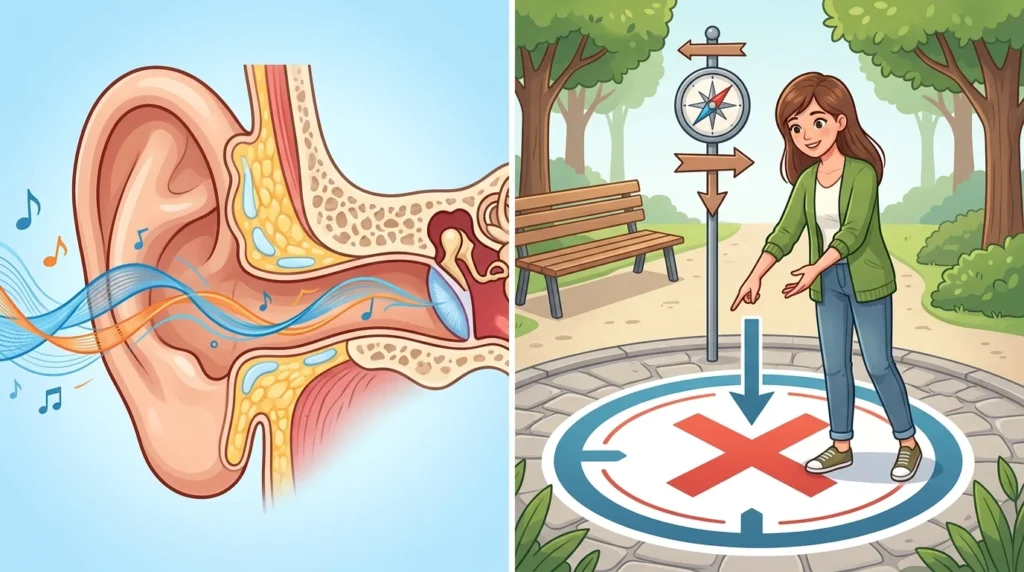
Hear → ears → sound
Here → location → place
If your sentence is about something you perceive with your ears, use hear.
If your sentence is about a location or position, use here.
Compare:
I can hear the children.
This sentence is about sound.
The children are here.
This sentence is about location.
Hear vs Here Comparison Table
| Word | Part of Speech | Meaning | Example |
|---|---|---|---|
| Hear | Verb | To perceive sound or receive information | I can hear music. |
| Here | Adverb | In, at, or to this place or position | Please come here. |
How to Use Hear Correctly
Hear a Sound
Use hear when you perceive a sound.
- I can hear the rain.
- Did you hear that noise?
- She heard someone knocking.
- We could hear birds singing.
Hear Someone Speaking
You can use hear when you can perceive someone’s voice.
- Can you hear me?
- I couldn’t hear what he said.
- She spoke loudly so everyone could hear her.
Hear Information
Hear can also mean to receive or learn information.
- I was sorry to hear the news.
- We were pleased to hear that you succeeded.
- Have you heard about the new project?
Hear From Someone
The phrase hear from means to receive communication from someone.
For example:
“I hope to hear from you soon.”
This is especially common in emails and professional communication.
How to Use Here Correctly
Here for a Location
Use here to identify a location near the speaker or the location currently being discussed.
- Come here.
- Your phone is here.
- I am waiting here.
- She works here.
Here for Direction
Here can also indicate movement toward a particular location.
- Bring the documents here.
- Come here and look at this.
- Put the box here.
Here in a Discussion
Here can refer to a particular point in a conversation, argument, document, or explanation.
For example:
“Here is where the explanation becomes important.”
In this sentence, here refers to a particular point rather than a physical place.
10 Correct Examples With Hear
- Can you hear the music?
- I can hear someone talking outside.
- Did you hear that strange noise?
- She couldn’t hear me because of the traffic.
- We were happy to hear the good news.
- I hope to hear from you soon.
- He heard the door close.
- Can everyone hear the speaker?
- I didn’t hear what she said.
- It was wonderful to hear your voice again.
10 Correct Examples With Here
- Please come here.
- Your bag is here.
- I work here.
- We have been waiting here for an hour.
- Put your phone here.
- She lives here with her family.
- There is a restaurant here.
- Come over here and take a look.
- We can stop here.
- This is here in the middle of the document.
Incorrect vs Correct Examples
| Incorrect | Correct | Why |
|---|---|---|
| Can you here me? | Can you hear me? | The sentence is about perceiving sound. |
| Please come hear. | Please come here. | The sentence refers to a location. |
| I can’t here you. | I can’t hear you. | The verb for perceiving sound is hear. |
| Your book is over hear. | Your book is over here. | Here refers to a place. |
| Did you here that? | Did you hear that? | The sentence asks about a sound. |
| Stay hear until I return. | Stay here until I return. | The sentence refers to a location. |
| I was happy to here the news. | I was happy to hear the news. | Hear can mean receive information. |
| Come hear and sit down. | Come here and sit down. | The sentence indicates movement to a place. |
| We could here the announcement. | We could hear the announcement. | The sentence describes receiving sound. |
| Your keys are hear. | Your keys are here. | Here identifies their location. |
Why Do People Confuse Hear and Here?
The main reason is pronunciation. In many varieties of English, hear and here are homophones or are pronounced very similarly. This means they can sound the same or nearly the same even though their spellings and meanings are different.
When people hear a word rather than see it written, they must use context to determine which spelling is correct. This can create mistakes, especially when typing quickly or learning English.
For example, if someone says, “Come here,” the listener hears the sound of the word but must know from context that the sentence refers to a location.
See Also:
Common Mistakes With Hear and Here
- Writing here when you mean perceiving sound.
- Writing hear when you mean a location.
- Confusing the words because they sound alike.
- Choosing the spelling based only on pronunciation.
- Using “come hear” when you mean “come here.”
- Writing “can you here me?” instead of “can you hear me?”
Hear and Here in Real English
Both hear and here are extremely common words in everyday English. You will find them in conversations, emails, text messages, academic writing, workplace communication, books, and online content.
Some common expressions include:
- Can you hear me?
- I can hear you.
- Come here.
- Stay here.
- Here we are.
- Here you go.
- I hope to hear from you.
Because these words are so common, learning the difference is particularly useful for accurate everyday writing.
Hear vs Here in Formal and Informal English
There is no major formal-versus-informal spelling difference between hear and here. Both words are standard in formal and informal English.
For example, “I hope to hear from you soon” is appropriate in a professional email, while “Come here!” can naturally occur in casual conversation.
The correct word depends on meaning, not formality.
American vs British English
The distinction between hear and here is essentially the same in American and British English. Both varieties use hear for sound and here for location or position.
Pronunciation can vary slightly among speakers and accents, but this does not change the basic spelling distinction.
See Also:
How to Remember Hear vs Here
Use this simple memory trick:
Hear has “ear” inside it.
HEAR
Your ear helps you hear sounds.
For here, think about a location:
Here = this place.
So remember:
Hear → ear → sound
Here → place → location
Hear vs Here in Real-Life Situations
During a Phone Call
“Can you hear me clearly?”
Use hear because the sentence is about sound.
Giving Directions
“Turn left and wait here.”
Use here because the sentence identifies a location.
In a Workplace
“I hope to hear from you soon.”
This means the speaker hopes to receive communication.
In Conversation
“Come here for a second.”
This asks someone to move to a particular place.
In a Classroom
“Can everyone hear the teacher?”
The sentence refers to hearing a voice or sound.
Frequently Asked Questions
What is the difference between hear and here?
Hear is a verb related to perceiving sound or receiving information. Here is usually an adverb referring to a place, position, or point. For example, “I can hear music” refers to sound, while “Come here” refers to a location.
Is it “come hear” or “come here”?
If you mean “come to this place,” the correct phrase is “come here.” If you mean “come and listen,” you can use hear in a different structure, such as “Come here and hear this song.”
Is “Can you here me?” correct?
No. The correct sentence is “Can you hear me?” because the sentence asks whether someone can perceive your voice.
Is “Come hear” ever correct?
Yes, but it has a different meaning. For example, “Come hear this song” means “Come and listen to this song.” If you are telling someone to move to your location, use “Come here.”
Are hear and here homophones?
In many varieties of English, hear and here are pronounced the same or very similarly, making them homophones for many speakers. Their meanings and spellings are different.
How can I remember hear and here?
Remember that hear contains the letters ear. Your ears help you hear. Here refers to a place or position.
Is hear a verb?
Yes. Hear is a verb. It can mean to perceive sound or to receive information through listening.
Is here a verb?
No. Here is most commonly an adverb. It can indicate a place, position, direction, or point in a discussion. It can also appear in other grammatical uses, such as the introductory expression “Here is your book.”
Which is correct: “I can hear you” or “I can here you”?
The correct sentence is “I can hear you.” The verb hear describes the ability to perceive someone’s voice.
Which is correct: “Your phone is hear” or “Your phone is here”?
The correct sentence is “Your phone is here.” The word here identifies the location of the phone.
Quick Summary
Hear and here sound the same or very similar for many English speakers, but they have different meanings. Hear is a verb connected with sound, listening, and receiving information. Here is usually an adverb that refers to a place, position, direction, or point in a discussion. A simple memory trick is that hear contains “ear,” which helps you hear. Think of here as meaning “this place.” For example, “Can you hear me?” is about sound, while “Please come here” is about location. Both words are standard in American and British English, and choosing between them depends on meaning rather than pronunciation.
See Also:
KS Meaning in Text: What Does KS Mean in Chat?