
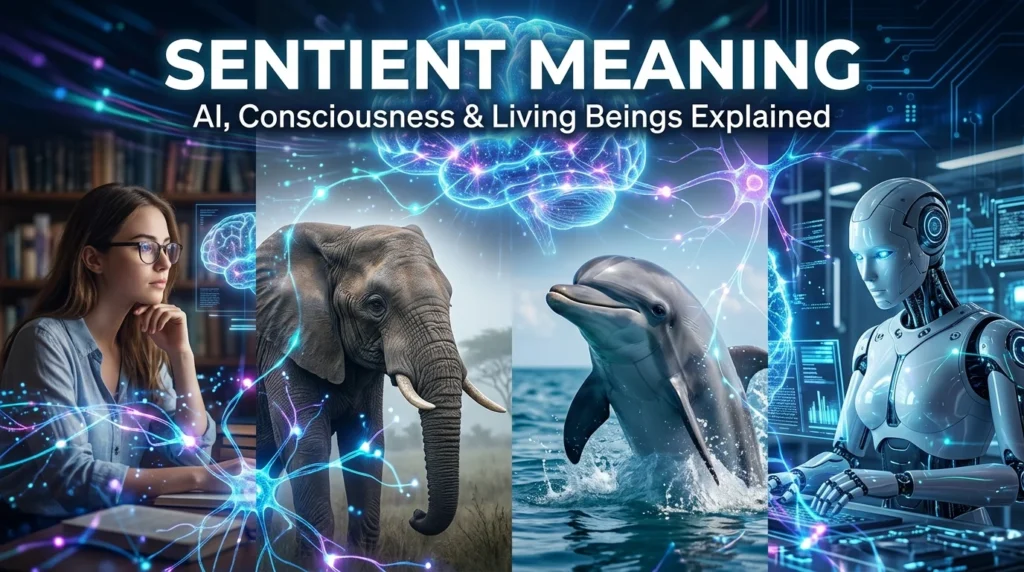

The word sentient is becoming increasingly common in discussions about artificial intelligence, philosophy, biology, ethics, and science fiction. You may have heard people ask whether robots could become sentient, whether animals are sentient, or what it truly means to be a sentient being. Because the word appears in so many different contexts, many people search for sentient meaning, sentient meaning in English, or what does sentient mean to understand its real definition. Although it sounds like a complex scientific term, its core meaning is actually simple and easy to understand.
Learning the meaning of sentient helps you follow conversations about AI, human consciousness, animal welfare, and modern technology with greater confidence. Whether the word is used in academic writing, online discussions, or everyday conversations, it generally refers to the ability to experience feelings, sensations, or awareness. This guide explains the meaning of sentient in clear English, explores how it is used in different fields, and provides practical examples that make the concept easy for beginners to understand.
Meaning & Definition
The sentient meaning refers to the ability of a living being to experience sensations, feelings, emotions, or awareness. A sentient being can perceive what is happening around it and respond to experiences such as pleasure, pain, fear, comfort, or happiness. In simple words, being sentient means having the capacity to feel and experience the world rather than simply existing without awareness.
The word is commonly used when discussing humans, animals, artificial intelligence, philosophy, and biology. While all humans are considered sentient, many scientists also agree that numerous animals are sentient because they can experience emotions and physical sensations. In discussions about AI, the word is often used to describe the theoretical possibility of machines becoming capable of genuine awareness and feelings.
Background
The word sentient comes from the Latin word sentire, which means to feel, to perceive, or to sense. It entered the English language centuries ago and has long been used in philosophy and science to describe beings capable of experiencing sensations and consciousness. Over time, the term became increasingly important in fields such as biology, psychology, ethics, neuroscience, and cognitive science.
Today, the popularity of artificial intelligence has introduced the word to a much wider audience. Questions like “Can AI become sentient?” and “Are robots sentient?” frequently appear in news articles, podcasts, movies, and online discussions. As technology continues to evolve, understanding the meaning of sentient has become more relevant than ever before.
Usage in Different Contexts
One reason the word sentient can seem confusing is that it is used in several different disciplines. In biology, it refers to living organisms capable of feeling pain or responding to their environment. In philosophy, it explores the nature of consciousness, awareness, and subjective experience. In discussions about artificial intelligence, it describes the hypothetical ability of machines to possess genuine feelings, awareness, or consciousness.
Outside academic fields, the word also appears in books, movies, video games, and science fiction, where robots, aliens, or fictional creatures are often described as sentient. Although the specific meaning varies slightly depending on the topic, the central idea always remains the same: a sentient being is capable of experiencing sensations or awareness rather than simply functioning automatically without perception.
Sentient Meaning in English
If you are searching for the sentient meaning in English, the simplest definition is having the ability to feel, perceive, or experience sensations and emotions. A sentient being is aware of its surroundings and can react to experiences such as pain, happiness, fear, comfort, or excitement. This meaning applies to humans and many animals and is also discussed in theories about advanced artificial intelligence.
The word is commonly used in education, science, philosophy, technology, and everyday English. For example, someone might describe dolphins, elephants, or humans as sentient because they demonstrate awareness and emotional responses. In contrast, an ordinary machine is generally not considered sentient because it performs programmed tasks without genuine feelings or conscious experiences.
What Does Sentient Mean?
Many people ask, what does sentient mean? In simple words, sentient means able to feel, sense, or experience the world. It describes someone or something that has awareness and can respond emotionally or physically to what happens around them. The word does not simply refer to intelligence—it specifically relates to the ability to have subjective experiences and sensations.
For example, humans are sentient because they experience emotions, physical pain, joy, and awareness. Many scientists also consider animals such as dogs, cats, elephants, dolphins, and octopuses to be sentient because they display emotional and behavioral responses. In discussions about artificial intelligence, researchers continue to debate whether future AI systems could ever become truly sentient rather than simply processing information.
Sentient Meaning in AI

The sentient meaning in AI refers to the theoretical idea that an artificial intelligence system could one day become capable of genuine awareness, emotions, feelings, and subjective experiences instead of simply processing information. Today’s AI models can answer questions, recognize images, generate text, and solve complex problems, but they do not possess consciousness or real emotions. They follow algorithms, patterns, and learned data rather than experiencing the world the way humans do.
This topic has become increasingly popular because of rapid advances in artificial intelligence and robotics. Scientists, philosophers, and technology experts continue to debate whether true AI sentience will ever be possible. At present, there is no scientific evidence that existing AI systems are sentient. They may appear intelligent, but intelligence alone is different from having awareness, emotions, or conscious experiences.
Sentient Meaning in Philosophy
The sentient meaning in philosophy focuses on the nature of consciousness, awareness, and the ability to have subjective experiences. Philosophers use the word when discussing what it means to feel pain, experience happiness, make conscious decisions, or perceive the surrounding world. Sentience plays a central role in debates about the mind, ethics, free will, and the treatment of both humans and animals.
Many philosophical discussions ask difficult questions such as whether consciousness can exist without a biological brain or whether advanced machines could ever become truly sentient. These debates have continued for centuries and remain active today because they influence how society understands intelligence, morality, and the rights of living beings. Sentience is therefore considered one of the most important concepts in the philosophy of mind.
Sentient Meaning in Biology
The sentient meaning in biology refers to the ability of living organisms to experience sensations, respond to stimuli, and perceive their environment. Humans are clearly sentient, but many animals are also considered sentient because they can feel pain, fear, comfort, pleasure, and other emotions. Scientific research has shown that mammals, birds, and several marine animals display behaviors that indicate awareness and emotional responses.
Biologists continue to study sentience because understanding animal awareness helps improve conservation efforts, veterinary care, and animal welfare policies. Species such as elephants, dolphins, dogs, cats, octopuses, and certain birds have demonstrated complex behaviors suggesting advanced perception and emotional intelligence. Although scientists continue to explore the boundaries of animal consciousness, the concept of sentience remains essential to modern biology.
Sentient Meaning in Simple Words
If you’re looking for the sentient meaning in simple words, think of it as the ability to feel and experience life. A sentient being is not simply alive—it can recognize its surroundings, experience emotions, respond to pain, and interact with the world in meaningful ways. This simple explanation makes the concept easier for beginners who are unfamiliar with philosophical or scientific terminology.
For example, when your pet feels happy after seeing you, reacts to danger, or becomes frightened during a thunderstorm, it is showing signs of sentience. Likewise, humans experience joy, sadness, excitement, fear, and physical sensations every day. These emotional and sensory experiences are what make humans and many animals sentient rather than merely functioning like machines.
Sentient Meaning with Examples
Learning through examples is one of the easiest ways to understand the sentient meaning because the word appears in different contexts. Although the situations vary, the underlying idea remains the same: a sentient being is capable of feeling, perceiving, or experiencing the world around it.
Here are some practical examples:
- Humans are sentient because they experience emotions, thoughts, and physical sensations.
- Many scientists believe elephants are highly sentient animals because they show empathy and grief.
- Dolphins are considered sentient due to their intelligence and social behavior.
- Researchers continue to debate whether future AI could ever become sentient.
- The novel tells the story of a sentient robot that develops emotions and self-awareness.
- Animal welfare laws are often based on the understanding that many species are sentient and capable of suffering.
These examples demonstrate how the word is used in science, philosophy, technology, literature, and everyday English while always relating to awareness and the ability to experience feelings.
Sentient Meaning and Pronunciation
Many English learners search for sentient meaning and pronunciation because the word is common in discussions about science, artificial intelligence, philosophy, and biology. Although it may look difficult, the pronunciation is straightforward once you hear or practice it a few times.
Pronunciation: SEN-shee-uhnt (also commonly pronounced SEN-tee-uhnt)
IPA: /ˈsen.ʃənt/ or /ˈsen.ti.ənt/
The word comes from the Latin sentire, meaning to feel or to perceive. In modern English, sentient describes a person, animal, or theoretical being that can experience sensations, emotions, awareness, or consciousness.
Sentient Meaning in a Sentence
Using sentient in sentences is one of the best ways to understand how the word fits naturally into everyday English. It is commonly used in conversations about people, animals, artificial intelligence, ethics, and science fiction.
Here are some examples:
- Humans are sentient beings capable of feeling emotions.
- Many scientists believe dolphins are highly sentient animals.
- The movie features a sentient robot that develops emotions.
- Animal welfare laws recognize many species as sentient.
- Researchers continue debating whether future AI could become sentient.
- The philosopher argued that every sentient creature deserves moral consideration.
These examples show that the word is suitable for scientific, academic, and everyday discussions.
Sentient vs Conscious Meaning
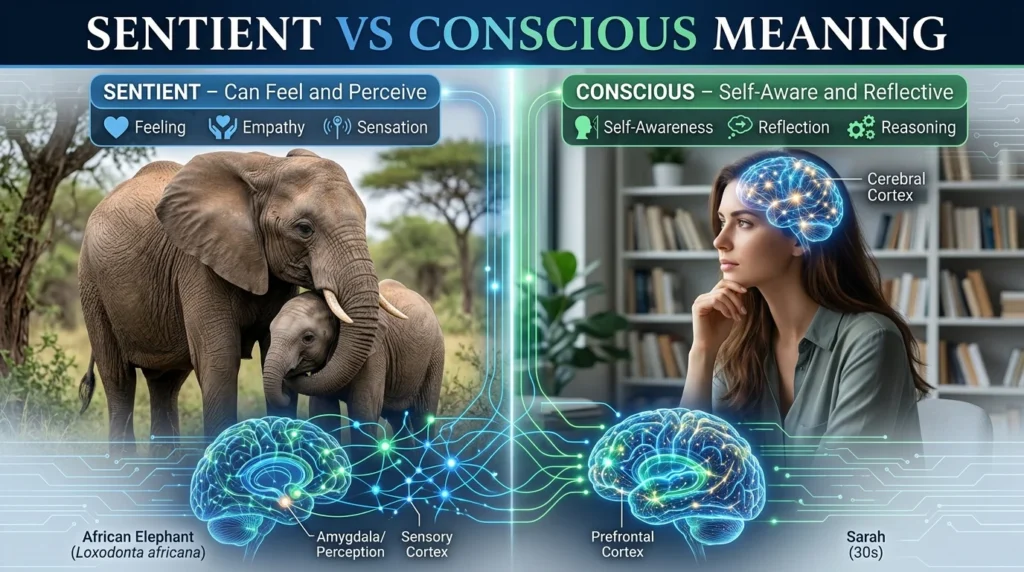
Although sentient and conscious are closely related, they are not exactly the same. A sentient being has the ability to feel sensations such as pain, pleasure, fear, or happiness. Sentience focuses on experiencing the world through feelings and perception.
Conscious, however, usually refers to being aware of oneself, one’s thoughts, and one’s surroundings. Consciousness often includes higher levels of thinking, reasoning, reflection, and self-awareness. In simple terms, every conscious being is generally considered sentient, but discussions in philosophy and cognitive science often distinguish between basic sentience and full conscious awareness.
Sentient vs Sapient
Another word often confused with sentient is sapient. While sentient means being able to feel and experience sensations, sapient refers to possessing wisdom, advanced reasoning, and higher intelligence. A being may be sentient without being sapient.
For example, many animals are considered sentient because they experience emotions and pain. Humans, on the other hand, are generally described as both sentient and sapient because they possess emotional awareness as well as advanced reasoning, language, planning, and complex decision-making abilities. Understanding this distinction helps avoid one of the most common vocabulary mistakes.
Can AI Become Sentient?
One of the most frequently asked questions today is whether artificial intelligence could ever become sentient. Current AI systems can analyze data, recognize patterns, generate human-like responses, and perform impressive tasks. However, they do not possess genuine feelings, consciousness, or subjective experiences. They simulate intelligence rather than experience awareness.
Many experts continue to debate whether future technological advances could eventually lead to truly sentient machines. Some researchers believe it may be possible in the distant future, while others argue that consciousness requires biological processes that machines cannot replicate. At present, there is no scientific evidence that existing AI systems are sentient.
Common Misconceptions About Sentience
A common misconception is that sentient simply means intelligent. Intelligence and sentience are different concepts. A computer may solve complex mathematical problems, but that does not mean it experiences emotions or awareness. Likewise, an animal may not solve advanced equations but can still be sentient because it feels pain, fear, affection, and comfort.
Another misunderstanding is that only humans are sentient. Scientific research strongly suggests that many animals are sentient and capable of experiencing emotions and physical sensations. This understanding has influenced animal welfare laws, ethical discussions, and conservation efforts around the world. Knowing the true meaning of sentience helps people better understand both science and ethics.
Frequently Asked Questions
What does sentient mean?
Sentient means having the ability to feel, perceive, experience sensations, or respond emotionally to the surrounding world.
What is a sentient being?
A sentient being is a person or animal capable of experiencing feelings, emotions, pain, pleasure, and awareness.
What does sentient mean in AI?
In AI, sentient refers to the hypothetical ability of a machine to possess genuine consciousness, awareness, and emotions rather than simply processing information.
Are humans sentient?
Yes. Humans are sentient because they experience emotions, physical sensations, thoughts, and awareness.
Are animals sentient?
Yes. Many scientists agree that numerous animals, including dogs, elephants, dolphins, birds, and octopuses, are sentient.
What is the difference between sentient and conscious?
Sentient refers to the ability to feel and perceive, while conscious usually refers to self-awareness and awareness of one’s surroundings.
What is the difference between sentient and sapient?
Sentient means capable of feeling, while sapient refers to wisdom, reasoning, and advanced intelligence.
How do you pronounce sentient?
It is commonly pronounced SEN-shee-uhnt or SEN-tee-uhnt.
Can AI become sentient?
Current AI is not sentient. Whether future AI could become sentient remains a subject of scientific and philosophical debate.
How do you use sentient in a sentence?
Example: “Many scientists believe elephants are highly sentient animals.”
Conclusion
Understanding the sentient meaning is important because the word appears in discussions about biology, philosophy, ethics, artificial intelligence, and everyday English. At its core, sentient describes the ability to feel, perceive, and experience the world through awareness and emotions. While humans are clearly sentient, many animals are also recognized as sentient, and the possibility of sentient AI continues to inspire scientific research and philosophical debate.
If you enjoy learning English vocabulary, scientific terms, internet slang, and commonly searched word meanings, Trendy Meaning is the perfect place to expand your knowledge. Every article is written in clear, beginner-friendly English with practical examples, simple explanations, and up-to-date information to help you understand even the most complex words with confidence.
See Also:
ASL Meaning Slang: Text, Snapchat, TikTok & Chat Guide