


The word homicide is commonly used in law, criminal justice, news reports, and everyday English. If you have searched for homicide meaning, you are probably trying to understand what it means, how it differs from murder, and when it is used.
In simple terms, homicide refers to the killing of one person by another person. It is a legal term that includes both unlawful and lawful killings, depending on the circumstances. Not every homicide is considered murder.
In this guide, Trendy Meaning explains what does homicide mean, its definition, origin, examples, and common usage in different contexts.
Meaning & Definition
The homicide meaning refers to the act of one person causing the death of another person.
The term itself is neutral and does not automatically indicate whether the act was legal or illegal.
The common meanings include:
- The killing of one person by another
- A legal term used in criminal law
- An act resulting in another person’s death
- A human-caused death
Whether a homicide is considered a crime depends on the facts of the case and the applicable law.
Homicide Meaning in English
The homicide meaning in English can be explained as:
- Killing of another person
- Human-caused death
- Legal term for one person causing another person’s death
For example:
“The police are investigating the case as a homicide.”
This means authorities believe one person may have caused another person’s death and are investigating the circumstances.
Another example:
“The report confirmed the death was classified as a homicide.”
Here, the death was legally categorized as being caused by another person.
What Does Homicide Mean?
When people ask what does homicide mean, they usually see the word in news reports, crime stories, or legal discussions.
In simple words, homicide means that one person’s actions resulted in the death of another person. The word itself does not determine whether the act was intentional, accidental, justified, or criminal.
For example:
“The detectives opened a homicide investigation.”
This means investigators are examining a death caused by another person.
Simple Explanation
Think of homicide as meaning:
- One person causes another person’s death
- A legal classification
- Human-caused death
- Not always a crime
The exact legal meaning depends on the circumstances and the laws of the country or region.
Homicide Definition With Examples
The homicide definition is the killing of one human being by another human being.
Examples of Homicide in Sentences
“The case is being investigated as a homicide.”
“The homicide detectives interviewed several witnesses.”
“The medical examiner ruled the death a homicide.”
“The investigation focused on determining how the death occurred.”
These examples show how the word is commonly used in legal, law enforcement, and news contexts.
Background
The term homicide has been used in legal systems for centuries to describe one person causing the death of another. Modern criminal law distinguishes different kinds of homicide based on intent, circumstances, and applicable legal defenses.
Today, the word is frequently used in court proceedings, police investigations, forensic science, and media reporting.
Origin and History of Homicide
The word homicide comes from the Latin words homo, meaning “human”, and caedere, meaning “to kill.”
Over time, the term became part of English legal vocabulary and is now widely used by lawyers, judges, police officers, and journalists.
Usage in Different Contexts
The meaning of homicide remains generally consistent across different contexts.
Homicide in Law

In legal contexts, homicide refers to one person causing another person’s death. The law then determines whether the act was criminal, justified, accidental, or otherwise.
Example:
“The court reviewed the homicide case.”
Homicide in Police Investigations
Law enforcement agencies use the term during investigations involving deaths caused by another person.
Example:
“Homicide detectives arrived at the scene.”
Homicide in News Reports
News organizations often use the word when reporting criminal investigations or official findings.
Example:
“Police confirmed they are investigating the death as a homicide.”
Homicide in Criminal Justice
The term appears in legal documents, forensic reports, and courtroom proceedings involving deaths caused by human actions.
Example:
“The prosecutor presented evidence in the homicide trial.”
Homicide vs Murder Difference
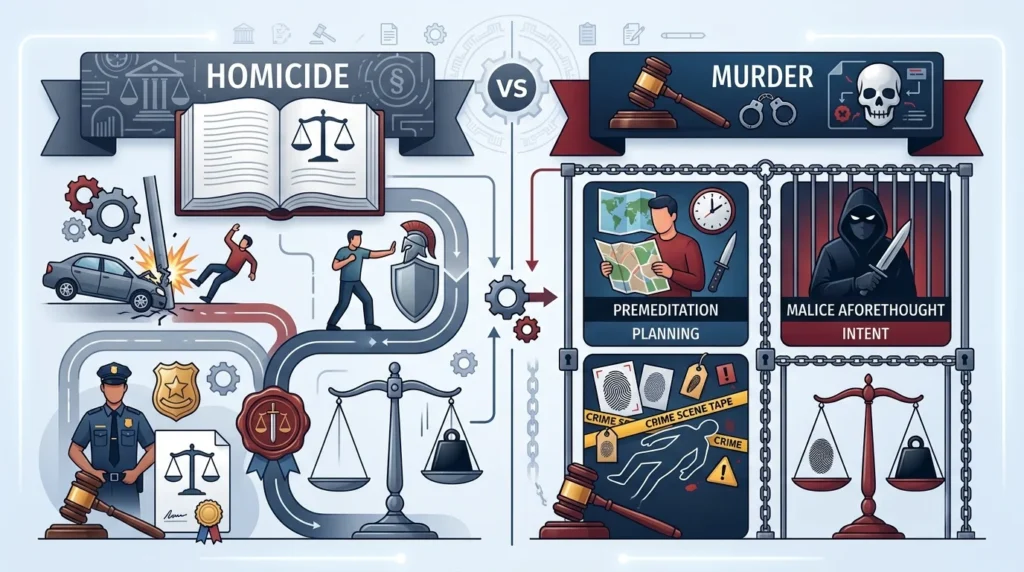
Although the terms are often used together, homicide and murder do not mean the same thing.
Homicide
Homicide is the legal term for one person causing the death of another person. It may be lawful or unlawful, depending on the circumstances.
Example:
“The case was investigated as a homicide.”
Murder
Murder is a specific type of unlawful homicide that typically involves criminal intent or other elements defined by law.
Example:
“The suspect was charged with murder.”
Simple difference:
Homicide = one person causes another person’s death.
Murder = a criminal form of homicide.
Types of Homicide
Legal systems may classify homicide into different categories depending on the facts and the law.
Common examples include:
- Criminal homicide
- Justifiable homicide
- Excusable homicide
- Negligent homicide
The exact definitions vary by country and legal jurisdiction.
Homicide Meaning in Everyday English
Outside legal settings, people most often encounter the word in news reports, documentaries, crime shows, and newspapers.
Example:
“The evening news reported a homicide investigation.”
In everyday English, the word usually indicates that authorities are investigating a death caused by another person.
Synonyms of Homicide
Depending on the context, similar words include:
Killing
Slaying
Fatal attack
Human-caused death
Deadly act
The best synonym depends on the legal or conversational context.
Antonyms of Homicide
Words with opposite meanings include:
Life
Survival
Protection
Rescue
Preservation
These describe situations involving saving or preserving life rather than causing death.
How to Use Homicide Correctly
Use homicide when discussing legal, forensic, or news-related situations involving one person causing another person’s death.
Examples:
“The detectives investigated the homicide.”
“The medical examiner ruled the death a homicide.”
“The homicide unit handled the case.”
“The court reviewed evidence in the homicide trial.”
The word is appropriate in legal, academic, journalistic, and professional discussions.
Frequently Asked Questions
What is homicide meaning?
Homicide is the act of one person causing the death of another person. The term itself does not indicate whether the act was lawful or unlawful.
Is homicide the same as murder?
No. Murder is one type of homicide. Not every homicide is classified as murder.
What does homicide mean in law?
In law, homicide refers to one human causing the death of another. The legal classification depends on the circumstances and applicable laws.
Why do police say homicide?
Police use the term because it is a neutral legal classification while investigators determine exactly what happened.
How do you use homicide in a sentence?
Example: “Police opened a homicide investigation after receiving the forensic report.”
Conclusion
The homicide meaning refers to one person causing the death of another person. It is a legal term that includes both criminal and non-criminal situations, depending on the circumstances. Understanding what does homicide mean, how it differs from murder, and how it is used in law and news reports helps you interpret the term accurately and avoid common misunderstandings.
At Trendy Meaning, we explain English words, legal terms, internet slang, and modern vocabulary with simple definitions, practical examples, and real-world usage to make learning easier.
See Also:
ASL Meaning Slang: Text, Snapchat, TikTok & Chat Guide