
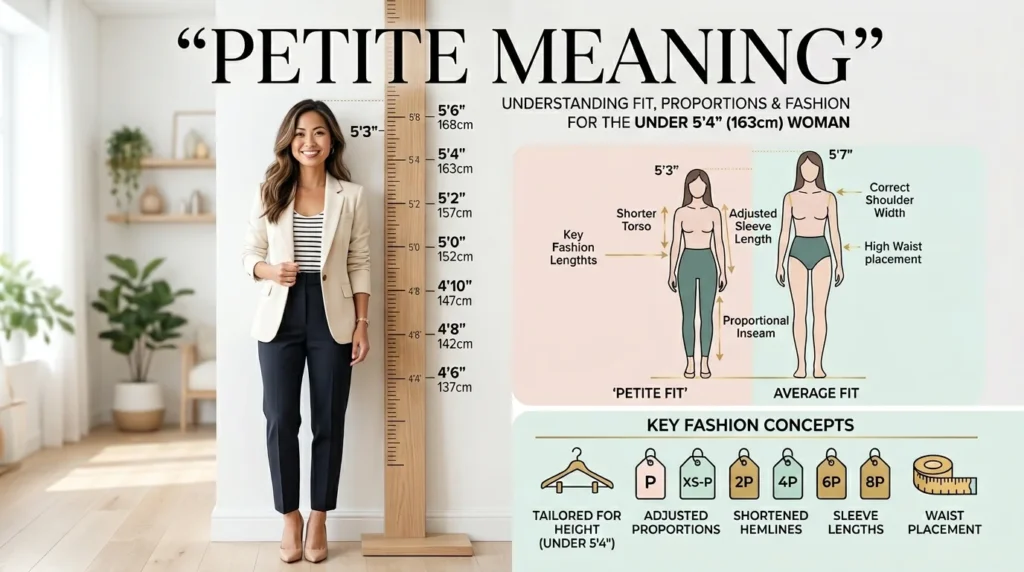

Have you ever heard someone describe a woman as petite and wondered what it actually means? Many people assume that petite simply means short, but the term has a much broader meaning. It is commonly used in fashion, body type discussions, clothing sizes, and everyday conversations. Because of this, people often ask questions such as what does petite mean for a woman, what height is considered petite for females, and whether petite refers to height, weight, or body shape.
Understanding the true meaning of petite can help you choose better-fitting clothes, understand body proportions, and avoid common misconceptions. In this complete guide, you will learn the definition of petite, its origins, how it is used in different contexts, and the differences between petite, slim, skinny, and short. If you are looking for a detailed and easy-to-understand explanation, this guide covers every aspect of the topic.
For more detailed word meanings, definitions, and language explanations, readers can also visit Trendy Meaning to explore a wide range of commonly searched terms and phrases.
Meaning & Definition
The word petite comes from the French language and generally means small or little. In modern English, it is most commonly used to describe a woman who has a shorter height and smaller body proportions compared to the average female.
However, petite does not necessarily mean thin, underweight, or extremely small. A woman can be petite and curvy, petite and athletic, or even petite and plus-size. The key factor is usually height and body proportions rather than body weight alone.
In the fashion industry, the term petite is used to describe clothing specifically designed for women who are shorter than average. Petite clothing includes adjusted measurements such as shorter sleeves, reduced inseam lengths, higher waist placements, and better overall proportions for shorter frames.
Simply put, in fashion, petite primarily refers to shorter height and adjusted body proportions, while in everyday English it can also suggest a small or delicately built appearance.
Background
The term petite has been used for centuries and originates from the French word “petit,” meaning small. Over time, English speakers adopted the feminine form “petite” to describe women who were physically smaller in stature.
As the fashion industry evolved, clothing manufacturers realized that standard clothing sizes did not fit shorter women properly. Dresses were often too long, sleeves extended past the wrists, and waistlines sat too low. To solve this issue, fashion brands introduced petite sizing categories specifically tailored to shorter women.
Today, petite is no longer just a descriptive term. It has become an important category in fashion, retail, and body-type discussions. Many major clothing brands offer dedicated petite collections because a significant percentage of women fall into the petite height range.
Usage in Different Contexts
The word petite can have slightly different meanings depending on the context in which it is used.
In everyday conversations, petite usually describes a woman who appears small, short, or delicately built. People may use the term as a compliment to describe someone with a compact and balanced appearance.
In fashion, petite refers to clothing designed for shorter women. Here, the focus is not on weight but on proportions. A woman can wear petite clothing even if she is not particularly slim.
In body-type discussions, petite often refers to smaller bone structure, shorter limbs, and overall compact proportions. Fitness experts, stylists, and image consultants frequently use the term when discussing body shapes and clothing recommendations.
Because the meaning changes slightly depending on the situation, understanding the context is important when interpreting the word petite.
What Does Petite Mean for a Woman?
When referring to a woman, petite generally means she has a shorter height and smaller body proportions compared to the average female population. The term is not intended to describe weight alone.
A petite woman may have narrower shoulders, shorter legs, a smaller frame, and reduced body dimensions overall. However, body shape can vary significantly. Some petite women are slim, while others may have curvier figures.
The most important characteristic is that her proportions are scaled to a shorter stature. This is why petite clothing exists—to ensure garments fit correctly without requiring extensive alterations.
What Height Is Considered Petite for Females?
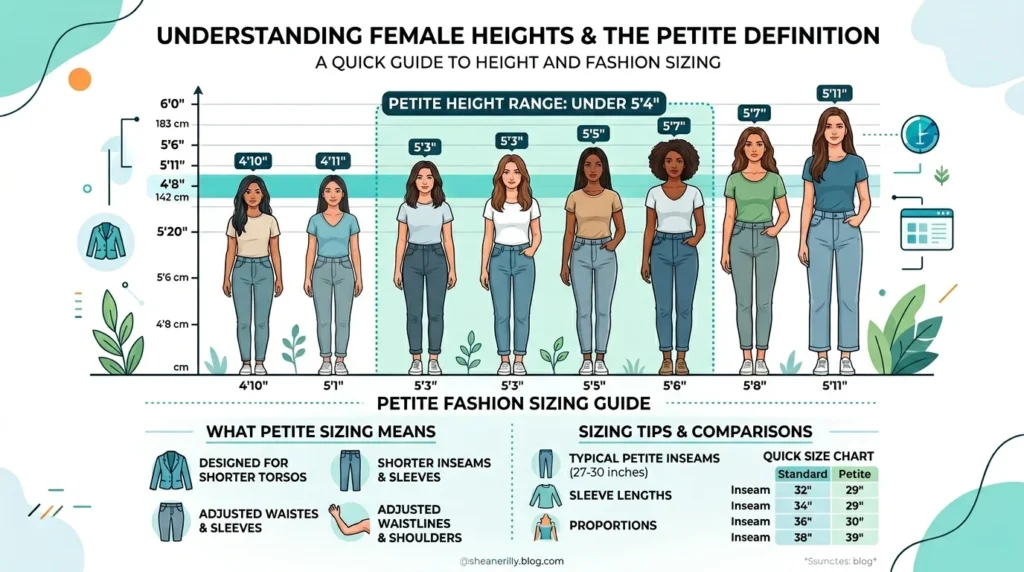
In the fashion industry, women who are approximately 5’4″ (163 cm) or shorter are generally considered petite.
While different brands may use slightly different standards, most petite clothing lines are designed for women who fall below this height threshold. Height alone is not always the deciding factor, however. Body proportions also matter.
Some women who are slightly taller than 5’4″ may still find petite clothing fits better because of shorter legs, shorter arms, or a smaller torso.
Petite Meaning in Body Type and Fashion
In body type discussions, petite refers to overall body proportions rather than just numerical height.
A petite body type often includes shorter limbs, a smaller skeletal frame, compact dimensions, and balanced proportions. Fashion experts pay close attention to these characteristics when recommending clothing styles.
In fashion, petite clothing is specifically engineered to match these proportions. Sleeve lengths, shoulder widths, pant inseams, and waist placements are adjusted to create a better fit for shorter women. This makes petite sizing much more accurate than simply shortening standard-sized clothing.
The meaning of petite can change slightly depending on whether you are talking about a person’s body, figure, physical build, or clothing fit. In general, petite describes a smaller or shorter overall appearance, while in fashion it usually refers to clothing designed around shorter body proportions. This distinction is important because petite does not automatically mean skinny or underweight.
What is Petite Body Meaning
“Petite body” generally describes a person with a shorter stature and relatively compact body proportions. It can refer to characteristics such as shorter limbs, a smaller frame, or a shorter torso, but it does not describe one specific body shape. A petite person can be slim, curvy, athletic, or have a fuller figure. In clothing, the term is especially useful because standard garments may be designed around longer proportions, while petite garments adjust areas such as the sleeves, rise, inseam, and waist placement.
Also Read: Nuanced Meaning: Definition, Examples & Easy Explanation
What is Petite Figure Meaning
“Petite figure” usually means a small, short, or delicately proportioned appearance. The phrase is often used when describing someone’s overall silhouette rather than their exact clothing size. A petite figure may look compact and balanced, but it does not necessarily mean the person is extremely thin. For example, someone can have a petite figure and still have curves, broader hips, or an athletic build. The exact meaning therefore depends on the context in which the phrase is used.
What is Petite Build Meaning
“Petite build” refers to a person’s overall physical structure being relatively small or compact, often combined with shorter stature. It can include features such as a smaller frame, shorter limbs, or narrower proportions. However, a petite build should not automatically be interpreted as being skinny. Someone can have a petite build while having a curvy or muscular body. In everyday English, the phrase often gives the impression of someone who is small in stature and delicately built.
What is Petite Fit Meaning
“Petite fit” refers to clothing designed with shorter body proportions in mind. It is not simply a smaller clothing size. Petite garments may have shorter sleeves and inseams, a higher waist placement, a shorter rise, adjusted shoulder proportions, and other changes that help the garment fit a shorter frame correctly. This means a person can wear a larger numerical size and still need a petite fit. Petite describes the proportions of the garment, while the clothing size describes how much room the garment provides around the body.
What is Petite Person Meaning
A “petite person” generally means someone who is relatively small or short in stature and may have compact body proportions. In everyday conversation, the word is most commonly used for women, although petite can describe a person more generally. The exact meaning depends on context: when describing someone’s appearance, it can suggest a small or delicate build, while in fashion, petite usually refers to shorter proportions and specialized clothing sizes.
Petite Značenje: What Does Petite Mean?
If you see the phrase “petite značenje,” it is asking for the meaning or definition of the word petite. “Značenje” means “meaning” in several South Slavic languages, so “petite značenje” essentially means “petite meaning.” In English, petite can describe someone who is small, short, or delicately built, while in fashion it commonly refers to clothing designed for shorter body proportions.
Difference Between Petite and Short Women
Many people mistakenly believe petite and short mean exactly the same thing, but there is a subtle difference.
Short simply refers to height. A woman can be short while having average or larger body proportions. Petite, on the other hand, refers to both height and proportion.
For example, two women may both be 5’2″. One may have a larger frame and longer torso, while the other may have smaller overall proportions. The second woman would more likely fit into the petite category.
This distinction is particularly important when choosing clothing sizes.
Can a Woman Be Petite and Curvy?
Absolutely. One of the biggest myths about petite women is that they must be thin or skinny.
A woman can be petite and curvy at the same time. Height and body shape are separate characteristics. A petite woman may have fuller hips, a defined waist, and a larger bust while still fitting within petite height and proportion ranges.
This is why many brands now offer petite plus-size collections. The goal is to accommodate shorter proportions regardless of body shape.
Also Read: Downing Meaning: Definition, Uses, Examples & Pronunciation
Is Petite About Height or Weight?
Petite is primarily about height and proportions, not weight.
Many people incorrectly assume that petite means lightweight or very slim. In reality, women of various weights can be petite if they have shorter stature and proportionally smaller dimensions.
A woman may weigh more than average yet still qualify for petite sizing because of her height and body structure. This distinction is important because it helps separate body size from body proportion.
What Size Is Considered Petite in Clothing?
Petite clothing sizes are not a separate size category like small or medium. Instead, they are modified versions of standard sizes designed for shorter women.
Petite garments often feature:
- Shorter sleeves
- Higher knee placements
- Shorter inseams
- Adjusted waistlines
- Better shoulder proportions
- Reduced garment lengths
For example, a woman may wear a Petite Medium rather than a regular Medium if her height and proportions fit petite standards.
Petite vs Slim vs Skinny Differences
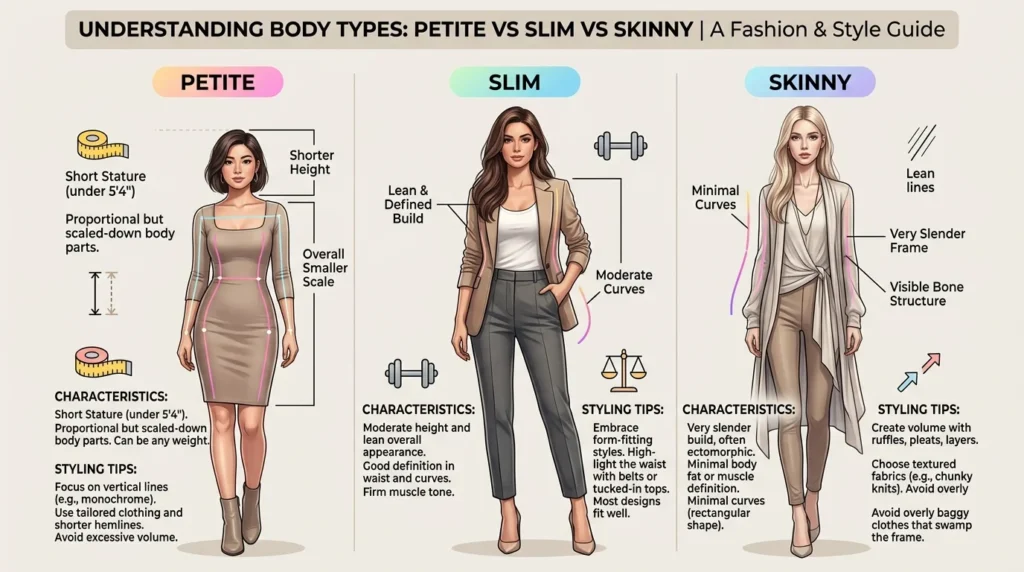
These terms are often confused, but they describe different characteristics.
Petite refers to height and proportions.
Slim refers to having a lean body shape with relatively low body fat.
Skinny typically describes a very thin appearance with minimal body mass.
A woman can be petite and slim, petite and skinny, or petite and curvy. These categories are not mutually exclusive because they measure different physical attributes.
Understanding these distinctions helps prevent misunderstandings about body types.
How Do I Know If I Am Petite?
You may be petite if:
- You are 5’4″ or shorter.
- Regular pants are often too long.
- Sleeves frequently extend beyond your wrists.
- Dresses fit loosely around proportions.
- Standard waist placements sit too low.
- Petite clothing fits better than regular sizes.
The best indicator is how clothing fits your proportions rather than height alone.
Can Tall Women Have a Petite Frame?
Yes. This is one of the most overlooked aspects of the term petite.
A tall woman may have a petite frame if she has narrow shoulders, smaller bones, delicate features, and compact proportions. However, in fashion sizing, she would not typically qualify for petite clothing because the height requirement would not be met.
This demonstrates the difference between a petite frame and petite sizing.
Petite Body Shape Characteristics Explained
Common characteristics associated with petite body types include:
- Shorter overall height
- Smaller skeletal frame
- Compact proportions
- Shorter limbs
- Narrower shoulders
- Smaller torso dimensions
- Shorter inseam lengths
Not every petite woman will have all of these characteristics, but many will share several of them.
Why Are Petite Clothing Sizes Different?
Petite clothing exists because simply shortening standard garments does not create a proper fit.
Designers adjust multiple measurements to ensure clothing complements shorter proportions. This includes repositioning waistlines, altering sleeve lengths, reducing shoulder widths, and adjusting garment shapes.
Without these modifications, clothing may appear oversized or unbalanced on petite individuals.
What Is the Average Height for Petite Women?
Although definitions vary by country and brand, women who are approximately 5’4″ (163 cm) or below are generally considered petite in the fashion industry.
Many petite clothing collections are specifically designed around this height range. However, body proportions remain equally important when determining whether petite sizing is appropriate.
Common Myths About Petite Women
Several misconceptions surround the term petite.
Many people believe petite means skinny. This is false because petite relates primarily to height and proportions.
Others assume petite women cannot be curvy or athletic. In reality, petite women come in every body shape imaginable.
Another myth is that petite clothing is only for very small sizes. Many brands now offer extended petite sizing options to accommodate a wider range of body types.
Also Read: Collate Meaning: Simple Definition, Printing & Uses
Frequently Asked Questions
What does petite mean exactly?
Petite refers to a woman who has a shorter height and proportionally smaller body dimensions compared to average standards.
Is petite the same as being short?
No. Short refers only to height, while petite includes overall body proportions.
Can a plus-size woman be petite?
Yes. A woman can be both petite and plus-size because petite is based on height and proportions rather than weight.
Is 5’4 considered petite?
Yes. Most fashion brands classify women who are 5’4″ or shorter as petite.
Can someone be petite and curvy?
Yes. Many petite women have curvy body shapes while still fitting petite height standards.
What are petite clothing sizes?
Petite sizes are specially designed clothing measurements intended for shorter women.
How can I tell if I have a petite frame?
You may have a petite frame if you have smaller bone structure, shorter limbs, and compact body proportions.
Are petite clothes only for skinny women?
No. Petite clothing is designed for height and proportions, not body weight.
Can men be petite?
Yes. Although the term is most commonly used for women, it can describe men with smaller stature and proportions as well.
Why do petite clothes fit better for shorter women?
Petite garments are designed with adjusted proportions such as shorter sleeves, inseams, and waist placements to provide a more balanced fit.
Conclusion
Petite is much more than a simple description of height. It refers to a combination of shorter stature and proportionally smaller dimensions that affect how clothing fits and how body types are categorized. Understanding the difference between petite, short, slim, and skinny can help you make better fashion choices and avoid common misconceptions.
Whether you are exploring petite body types, learning about clothing sizes, or simply trying to understand the definition, knowing the full meaning of petite provides valuable insight into fashion, body proportions, and everyday language. For more detailed word meanings, definitions, and explanations, visit Trendy Meaning and discover easy-to-understand guides on popular terms people search every day.
Also Read: GOAT Meaning: Definition, Slang & Sports Explanation