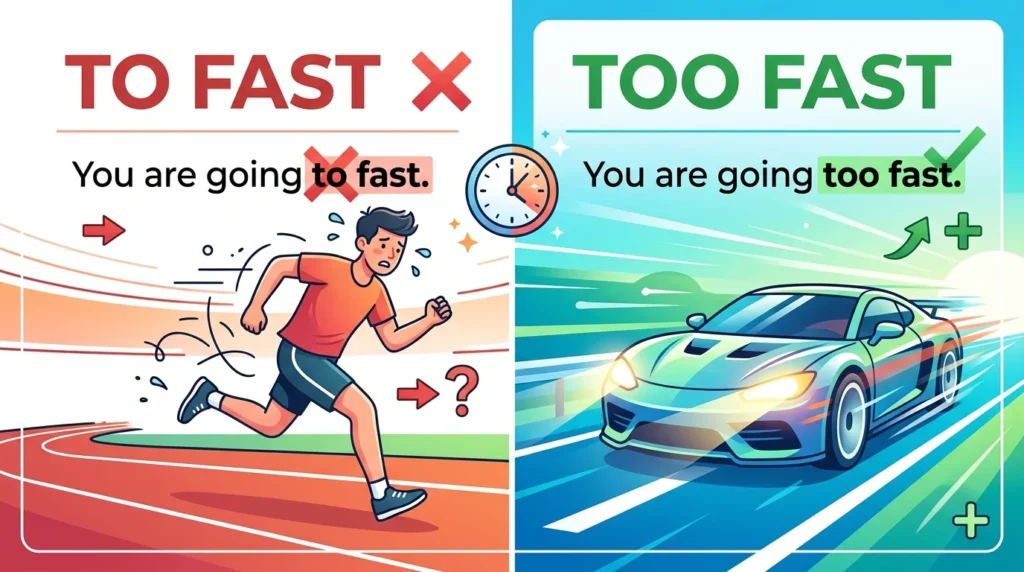

Too fast is correct when you mean “faster than is appropriate, comfortable, safe, or necessary.” To fast can also be grammatically correct, but only when fast is a verb meaning to go without food. For example, “You are driving too fast” describes excessive speed, while “I need to fast before the test” means to avoid eating. The two phrases sound alike, but their meanings and grammatical functions are different. :contentReference[oaicite:0]{index=0}
Quick Answer
Use too fast when you are talking about excessive speed or something happening more quickly than appropriate. Use to fast only when fast is a verb meaning to abstain from food. For example, “She is driving too fast” is correct, while “She is driving to fast” is incorrect. However, “She decided to fast” is also correct because to introduces the verb fast. The easiest way to remember the difference is: too fast = excessive speed; to fast = to abstain from food.
What Is the Difference Between To Fast and Too Fast?
Too fast and to fast contain the same two spoken sounds, but they perform different grammatical jobs.
In too fast, too is an adverb that expresses excess. It tells us that something happens at a speed that is greater than wanted, suitable, safe, or necessary. Cambridge gives examples such as something traveling “too fast” to describe excessive speed. :contentReference[oaicite:1]{index=1}
In to fast, to is the infinitive marker and fast is a verb. Here, fast means to deliberately go without food for a period of time.
| Phrase | Meaning | Example |
|---|---|---|
| too fast | Excessively fast | You are driving too fast. |
| to fast | To abstain from food | I need to fast before the test. |
Why It Matters
Confusing to and too can change the meaning of a sentence completely. If you write “You are driving to fast,” readers will normally understand that you meant “You are driving too fast,” but the spelling is incorrect for that meaning.
The reverse can also cause confusion. “I plan to fast” is perfectly grammatical when you mean that you plan to abstain from food. Replacing to with too would change the sentence into something that does not express the intended verb construction.
This distinction matters in school assignments, emails, workplace communication, social media posts, instructions, and everyday messages because to and too sound alike but are not interchangeable.
The Core Rule
Use “too fast” for excessive speed. Use “to fast” when “fast” means to abstain from food.
Think of the two patterns this way:
- too + fast = excessively fast
- to + fast = the infinitive form of the verb fast
Examples:
He is walking too fast.
The walking speed is excessive.
He decided to fast.
He decided to abstain from food.
The extra o in too can help you remember the idea of extra or excessive.
How to Use Too Fast
Use too fast when fast describes speed or pace and too means more than is appropriate or desirable.
Talking About Physical Speed
Use too fast for cars, bicycles, runners, trains, machines, and other things that move.
- The car is going too fast.
- He runs too fast for me to keep up.
- The train was moving too fast to stop immediately.
Talking About Speaking
Too fast can also describe speech. In this case, it means someone is speaking at a pace that is difficult for another person to follow.
For example:
“You are speaking too fast. Could you slow down?”
Talking About Learning or Progress
The phrase can describe something that develops or happens more quickly than is useful or appropriate.
For example:
“The teacher moved too fast through the lesson.”
Here, too fast does not necessarily describe physical movement. It describes the pace of the lesson.
Using “Way Too Fast”
Way too fast is a common expression meaning much too fast or far too fast.
For example:
“That motorcycle was going way too fast.”
Way intensifies the phrase too fast; it does not replace too.
How to Use To Fast
To fast is correct when fast is used as a verb meaning to abstain from food for a period of time. In this structure, to introduces the base form of the verb.
After “Plan”
“I plan to fast tomorrow.”
Here, to fast means that the speaker plans to abstain from food.
See Also: Appreciate It or Appreciated It: What Is the Difference?
After “Decide”
“She decided to fast for a day.”
The word to introduces the verb fast.
In Medical Contexts
“The doctor told me to fast before the blood test.”
Here, to fast refers to avoiding food before a medical procedure or test.
In Religious or Personal Contexts
“They choose to fast during a religious observance.”
Again, fast is a verb, so to fast is the correct infinitive construction.
Correct Examples
- You are driving too fast for this road.
- She speaks too fast during presentations.
- The children were running too fast to stay together.
- The project is moving too fast for the team to review everything.
- That car was going way too fast.
- He decided to fast before the medical examination.
- I need to fast before my appointment.
- She plans to fast tomorrow.
- They chose to fast for personal reasons.
- The doctor instructed him to fast before the procedure.
- Slow down because you are driving too fast.
- It is difficult to understand her when she talks too fast.
See Also: Batton or Baton Differences: Which Spelling Is Correct?
Incorrect vs. Correct
| ❌ Incorrect | ✅ Correct | Why |
|---|---|---|
| You are driving to fast. | You are driving too fast. | Too expresses excessive speed. |
| He runs to fast for me. | He runs too fast for me. | The sentence describes speed that is excessive for the speaker. |
| She talks to fast. | She talks too fast. | Too modifies the adverbial idea of speed. |
| The car is going to fast. | The car is going too fast. | The intended meaning is excessive speed. |
| You are typing to fast. | You are typing too fast. | The writer means that the typing speed is excessive. |
| The lesson is moving to fast. | The lesson is moving too fast. | Too fast describes an excessive pace. |
| He wants too fast before surgery. | He wants to fast before surgery. | Here fast is a verb, so the infinitive requires to. |
| She plans too fast tomorrow. | She plans to fast tomorrow. | To fast means that she plans to abstain from food. |
| I need too fast before the test. | I need to fast before the test. | To introduces the verb fast. |
| They decided too fast for religious reasons. | They decided to fast for religious reasons. | The sentence requires the infinitive to fast. |
| He is going to fast on the highway. | He is going too fast on the highway. | When describing driving speed, use too fast. |
| She speaks to fast during meetings. | She speaks too fast during meetings. | Too indicates that her speaking speed is excessive. |
Why People Make This Mistake
They Sound the Same
The main reason is pronunciation. To and too commonly have the same pronunciation in ordinary speech, so listening does not tell you which spelling belongs in a sentence.
When you hear “too fast,” you cannot see the extra o. You have to determine the correct spelling from the meaning and grammatical structure.
They Look Similar
The words to and too differ by only one letter. Because the words are short and frequently used, writers can easily type one when they mean the other.
Fast Has More Than One Grammatical Role
Fast can describe speed, but it can also function as a verb meaning to abstain from food. That creates two legitimate constructions:
- too fast = excessively fast
- to fast = to abstain from food
Understanding what fast means in the sentence makes the choice much easier.
Spellcheck Does Not Teach the Difference
Spellcheck may identify some uses of to and too, but these words are both legitimate English words. Software may not always understand the meaning you intended. Learning the grammatical difference is more reliable than depending entirely on automatic correction.
Translation Can Cause Confusion
English learners may have one word or one grammatical structure in their first language where English uses several different forms. Since to and too sound alike, choosing between them from pronunciation alone can be especially difficult.
Common Mistakes Checklist
- Writing “to fast” for speed: Use too fast when something is excessively quick.
- Writing “too fast” before the verb fast: Use to fast when fast means to abstain from food.
- Choosing by sound: Since to and too can sound identical, use meaning and grammar instead.
- Forgetting that fast is a verb: In “I need to fast,” fast is an action.
- Forgetting that too shows excess: In “You are too fast,” too indicates that the speed is beyond an appropriate level.
- Using “to fast” in driving sentences: “He is driving too fast” is the correct form.
To Fast and Too Fast in Real English
Grammatically Correct and Natural: “Too Fast”
Too fast is completely natural when someone or something moves, speaks, works, or progresses at an excessive pace. Expressions such as “You are driving too fast” and “She talks too fast” are ordinary English. The word too functions as an adverb expressing excess, while fast describes the speed or pace. :contentReference[oaicite:2]{index=2}
Grammatically Correct and Natural: “To Fast”
To fast is also grammatically correct when fast is the verb meaning to abstain from food. It is natural in sentences about religious practice, medical preparation, or personal choices, such as “I need to fast before the test” or “They decided to fast.” In this structure, to is an infinitive marker rather than a word expressing direction or excess.
Grammatically Incorrect for Speed: “To Fast”
When a writer means “excessively fast,” to fast is not the correct spelling. For example, “The car is going to fast” should be “The car is going too fast.” The error does not create a new meaning of excessive speed; it simply uses the wrong member of the to/too pair. Context may make the intended meaning obvious, but the written form should still be corrected.
American vs. British English
There is no meaningful American-versus-British spelling difference in this distinction. Standard English uses too fast for excessive speed and to fast when fast is the verb meaning to abstain from food.
The distinction is grammatical and semantic rather than regional. You should not choose to or too based on whether you are writing American or British English.
Formal vs. Informal Usage
Both to fast and too fast can be used in formal and informal English when their meanings are appropriate.
For example, a formal medical instruction might say, “The patient needs to fast before the procedure,” while a casual conversation might say, “You are driving too fast.” The difference is not about formality. It is about meaning and grammatical function.
See Also: Inseam Meaning: Definition, Measurement & Size Guide
Comparison Table
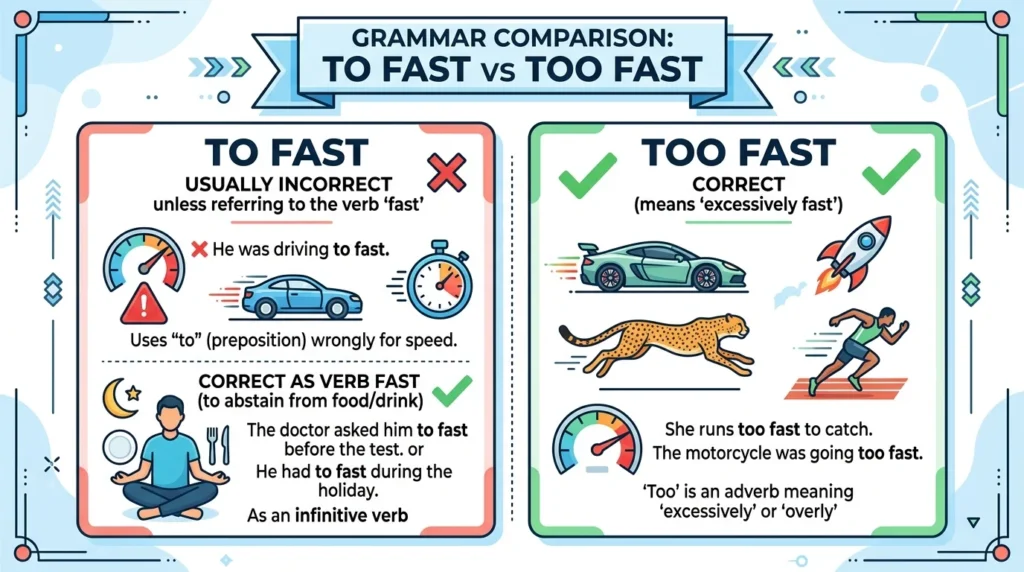
| Feature | To Fast | Too Fast |
|---|---|---|
| Correct? | Yes, in the appropriate context | Yes |
| Main meaning | To abstain from food | Excessively fast |
| Role of “to/too” | Infinitive marker | Adverb expressing excess |
| Role of “fast” | Verb | Adverb or adjective, depending on context |
| Example | I need to fast. | You are driving too fast. |
| Related idea | Fasting | Speed or pace |
| Used for driving speed? | No | Yes |
| Used for avoiding food? | Yes | No |
Real-Life Situations
In an Interview
“Could you repeat the question? You are speaking too fast.”
Here, too fast describes a speaking speed that is difficult to follow.
In a Workplace Meeting
“The project is moving too fast, so we need more time to review the details.”
The phrase describes the pace of the project.
In an Email
“Please slow down the presentation slightly because the slides are moving too fast.”
Too fast is appropriate because the email refers to excessive pace.
In a Text Message
“You’re driving too fast 😂 Slow down!”
The informal setting does not change the spelling. Too is still correct.
In an Academic or Medical Context
“The patient was instructed to fast before the examination.”
Here, to fast is correct because fast is a verb meaning to abstain from food.
How to Remember the Difference
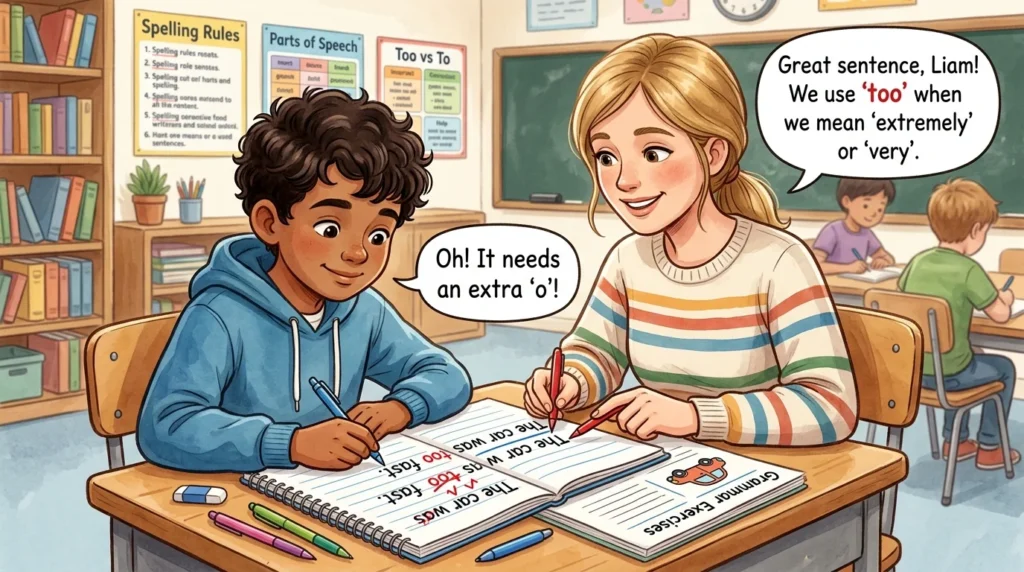
The easiest memory trick is to connect the extra o in too with the idea of extra.
Too = extra or more than needed.
Therefore:
- too fast = more fast than appropriate
- too loud = more loud than appropriate
- too expensive = more expensive than acceptable
- too late = later than appropriate
For to fast, think of to as introducing an action:
to run, to eat, to sleep, to fast
A simple memory sentence is:
“If the speed is extra, use too. If fasting is the action, use to.”
Practice Quiz
Choose to fast or too fast in each sentence.
- You are driving ______ on this road.
- I need ______ before my medical test.
- She talks ______ for the students to follow.
- They decided ______ during the religious observance.
- The car was moving ______ to stop safely.
- He plans ______ tomorrow.
- The teacher is speaking ______ for me to take notes.
- The doctor told her ______ before the procedure.
Answers
1. too fast
2. to fast
3. too fast
4. to fast
5. too fast
6. to fast
7. too fast
8. to fast
Frequently Asked Questions
Is it to fast or too fast?
Both can be correct, but they have different meanings. Too fast means excessively fast. To fast means to abstain from food.
Is “driving to fast” correct?
No. If you mean that someone is driving at an excessive speed, write “driving too fast.”
Can “to fast” ever be correct?
Yes. “To fast” is correct when fast is a verb meaning to abstain from food. For example, “I need to fast before the blood test.”
What does too fast mean?
Too fast means at an excessive speed or pace. It can describe physical movement, speech, learning, work, progress, or other activities.
What does to fast mean?
To fast means to abstain from food for a period of time. It is the infinitive form of the verb fast.
Why do to and too cause so many mistakes?
They commonly sound the same in speech, but they have different spellings, meanings, and grammatical functions. Because pronunciation does not reveal the spelling, writers must use context to choose the correct word.
Is “way too fast” correct?
Yes. Way too fast is a common expression meaning much too fast or far too fast. For example, “The driver was going way too fast.”
Is “too fast” formal or informal?
Too fast is neutral English and can appear in both formal and informal writing. The same is true of to fast when the meaning of fasting is intended.
Does American English use “to fast” and “too fast” differently?
No. The basic distinction is the same in American and British English. The choice depends on meaning and grammar, not on regional English variety.
Can fast be a verb?
Yes. Fast can be a verb meaning to abstain from food. For example, “They decided to fast.” It can also function as an adjective or adverb related to speed.
What is the easiest way to remember to vs. too?
Remember that too has an extra o, which you can associate with something extra or excessive. Therefore, too fast means excessively fast. To fast uses to as the infinitive marker before the verb fast.
Quick Summary
Too fast and to fast are both possible English phrases, but they do not mean the same thing. Use too fast when something happens at an excessive speed or pace, such as “You are driving too fast.” Use to fast when fast is a verb meaning to abstain from food, such as “I need to fast before the test.” The words to and too commonly sound alike, which makes them easy to confuse in writing. The simplest memory rule is: too means extra or excessive, while to can introduce a verb. If you mean excessive speed, choose too fast.
See Also: Presence Meaning: Definition, Business, Online & Examples