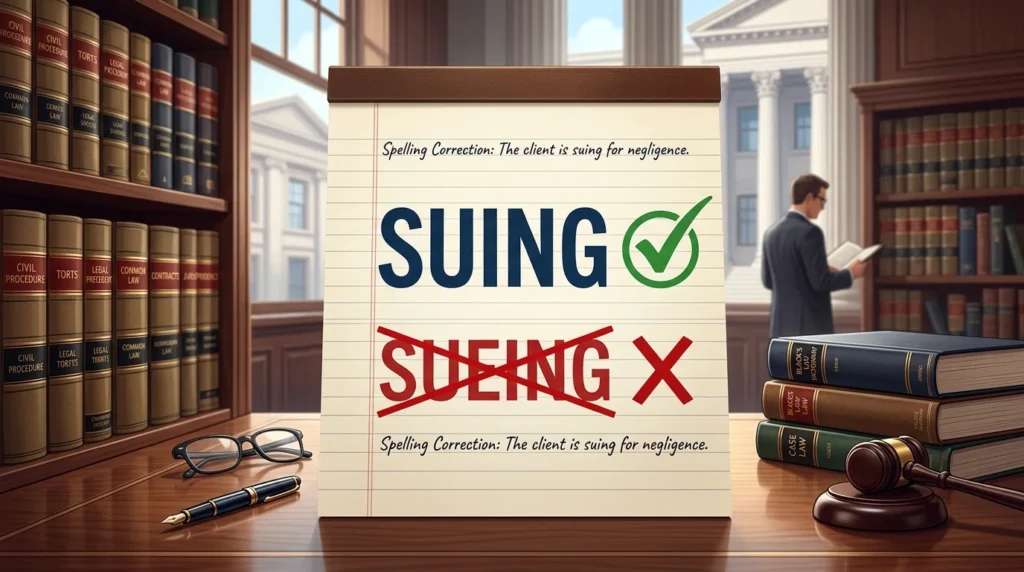

Suing is the correct spelling, while sueing is a misspelling in standard English. Suing is the present participle and gerund form of the verb sue, which means to take legal action against a person or organization. The final e in sue is dropped before -ing is added: sue → suing. Major dictionaries list suing as the correct -ing form.
Quick Answer
Suing is correct. Sueing is incorrect in standard modern English. The verb sue becomes suing when the -ing ending is added because the final silent e is removed. Use suing in legal writing, school assignments, workplace communication, emails, and everyday English. For example: “The company is suing its former contractor.” The two spellings are pronounced essentially the same, so the mistake is mainly a spelling problem rather than a difference in meaning or pronunciation.
What Is the Difference Between Suing and Sueing?
Suing is the standard English spelling of the -ing form of sue. It describes the action of taking legal action against someone or an organization. For example, “The customer is suing the company for damages.”
Sueing is not the standard spelling of this form. It usually appears when a writer treats the word sue as if the letters should remain unchanged before -ing is added. That produces sueing, but standard English uses suing instead. Oxford lists the -ing form specifically as suing, while Cambridge also identifies suing as the present participle of sue.
Why the Difference Matters
This may look like a small spelling issue, but sue is commonly used in legal, business, academic, and professional writing. A spelling error can make an otherwise clear sentence look careless, especially when the word appears in a formal document.
For example, compare these sentences:
- “The customer is suing the manufacturer.”
- “The customer is sueing the manufacturer.”
The first sentence uses the standard spelling. The second contains a spelling error. The meaning a reader intends is usually obvious, but correct spelling is still important when writing clearly and professionally.
The Core Rule
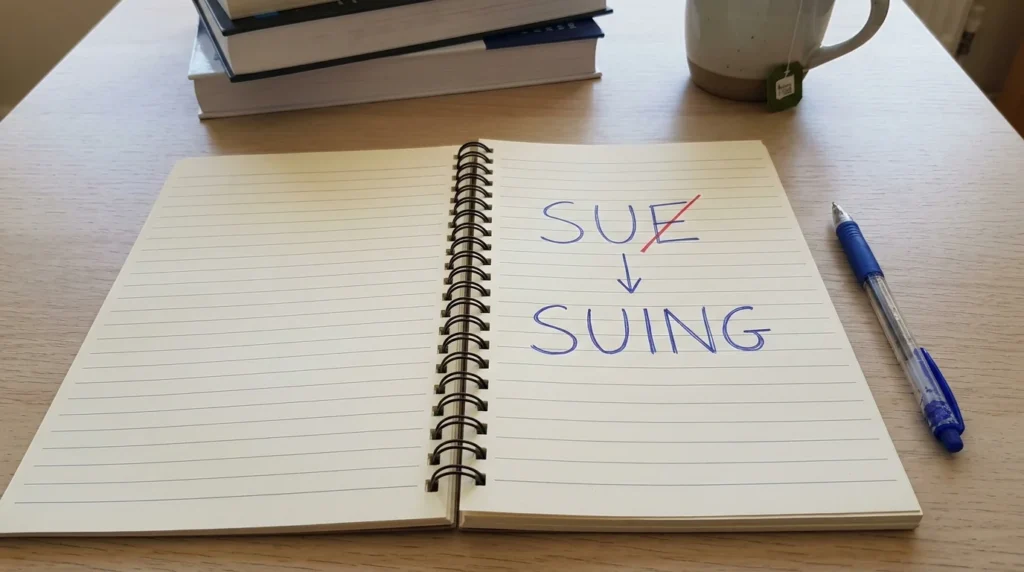
When a verb ends in a final silent “e,” that “e” is commonly removed before the -ing ending is added.
Apply the rule to sue:
sue → remove e → su + ing → suing
So the correct form is:
✅ suing
Not:
❌ sueing
This is the same general spelling pattern seen in words such as make → making, write → writing, and use → using. English has exceptions to spelling rules, so the safest approach is to learn the established form of each word rather than assume every verb behaves identically.
How to Use Suing Correctly
Suing can function as the present participle in a progressive verb construction or as a gerund, a verb form that functions like a noun.
See Also: Appreciate It or Appreciated It: What Is the Difference?
Suing as a Present Participle
When suing appears with a form of be, it commonly describes an action in progress or a situation viewed as ongoing.
Examples:
- The company is suing its former supplier.
- They are suing the manufacturer for damages.
- She was suing the landlord over the dispute.
Suing as a Gerund
Suing can also act as a noun-like form.
For example:
Suing should not always be the first response to a disagreement.
Here, suing names an activity rather than describing who is performing an action at a particular moment.
Suing After a Preposition
The -ing form is also natural after certain prepositions.
Examples include:
- They talked about suing the company.
- She is considering suing for damages.
- He warned them against suing without legal advice.
Correct Examples
- The customer is suing the company for damages.
- She threatened to start suing if the dispute continued.
- The employees are suing their former employer.
- He is considering suing over the contract dispute.
- The family is suing the manufacturer.
- They discussed the possibility of suing during the meeting.
- Her lawyer advised her to think carefully before suing.
- The article reported that several customers were suing the company.
- She wrote an email explaining why she was considering suing.
- The student correctly used suing in his grammar exercise.
- The organization is suing over an alleged breach of contract.
- Posting about suing someone online does not necessarily mean a lawsuit has already been filed.
See Also: Puns or Jokes: What Is the Difference?
Incorrect vs. Correct
| ❌ Incorrect | ✅ Correct | Why |
|---|---|---|
| She is sueing the company. | She is suing the company. | Sue drops its final e before -ing. |
| They are sueing for damages. | They are suing for damages. | Suing is the standard -ing form of sue. |
| He talked about sueing his employer. | He talked about suing his employer. | The word remains suing after the preposition about. |
| She considered sueing the landlord. | She considered suing the landlord. | The gerund form is suing, not sueing. |
| The company is sueing its supplier. | The company is suing its supplier. | The final silent e is removed before -ing. |
| They were sueing over the dispute. | They were suing over the dispute. | The past progressive still uses the standard -ing form. |
| He mentioned sueing in his email. | He mentioned suing in his email. | Suing is the correct noun-like -ing form. |
| She is thinking about sueing. | She is thinking about suing. | The preposition about is followed by the correct gerund form. |
| The lawyer discussed sueing the contractor. | The lawyer discussed suing the contractor. | Sueing is a spelling error. |
| They are planning on sueing. | They are planning on suing. | The established -ing form is suing. |
| He denied sueing the business. | He denied suing the business. | After denied, the gerund form is suing. |
| She avoided sueing immediately. | She avoided suing immediately. | The correct spelling remains suing. |
Why People Make This Mistake
The Base Word Looks Like It Should Stay Complete
The mistake is easy to understand because the base verb is sue. A writer may naturally think that adding -ing means simply placing the ending after the complete word:
sue + ing = sueing
English spelling does not work that way here. The final silent e is removed, giving:
sue + ing → suing
See Also: Company Wide vs Companywide: Differences Explained
Pronunciation Does Not Reveal the Spelling
Suing and the misspelled form sueing can look as though they should represent different pronunciations, but in ordinary intended use the writer is generally trying to represent the same word. Because the error is mainly visible in writing, a speaker may never notice it until they type or spell the word.
Spelling Patterns Can Be Confusing
English has many different spelling patterns for words ending in vowels and vowel combinations. Learners may remember examples where letters are retained and then apply that pattern to sue. The safest solution is to remember the established form sue → suing rather than trying to construct it from sound alone.
Autocomplete and Spellcheck Can Hide the Problem
Typing software may correct an unfamiliar spelling automatically, but writers should not rely completely on spellcheck. Understanding the formation of the word makes it easier to recognize the correct spelling even when no correction appears.
Translation Can Contribute to the Error
English learners who are translating directly from another language may expect the equivalent of “sue” plus an unchanged verb stem plus an equivalent of -ing. English spelling does not always follow that structure, which can lead to forms such as sueing.
Common Mistakes Checklist
- Writing “sueing”: Remember that sue becomes suing.
- Keeping the final e: Do not automatically keep the final e when adding -ing to sue.
- Spelling from pronunciation: The sound does not tell you that the written form should contain e before ing.
- Assuming every verb keeps its spelling: Many English verbs change spelling when suffixes are added.
- Trusting an uncorrected spelling: Spellcheck is useful, but knowing the word formation is more reliable.
- Using “sueing” in formal writing: Replace it with the standard spelling suing.
Suing in Real English
Grammatically Correct and Natural
Suing is the normal standard form in modern English. Sentences such as “The company is suing its supplier” and “She is considering suing for damages” are grammatically correct and natural. Dictionaries identify suing as the -ing form of sue, and the form is used across legal, business, academic, and everyday contexts.
Grammatically Possible but Unnatural
Sueing is not a useful alternative spelling that carries a different nuance. In standard modern English, it is treated as a misspelling rather than a stylistic variant of suing. A reader can usually understand what the writer means, but there is no reason to choose sueing when the established form is suing.
See Also: No Cap Meaning: Definition, Slang, Texting & Social Media Explained
Natural Everyday English
In everyday speech, people commonly use phrases such as “They are suing the company,” “She is thinking about suing,” or “He threatened to sue.” The spelling issue appears mainly when these expressions are written down. The standard written form remains suing, whether the context is casual conversation, an email, a news report, or formal legal writing.
American vs. British English
There is no meaningful American-versus-British spelling difference between suing and sueing. Standard English uses suing in both varieties. Oxford lists suing as the -ing form, while Cambridge gives the same form in its English dictionary.
There can be pronunciation differences in the verb sue across English varieties, but those differences do not create a different standard spelling for its -ing form.
Formal vs. Informal Usage
The correct spelling suing works in both formal and informal English. You can use it in a legal document, business email, school assignment, text message, or casual conversation.
The difference is not one of register. Sueing is not a more casual version of suing. It is simply a nonstandard spelling error.
Suing vs. Sueing Comparison Table

| Feature | Suing | Sueing |
|---|---|---|
| Standard spelling? | Yes | No |
| Base verb | Sue | Sue |
| Meaning | Taking legal action | No separate standard meaning |
| Part of speech | Present participle / gerund | Misspelled form |
| Correct -ing formation | Sue → suing | Sue → sueing is incorrect |
| Formal writing | Correct | Incorrect |
| Informal writing | Correct | Still incorrect |
| American English | Standard | Nonstandard |
| British English | Standard | Nonstandard |
Real-Life Situations
In an Email
“The customer is considering suing the company because the issue has not been resolved.”
Here, suing correctly follows considering.
In a Workplace Meeting
“Before we discuss suing, we should review the contract.”
The word suing works naturally as the activity being discussed.
In a Text Message
“They said they might be suing the company.”
Although the message is informal, the spelling remains suing.
See Also: Ceftazidime Meaning: Uses, Dosage, Side Effects & Definition
In an Academic Essay
“The plaintiff considered suing the organization after the dispute.”
The standard spelling is especially important in formal academic writing.
In a Legal Context
“The company is suing for damages.”
Suing is standard legal vocabulary for describing the act of bringing a legal claim.
How to Remember the Correct Spelling
The easiest memory trick is:
Drop the final e, then add -ing.
Think of the transformation as:
SUE → SU → SUING
You can connect it with familiar examples:
- make → making
- write → writing
- use → using
- move → moving
- sue → suing
A useful sentence to remember is: “When I sue, I am suing.”
Practice: Choose the Correct Form
- The company is (suing / sueing) its former partner.
- She is thinking about (suing / sueing) for damages.
- They discussed (suing / sueing) the contractor.
- He threatened to start (suing / sueing).
- The customer is considering (suing / sueing) the manufacturer.
Answers: 1. suing 2. suing 3. suing 4. suing 5. suing.
Frequently Asked Questions
Is suing or sueing correct?
Suing is correct. Sueing is a misspelling. The standard -ing form of sue is suing.
Why is suing spelled without the e?
The final silent e in sue is removed before the -ing ending is added. The result is sue → suing.
Is sueing ever correct?
In standard modern English, sueing is not the accepted spelling of the -ing form of sue. Use suing instead.
Does suing mean taking someone to court?
Yes. Suing describes the action of bringing legal proceedings or making a legal claim against a person or organization.
Is suing a verb?
Suing is an -ing verb form. It is the present participle of sue and can also function as a gerund when the -ing form acts like a noun.
What is the past tense of sue?
The past tense and past participle of sue are sued. The main forms are sue → sued → sued → suing.
Is suing the same in American and British English?
Yes. The standard spelling is suing in both American and British English. There is no standard regional spelling sueing.
Can I use suing in formal writing?
Yes. Suing is appropriate in formal writing, including legal, academic, business, and professional contexts.
Can I use suing in casual messages?
Yes. The word is also completely normal in informal writing. The register of the sentence does not change its spelling.
Why does sue become suing instead of sueing?
The spelling follows the common pattern of removing a final silent e before adding -ing. Therefore, sue becomes suing, not sueing.
How do you pronounce suing?
Suing is pronounced approximately SOO-ing, with the vowel sound of sue followed by the -ing sound. Oxford gives the pronunciation as /ˈsuːɪŋ/.
What is an easy way to remember suing?
Remember the sequence sue → su → suing. Drop the final e, then add -ing. The short sentence “I sue, I am suing” can also help reinforce the spelling.
Quick Summary
Suing is the correct spelling, and sueing is a misspelling in standard English. Suing is the present participle and gerund form of sue, a verb meaning to take legal action against a person or organization. The spelling follows the common pattern of dropping a final silent e before adding -ing: sue → suing. The same spelling is used in American and British English, and it is appropriate in both formal and informal contexts. If you are writing an email, school assignment, business document, legal text, or social media post, use suing. The easiest rule to remember is simple: drop the e, then add -ing.
See Also: Cathartic Meaning: Definition, Psychology & Examples