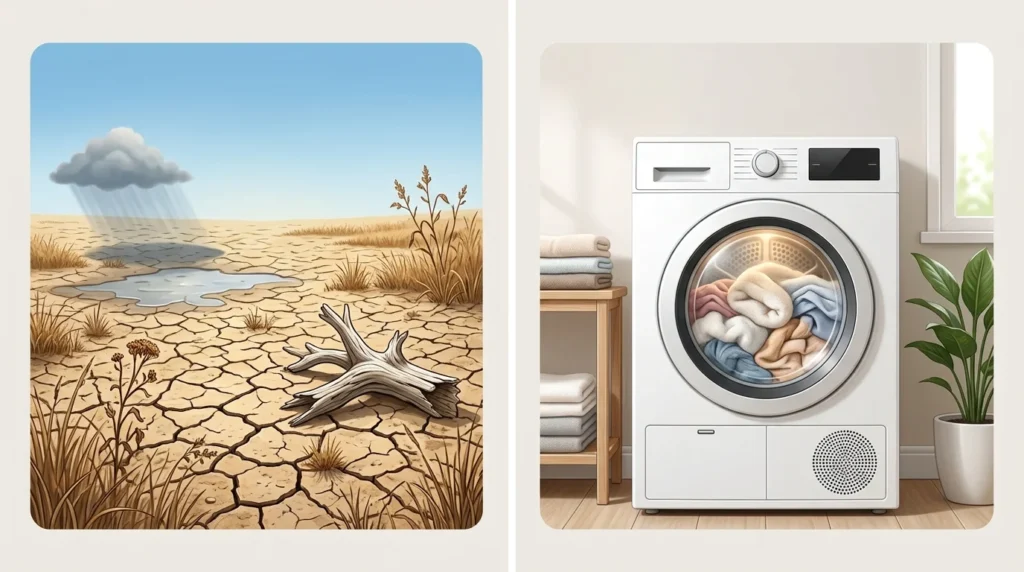

Drier and dryer are both correct English words, but they commonly have different uses. Drier is the comparative form of dry, meaning “more dry” or “less moist,” as in “The air is drier today.” Dryer is commonly a noun for a machine or device that dries something, such as a clothes dryer or hair dryer. However, drier can also be used as a noun for a drying machine, so context matters.
Quick Answer
Use drier when you mean “more dry” or “less moist”: “The weather is drier this week.” Use dryer when you mean a machine or device that dries something: “Put the clothes in the dryer.” However, drier is also a recognized noun meaning a dryer, so it is not always wrong when referring to an appliance. The easiest everyday rule is: drier describes increased dryness; dryer usually names a drying machine or device.
What Is the Difference Between Drier and Dryer?
The main difference is grammatical function and meaning.
Drier is most commonly the comparative form of the adjective dry. It tells us that something has become more dry or is less moist compared with something else or with an earlier condition.
For example:
The towel is drier now.
Here, drier describes the towel’s condition.
Dryer is most commonly a noun referring to a machine or device that removes moisture. Common examples include a clothes dryer, hair dryer, and grain dryer.
For example:
The dryer is still running.
Here, dryer names a machine.
There is an important exception: dictionaries also recognize drier as a noun meaning a dryer. Cambridge explicitly lists drier as another spelling of dryer.
Why It Matters
Choosing between drier and dryer can change the grammatical role of a sentence. If you are describing a climate, towel, room, skin, or soil as having less moisture, drier is normally the form you want.
If you are naming the appliance that removes moisture from clothes or hair, dryer is the familiar modern form in many contexts.
For example:
- The clothes are drier. — describes the clothes.
- The clothes are in the dryer. — names the machine.
The distinction is especially useful in school writing, product descriptions, workplace communication, home-related instructions, and everyday messages.
The Core Rule
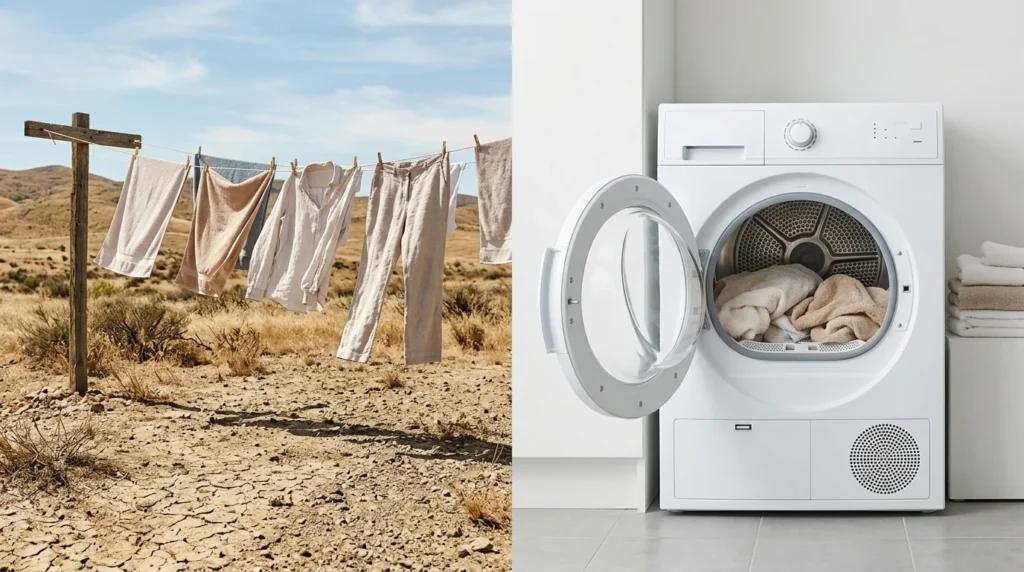
Drier usually means “more dry,” while dryer usually means “a machine or device that dries.”
Think of the two common patterns:
- dry → drier = comparative adjective
- dry → dryer = noun for something that dries
Examples:
The air is drier today.
The hair dryer is in the bathroom.
But remember that drier can also be a noun meaning a drying machine. This means the simple rule is a useful guide, not an absolute rule.
How to Use Drier
Use drier when dry is being compared with another condition, object, time, or place. It is the comparative form of dry.
Drier for Physical Moisture
Use drier to describe something containing less moisture.
- The towel is drier than before.
- The soil becomes drier during the summer.
- My skin feels drier in cold weather.
- The clothes are drier after an hour outside.
The standard comparative pattern is:
dry → drier → driest
Because dry ends in a consonant followed by y, the y changes to i before -er is added. Cambridge lists drier as the comparative of dry.
See Also: To Fast or Too Fast: Which Is Correct?
Drier for Weather and Climate
Drier is common when comparing weather or climate conditions.
For example:
This region is drier than the coastal area.
We are expecting drier weather next week.
In both sentences, drier describes a condition rather than naming a machine.
Drier for Skin and Hair
You can also use drier for changes in skin or hair.
For example:
My hands become drier during winter.
This shampoo can leave your hair drier.
Drier for Figurative Meanings
Dry has meanings beyond physical moisture. It can describe humor, writing, or a style that is restrained or understated. The comparative form drier can therefore be used in those contexts too.
For example:
His humor is drier than hers.
Here, drier is not describing moisture. It is comparing styles of humor.
How to Use Dryer
Use dryer when referring to a machine or device that dries something.
Clothes Dryer
The most familiar use is for a machine that dries clothes.
Put the wet towels in the dryer.
The dryer stopped working.
Cambridge defines dryer as a machine that dries things and gives examples such as hair dryers and grain dryers.
Hair Dryer
A hair dryer is a device used to dry hair.
I left my hair dryer at home.
She used a hair dryer after washing her hair.
Hand Dryer
A hand dryer is a device that blows air to dry people’s hands, commonly found in public restrooms.
The hand dryer wasn’t working.
Other Types of Dryers
The word can refer to many types of equipment designed to remove moisture.
- clothes dryer
- hair dryer
- hand dryer
- grain dryer
- food dryer
- industrial dryer
Oxford lists dryer as a noun for a machine used for drying and notes drier as another form.
Correct Examples
- The air feels drier today.
- This towel is drier than the other one.
- The soil becomes drier during the hot season.
- My skin gets drier in winter.
- The desert has a much drier climate.
- His sense of humor is drier than mine.
- Put the wet clothes in the dryer.
- The dryer is making a strange noise.
- I need to buy a new hair dryer.
- The hotel bathroom has a hand dryer.
- The grain dryer removes moisture from the harvested grain.
- The clothes are drier now, so we can fold them.
Incorrect vs. Correct
| ❌ Incorrect | ✅ Correct | Why |
|---|---|---|
| The weather is dryer today. | The weather is drier today. | Here the word compares the level of dryness, so the comparative form drier is normally used. |
| This towel is dryer than that one. | This towel is drier than that one. | The sentence compares how dry the towels are. |
| The soil is dryer this year. | The soil is drier this year. | Drier is the comparative form of dry. |
| My skin feels dryer in winter. | My skin feels drier in winter. | The word describes increased dryness. |
| We are expecting dryer weather. | We are expecting drier weather. | The sentence describes weather with less moisture. |
| Put the clothes in the drier. | Put the clothes in the dryer. | Dryer is the usual spelling for the appliance in modern everyday English. |
| The dryer climate has less rainfall. | The drier climate has less rainfall. | Drier compares the climate’s dryness. |
| I bought a new drier for my hair. | I bought a new hair dryer. | Hair dryer is the standard familiar spelling for the device. |
| The towels are dryer after washing. | The towels are drier after drying. | The sentence describes the towels becoming more dry. |
| The dryer air made my skin uncomfortable. | The drier air made my skin uncomfortable. | The adjective should be drier when comparing or describing increased dryness. |
| The clothes are in the drier. | The clothes are in the dryer. | Dryer is the common noun for the appliance, although drier is also a dictionary-recognized noun variant. |
| This region is dryer than the north. | This region is drier than the north. | The sentence compares the dryness of two regions. |
Why People Make This Mistake
They Look Almost Identical
The words differ by only one letter:
drier
dryer
That small difference makes it easy to choose the wrong spelling when writing quickly.
See Also: Assume vs Presume vs Infer: Meanings and Differences
They Sound the Same or Very Similar
In many varieties of English, drier and dryer have the same or nearly the same pronunciation. Cambridge gives the same basic pronunciation for both words.
Because speech does not reliably reveal the spelling difference, writers need to use the meaning and grammatical role of the word.
Both Words Come From Dry
The connection to dry makes the spellings especially easy to confuse.
For the comparative adjective:
dry → drier
For the noun referring to a drying device:
dry → dryer
The two forms look related because they are related, but they developed different common uses.
Spellcheck May Not Help
Both drier and dryer are legitimate dictionary words. That means a spellchecker may accept either spelling even when only one fits the sentence’s intended meaning.
For example, “The climate is dryer” may not trigger a spelling warning even though drier is the standard comparative form intended in that sentence. Context-sensitive grammar checking is different from simple spelling checking.
English Learners May Translate the Meaning Directly
Learners may remember that both words relate to drying and then treat them as interchangeable. The better approach is to ask what the word is doing: is it comparing dryness, or is it naming a device?
Common Mistakes Checklist
- Using dryer as the comparative of dry: When you mean “more dry,” use drier.
- Using drier as the name of an appliance: Dryer is the usual modern choice for a clothes or hair appliance.
- Assuming drier is always wrong for a machine: Dictionaries recognize drier as a noun variant of dryer.
- Choosing based only on pronunciation: The words can sound the same, so check the meaning.
- Forgetting the comparative spelling: Remember dry → drier → driest.
- Using dryer for weather: When comparing weather conditions, drier is normally the correct choice.
Drier and Dryer in Real English
Grammatically Correct and Natural: Drier for Comparison
Drier is the normal comparative form when you mean that something has less moisture or is more dry than another condition. Expressions such as “drier weather,” “drier soil,” and “drier air” are standard English. It can also describe figurative meanings of dry, such as humor or writing. Cambridge identifies drier as the comparative of dry.
See Also: Flack Meaning: Definition, Uses, Examples & Flack vs Flak
Grammatically Correct and Natural: Dryer for a Machine
Dryer is the familiar everyday noun for a machine or device that dries something. “Clothes dryer,” “hair dryer,” and “hand dryer” are natural examples. This use is especially common in American English, while British English also commonly uses terms such as tumble dryer for a clothes-drying machine. Cambridge and Oxford both recognize dryer as a noun for drying equipment.
Grammatically Correct but Less Expected: Drier as a Machine
Drier can also be grammatically correct as a noun meaning a machine or device that dries something. This is not merely an invented spelling. Cambridge explicitly lists drier as another spelling of dryer. However, in many everyday contexts, especially common appliance names such as hair dryer and clothes dryer, dryer is the more familiar choice.
American vs. British English
There is no major difference in the comparative adjective: both American and British English use drier for the comparative of dry.
For drying appliances, dryer is widely recognized in both varieties, while British English commonly uses tumble dryer for a clothes-drying machine. Cambridge specifically notes “UK also tumble dryer.”
So the core distinction remains the same across both varieties:
- drier = more dry
- dryer = a machine or device that dries
With the additional dictionary-recognized noun variant, drier can also refer to a drying machine.
Formal vs. Informal Usage
Both drier and dryer are standard words and can be used in formal or informal writing when they fit the intended meaning.
For example, a formal report might say:
The region is expected to experience drier conditions.
A casual message might say:
Can you put my clothes in the dryer?
The difference is not mainly about formality. It is about whether you are describing increased dryness or referring to drying equipment.
Drier vs. Dryer Comparison Table

| Feature | Drier | Dryer |
|---|---|---|
| Most common role | Comparative adjective | Noun |
| Main meaning | More dry; less moist | A machine or device that dries |
| Base word | Dry | Dry |
| Comparative form? | Yes | No, in its common noun use |
| Example | The air is drier. | The dryer is running. |
| Used for weather? | Yes | Not in the standard comparative sense |
| Used for appliances? | Yes, as a recognized noun variant | Yes, commonly |
| Hair appliance | Possible variant, but less familiar | Hair dryer is the common form |
| Clothes appliance | Recognized variant | Common form |
| American English | Standard | Standard |
| British English | Standard | Standard; “tumble dryer” is also common for clothes |
Real-Life Situations
In an Interview
“The climate in my hometown is much drier than it is here.”
Use drier because the speaker is comparing two climates.
In a Workplace Meeting
“The storage area needs drier conditions to protect the materials.”
Drier describes the desired environmental condition.
In an Email
“The towels should be drier before we store them.”
Here, drier describes the towels.
In a Text Message
“The clothes are still wet. Can you check the dryer?”
Dryer refers to the appliance.
In an Exam or School Assignment
“The inland region has a drier climate than the coastal region.”
The word drier is correct because the sentence compares climate conditions.
In a Product Description
“This hair dryer uses warm air to remove moisture from wet hair.”
Dryer is a noun naming the product.
How to Remember the Difference
Use this simple memory rule:
Drier describes. Dryer dries.
If you can replace the word with “more dry”, choose drier.
For example:
The air is drier.
The air is more dry.
If you are naming a machine that performs the drying, dryer is usually the clearest everyday choice.
The clothes are in the dryer.
One important exception remains: drier is also a recognized noun spelling for a drying machine. Therefore, “drier = adjective only” is too strict.
See Also: Situationship Meaning: Definition, Signs, Examples & Differences
Practice Quiz
Choose drier or dryer in each sentence.
- The climate is ______ than it was last year.
- Put the wet clothes in the ______.
- My skin feels ______ during winter.
- We need a new hair ______.
- The soil is becoming ______ because of the lack of rain.
- The hotel has an automatic hand ______.
- This region has ______ air than the coast.
- The ______ stopped working halfway through the cycle.
- His humor is ______ than hers.
- The towels are ______ now.
Answers
1. drier
2. dryer
3. drier
4. dryer
5. drier
6. dryer
7. drier
8. dryer
9. drier
10. drier
Frequently Asked Questions
Is drier or dryer correct?
Both are correct words. Drier is normally the comparative form of dry, meaning “more dry.” Dryer is commonly a noun for a machine or device that dries something. However, drier is also recognized as a noun variant of dryer.
Is it drier or dryer weather?
The standard choice is drier weather. Here, you are comparing weather conditions and mean that the weather has less moisture or is more dry.
Is it a clothes drier or clothes dryer?
Clothes dryer is the common modern form, especially in American English. However, clothes drier is also a recognized variant because drier can function as a noun meaning a drying machine.
Is hair drier or hair dryer correct?
Hair dryer is the familiar standard form for the appliance. Dictionaries also recognize drier as a noun variant, but hair dryer is the clearest everyday choice.
Why does dry become drier instead of dryer?
Drier is the comparative form of the adjective dry. The spelling follows the pattern of changing the final y to i before adding -er: dry → drier.
Can drier be a noun?
Yes. Drier can be a noun meaning a machine or device that dries something. Cambridge lists it as another spelling of dryer. This is an important exception to the simplified rule that drier is only an adjective.
Can dryer be an adjective?
Dryer is most commonly encountered as a noun for a drying machine. When you need the comparative adjective meaning “more dry,” drier is the standard form.
Are drier and dryer pronounced the same?
They are pronounced the same or very similarly in many varieties of English. Cambridge gives essentially the same pronunciation for both words, which helps explain why they are frequently confused in writing.
Is drier more correct than dryer?
Neither word is simply “more correct.” They are both standard words, but their common grammatical uses differ. Use drier for the comparative of dry, and normally use dryer for a drying appliance.
What is the easiest way to remember drier and dryer?
Remember: drier describes dryness; dryer usually names the thing that dries. If you can substitute “more dry,” use drier. If you are talking about a machine, dryer is usually the natural everyday choice.
Does British English use drier or dryer?
British English uses drier as the comparative form of dry and recognizes dryer for a drying machine. For clothes, tumble dryer is also a common British term.
Quick Summary
Drier and dryer are both correct English words, but they have different common uses. Drier is normally the comparative form of dry, meaning “more dry” or “less moist,” as in “The air is drier today.” Dryer is commonly a noun for a machine or device that removes moisture, such as a clothes dryer or hair dryer. However, there is an important dictionary-recognized exception: drier can also be a noun meaning a dryer. For everyday writing, remember the simple rule: drier describes increased dryness, while dryer usually names a drying device. The distinction is the same in American and British English, although British English commonly uses “tumble dryer” for a clothes dryer.