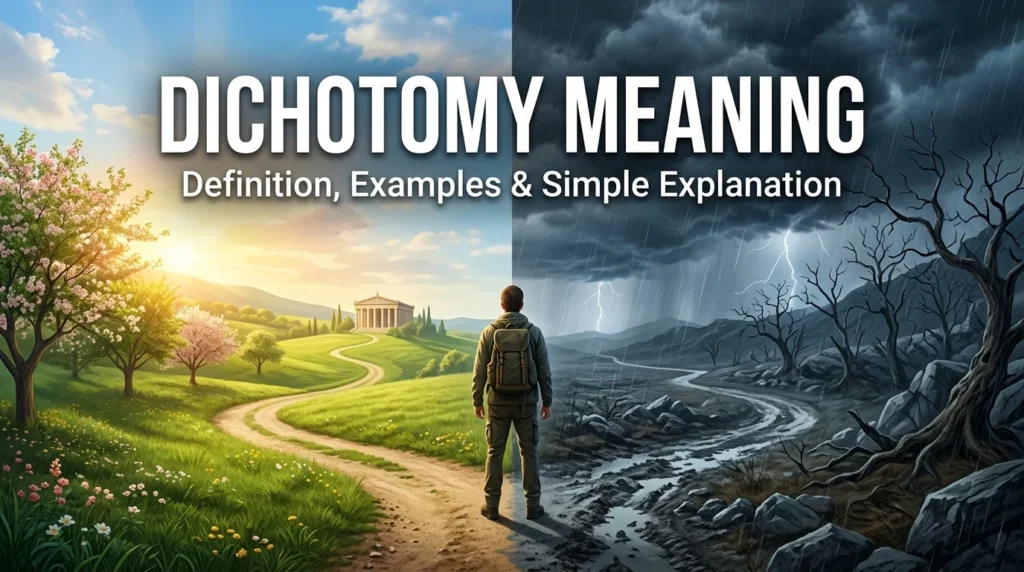

Have you ever heard someone say there is a clear choice between two opposite ideas, yet both seem connected? That is where the word dichotomy becomes useful. Many English learners come across this term in books, classrooms, psychology, philosophy, politics, and even everyday conversations, but they often struggle to understand its exact meaning. If you have searched for dichotomy meaning, you are in the right place because this guide explains everything in a simple and practical way.
Understanding the meaning of dichotomy helps you read academic texts more confidently, improve your vocabulary, and express complex ideas with precision. Whether you are a student, writer, or simply curious about English words, this guide covers definitions, examples, pronunciation, real-life uses, and common mistakes. If you want to explore more word meanings explained in plain English, Trendy Meaning is a great place to discover detailed and easy-to-understand guides.
Meaning & Definition
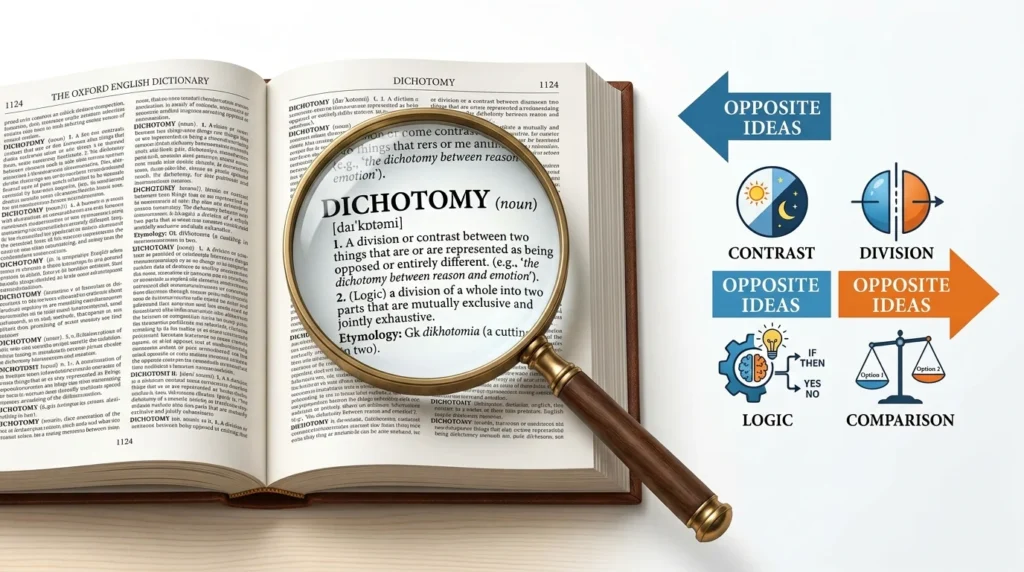
The dichotomy meaning in English refers to a division of something into two completely different, opposite, or contrasting parts. The word comes from the Greek language, where it originally meant “to cut into two parts.” Today, it is commonly used to describe situations where ideas, opinions, objects, or groups are separated into two distinct categories.
If someone asks, what does dichotomy mean, the simplest answer is that it describes a split between two opposing sides. For example, people often talk about the dichotomy between success and failure, emotion and logic, or tradition and innovation. In many cases, the two sides are presented as completely different, although real life is often more complex than a simple two-way division.
Background
The word dichotomy has existed for centuries and has been widely used in philosophy, science, mathematics, literature, psychology, and linguistics. It originated from the Greek words dicha, meaning “in two,” and tomia, meaning “cutting.” Over time, English adopted the term to describe any situation involving two contrasting parts.
Today, the meaning has expanded beyond academic writing. Journalists, teachers, researchers, business professionals, and everyday speakers use the word to explain opposing viewpoints or classifications. Because of its broad application, dichotomy has become an important vocabulary word for English learners and frequently appears in dictionaries, competitive exams, university assignments, and professional communication.
Usage in Different Contexts
The word dichotomy appears in many fields, but its core meaning remains the same: a separation into two opposite or contrasting categories. In everyday English, it may describe choices such as work versus personal life or city life versus rural living. Writers use the word to emphasize clear differences between ideas or characters.
In academic contexts, dichotomy is especially common in psychology, philosophy, sociology, biology, literature, education, economics, and politics. Researchers often discuss the dichotomy between nature and nurture, reason and emotion, or freedom and control. Understanding the context helps readers interpret the word accurately because each field applies the concept slightly differently while preserving its central idea of division into two contrasting parts.
Dichotomy Meaning in English
When people search for dichotomy meaning in English, they usually want a straightforward explanation without confusing dictionary language. In modern English, dichotomy means separating something into two distinct and contrasting groups. These groups are often viewed as opposites, although they may still belong to the same larger concept.
For instance, the distinction between optimism and pessimism can be described as a dichotomy because they represent opposite attitudes. Similarly, discussions about online learning versus classroom learning often highlight a dichotomy between two educational approaches. Knowing this meaning helps you understand books, articles, academic papers, and everyday conversations more effectively.
What Does Dichotomy Mean?
Many English learners ask, what does dichotomy mean because the word sounds formal and is commonly found in advanced reading materials. In simple words, a dichotomy exists whenever something is divided into two clearly different or opposite parts. The focus is on the contrast between the two sides rather than on similarities.
Imagine a debate where people argue whether technology improves life or harms it. Presenting only these two choices creates a dichotomy. However, many real-life situations contain more than two possibilities, which is why understanding the context is important before assuming every issue fits neatly into two categories.
Dichotomy Meaning with Examples
Learning through examples makes the concept much easier to understand. Here are a few examples of dichotomy in everyday English.
The teacher explained the dichotomy between fact and opinion before starting the debate. The company faced a difficult dichotomy between reducing costs and maintaining product quality. The novel explores the dichotomy between love and duty throughout the story.
These examples show that the word is often used when discussing two contrasting ideas rather than physical objects. Once you recognize this pattern, identifying a dichotomy in articles, speeches, and books becomes much easier.
Dichotomy Definition and Examples
A practical dichotomy definition is the separation of a concept, object, or idea into two opposite or contrasting parts. This definition applies across many subjects, including literature, psychology, science, and business. Although the two sides may appear mutually exclusive, they sometimes overlap in real-world situations.
Consider these examples: the dichotomy between freedom and responsibility, public and private sectors, optimism and pessimism, or theory and practice. Each pair represents two contrasting concepts that people often compare or debate. These examples help demonstrate why the word is valuable for discussing differences in a clear and concise way.
What Is a Dichotomy in Simple Words?
If you are wondering, what is a dichotomy in simple words, think of it as splitting one thing into two opposite parts. It is one of the easiest ways to explain the concept to beginners. Instead of using technical language, imagine placing ideas into two separate boxes based on their differences.
For example, day and night, success and failure, hot and cold, or buying and renting are common examples people easily understand. Although these comparisons simplify reality, they illustrate how a dichotomy works. This simple explanation makes the word much less intimidating for English learners and helps them remember it more easily.
See Also: Voluptuous Meaning Explained | Definition & Examples
False Dichotomy Meaning
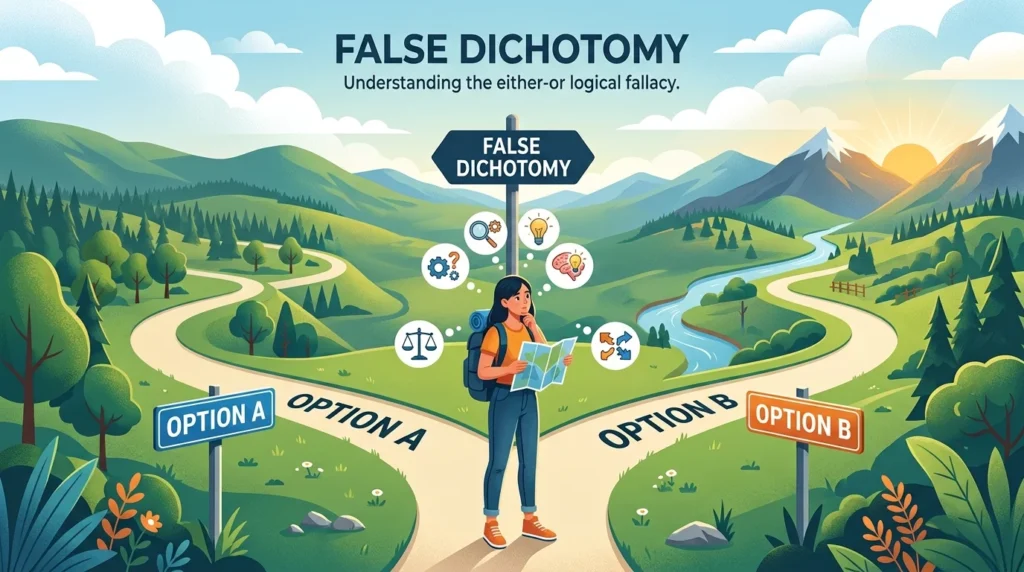
One of the most common phrases related to this topic is false dichotomy meaning. A false dichotomy, also called a false dilemma, is a logical fallacy where only two choices are presented even though other options exist. It oversimplifies a situation and makes people believe they must choose between two extremes when reality is much more flexible.
For example, someone might say, “You are either with us or against us.” This creates a false dichotomy because there are many possible middle positions, such as remaining neutral or supporting only certain ideas. Recognizing a false dichotomy helps improve critical thinking, prevents misleading arguments, and allows people to make better-informed decisions.
Dichotomy vs Paradox
Many learners confuse dichotomy vs paradox, but these terms describe different concepts. A dichotomy divides something into two contrasting or opposing parts, while a paradox is a statement that appears contradictory but may actually contain truth. Understanding this difference helps you use both words correctly in writing and conversation.
For example, the contrast between optimism and pessimism is a dichotomy because they represent opposite viewpoints. On the other hand, the sentence “Less is more” is a paradox because it sounds contradictory yet carries a meaningful idea. Knowing this distinction improves your vocabulary and helps you interpret literature, philosophy, and academic writing more accurately.
Dichotomy vs Duality
Another common search is dichotomy vs duality. Although both involve two parts, they are not identical. A dichotomy emphasizes separation and contrast, while duality focuses on two aspects that coexist and often complement each other rather than oppose each other completely.
For instance, body and mind can be described as a duality because they work together despite being different. However, true and false are generally viewed as a dichotomy because they represent opposing categories. Understanding this difference prevents confusion and helps you choose the correct word depending on the situation.
Dichotomy Pronunciation and Meaning
Many English learners also search for dichotomy pronunciation and meaning because the spelling is not immediately obvious. The word is pronounced as die-KOT-uh-mee. Breaking it into syllables makes pronunciation easier: di • chot • o • my.
Its pronunciation may seem difficult at first, but after hearing it a few times and practicing aloud, it becomes natural. Combining the correct pronunciation with a clear understanding of its meaning allows you to use the word confidently in presentations, discussions, classrooms, interviews, and professional communication.
How to Use Dichotomy in a Sentence
Knowing how to use dichotomy in a sentence helps you apply the word naturally instead of simply memorizing its definition. The word is usually followed by between when comparing two contrasting ideas or categories.
Here are some examples:
- The article explores the dichotomy between freedom and responsibility.
- The movie highlights the dichotomy between wealth and happiness.
- Modern society often struggles with the dichotomy between privacy and security.
- The novel examines the dichotomy between appearance and reality.
- The debate focused on the dichotomy between tradition and innovation.
These examples demonstrate that the word fits naturally in academic writing, journalism, speeches, essays, and everyday discussions.
Synonyms of Dichotomy
Learning synonyms expands your vocabulary and helps you avoid repetition. Depending on the context, words similar to dichotomy include:
- Division
- Separation
- Contrast
- Distinction
- Split
- Opposition
- Polarization
- Difference
- Disunion
- Partition
Although these words share similarities, dichotomy specifically refers to dividing something into two contrasting parts, making it more precise than many of its alternatives.
Antonyms of Dichotomy
Understanding antonyms provides a more complete picture of the word’s meaning. Common antonyms include:
- Unity
- Harmony
- Balance
- Integration
- Combination
- Connection
- Union
- Wholeness
- Agreement
- Continuity
These words emphasize togetherness rather than separation, making them useful opposites when discussing contrasting ideas.
Common Real-Life Examples of Dichotomy
Dichotomies appear in everyday life more often than people realize. We frequently compare opposite ideas to simplify discussions and make decisions. Some examples include work versus life balance, urban versus rural living, traditional education versus online learning, and spending versus saving money.
Businesses also face dichotomies when balancing profit with customer satisfaction, while individuals often experience the tension between personal freedom and social responsibility. Recognizing these examples makes the concept easier to understand because it moves beyond dictionary definitions into practical, real-world situations.
See Also: Razzmatazz Meaning Explained | Definition & Examples
Common Mistakes People Make
One common mistake is using dichotomy whenever two things are different. A dichotomy is stronger than an ordinary difference because it implies a clear division into two opposing groups. If the two ideas overlap significantly, another word such as “difference” or “contrast” may be more appropriate.
Another mistake is assuming every issue has only two possible answers. In reality, many problems involve multiple perspectives. Thinking only in terms of two extremes can create a false dichotomy, leading to poor reasoning and oversimplified conclusions.
Why Understanding Dichotomy Matters
Learning this word improves both reading comprehension and communication skills. It appears frequently in university textbooks, competitive exams, newspaper editorials, research papers, literature, philosophy, psychology, sociology, politics, and business discussions. Understanding it allows readers to grasp complex arguments more quickly.
It also strengthens critical thinking because you become better at recognizing when people simplify complicated issues into only two choices. This ability helps you evaluate arguments logically instead of accepting them at face value.
Frequently Asked Questions
What does dichotomy mean in simple words?
A dichotomy is the division of something into two opposite or contrasting parts. It helps describe situations where two ideas or categories are clearly separated.
What is an example of a dichotomy?
The contrast between success and failure, logic and emotion, or public and private life are common examples of dichotomies because they represent opposing concepts.
Is dichotomy always negative?
No. A dichotomy is simply a way of describing two contrasting parts. Whether it is positive, negative, or neutral depends entirely on the context in which it is used.
What is the difference between a dichotomy and a paradox?
A dichotomy divides something into two opposite groups, while a paradox is a statement that appears contradictory but may actually express a deeper truth.
What is a false dichotomy?
A false dichotomy is a logical fallacy that presents only two choices even though additional possibilities actually exist.
Conclusion
Understanding the dichotomy meaning is more than simply learning another English vocabulary word. It helps you recognize how people divide ideas into two contrasting categories and how those divisions shape discussions in education, business, psychology, philosophy, politics, and everyday life. Once you understand the concept, you will notice it in books, articles, debates, and daily conversations far more often than before.
Whether you searched for dichotomy meaning in English, what does dichotomy mean, dichotomy meaning with examples, false dichotomy meaning, or wanted to understand dichotomy vs paradox and dichotomy vs duality, this guide has covered every important aspect in a simple and practical way. If you enjoy learning English vocabulary through detailed yet easy-to-understand explanations, visit Trendy Meaning for more comprehensive word meanings, examples, pronunciation guides, and language resources that make learning English easier and more enjoyable.
See Also: Cronut Meaning Explained: Origin, History & Definition