

Have you ever noticed the word circa written before a year in history books, museum labels, family records, or antique descriptions? Many people see phrases like circa 1850 or c. 1700 but are unsure what they actually mean. If you searched for circa meaning, you’re not alone. This small word appears in historical documents, archaeology, genealogy, architecture, and academic writing, yet it often confuses English learners because it is rarely used in everyday conversation.
Understanding circa meaning is easier than it seems. Once you know how and when to use it, you’ll recognize it in books, research papers, historical timelines, and even online articles. This guide explains the meaning, pronunciation, origin, examples, and practical usage of the word in simple English. If you enjoy learning vocabulary with detailed yet easy-to-understand explanations, Trendy Meaning is the perfect place to discover more word meanings and improve your English naturally.
Meaning & Definition
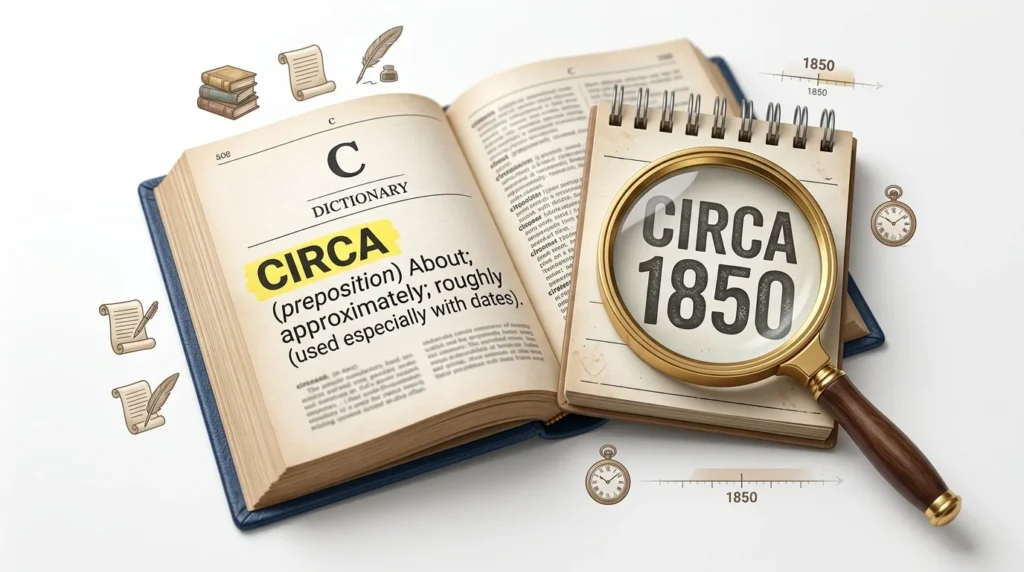
The circa meaning in English refers to approximately, around, or about, especially when talking about dates or years that are not known exactly. The word is placed before a date to show that the year or time period is an estimate rather than an exact fact. Instead of claiming complete accuracy, circa tells readers that the information is close to the actual date.
If someone asks, what does circa mean, the simplest answer is that it means approximately. For example, if an old painting was created around the year 1800 but historians cannot determine the exact year, they may write circa 1800 or c. 1800. This indicates that the artwork was produced near that year without guaranteeing the precise date.
Background
The word circa comes from Latin, where it originally meant around, about, or approximately. Over time, historians, archaeologists, scholars, and researchers adopted the word because it allowed them to describe uncertain dates accurately without misleading readers. Today, it remains one of the most recognized terms in historical and academic writing.
Although circa originated centuries ago, it continues to be widely used in museums, libraries, historical archives, family trees, auction houses, architecture, and scientific publications. Its purpose has never changed—it simply communicates that a particular date is estimated rather than confirmed. Understanding this background makes it easier to recognize why the word is so common in historical records.
Usage in Different Contexts
The word circa is most commonly associated with dates, but it appears in many different fields. Historians use it when the exact year of an event is unknown. Archaeologists include it when dating ancient artifacts, while genealogists rely on it to estimate birth and death years in family records. Museum curators, antique collectors, and researchers also use circa to describe objects whose exact creation dates remain uncertain.
Outside academic settings, circa sometimes appears in business branding, interior design, architecture, and real estate. For example, an old building may be described as circa 1925 to indicate its approximate construction date. Understanding these different contexts helps readers recognize the word beyond textbooks and historical documents.
Circa Meaning in English
When people search for circa meaning in English, they usually want a straightforward explanation that avoids complicated dictionary language. In modern English, circa means about, around, or approximately, particularly when referring to dates. It signals that the exact time is unknown but falls close to the stated year.
For example, if a castle was built circa 1450, it means historians believe the construction happened around the year 1450, although the precise date cannot be confirmed. This simple usage makes circa an important word for understanding historical texts, biographies, research articles, and museum descriptions.
What Does Circa Mean?
Many English learners ask, what does circa mean, because they frequently encounter it before years in books or documentaries. The answer is simple: it tells readers that a date is estimated rather than exact. Instead of pretending complete certainty, the word honestly communicates that experts have determined an approximate timeframe.
For example, writing circa 1750 means the event probably happened around the year 1750. The actual date could be slightly earlier or later, but available evidence is not strong enough to identify the precise year. This makes the word especially valuable in historical research and academic writing.
Circa Meaning with Examples
Understanding circa meaning with examples makes the concept much easier to remember. Consider the following sentences:
The church was built circa 1680. The manuscript dates to circa 1400. The artist was born circa 1825. The ancient sculpture was created circa 300 BC. Each sentence uses circa to show that the date is an educated estimate rather than an exact historical fact.
These examples demonstrate that circa almost always appears before dates and years. Unlike many English vocabulary words, it is rarely used to estimate quantities, distances, or measurements. Its primary purpose is to describe approximate points in time.
Circa Definition and Examples
A clear circa definition is: a word used before a date to indicate that the date is approximate rather than exact. It is one of the most common terms found in history books, museum exhibits, genealogy records, biographies, and academic research. The abbreviation c. is often used instead of writing the full word circa, but both have exactly the same meaning.
Here are a few practical examples. The monument was built circa 1200. The manuscript was written c. 1455. The family settled in the region circa 1890. In each case, the exact year is unknown, but historians believe the event occurred close to the stated date. This simple convention allows writers to present historical information accurately without making unsupported claims.
What Is Circa in Simple Words?
If you’re wondering what is circa in simple words, think of it as another way of saying around, about, or approximately when talking about time. It helps readers understand that the exact year is uncertain but falls close to the date mentioned.
Imagine someone says a house was built circa 1910. This doesn’t mean it was definitely completed in 1910. Instead, it means historians or experts believe it was built around that year. This simple explanation makes the word much easier to remember and use correctly.
Circa Pronunciation and Meaning
Many learners search for circa pronunciation and meaning because they are unsure how to say the word. It is commonly pronounced as SUR-kuh (UK) or SER-kuh (US). The pronunciation is straightforward once you hear it a few times and practice saying it aloud.
Knowing both the pronunciation and meaning helps you use the word confidently in presentations, classroom discussions, historical conversations, and professional writing. Since the word is mostly found in formal or academic contexts, correct pronunciation also improves your spoken English and vocabulary.
How to Use Circa in a Sentence
Learning how to use circa in a sentence is essential because the word follows a simple grammatical pattern. It is placed immediately before a date or year and usually begins with a lowercase letter unless it starts a sentence.
Here are a few examples:
- The castle was constructed circa 1450.
- The painting dates to circa 1885.
- The manuscript was copied c. 1600.
- Archaeologists believe the settlement existed circa 300 BC.
- The company was founded circa 1920.
These examples show that circa works naturally in historical, academic, museum, and research writing.
What Does Circa Mean Before a Date?
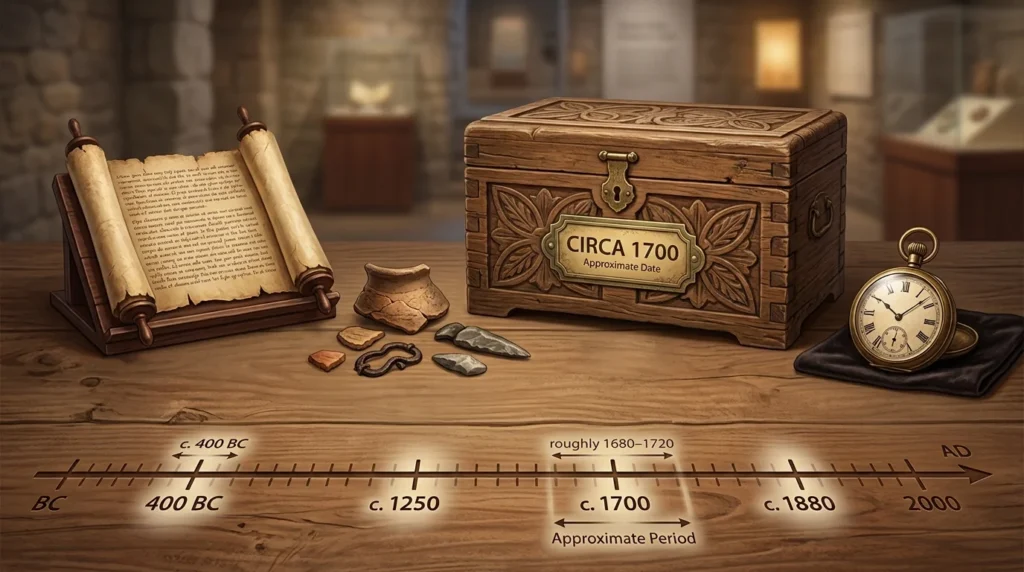
A common question is what does circa mean before a date. When placed before a year, circa tells readers that the date is estimated. It does not mean the information is incorrect—it simply means historians or researchers cannot determine the exact year with complete certainty.
For example, if a biography states circa 1820, the person was probably born around that year, although no official record confirms the exact date. This practice is widely accepted in history, archaeology, genealogy, and museum documentation because it provides an honest representation of available evidence.
See Also: Dichotomy Meaning: Definition, Examples & Simple Explanation
Circa Abbreviation Meaning (C. Meaning)
Another frequently searched topic is circa abbreviation meaning. Instead of writing the full word circa, many books and academic papers simply use the abbreviation c. Both forms have exactly the same meaning and can be used interchangeably.
For example, c. 1500 and circa 1500 communicate the same idea. The abbreviated version is especially common in museum labels, encyclopedia entries, historical timelines, family trees, and research papers because it saves space while remaining universally understood.
Circa Meaning in History
The phrase circa meaning in history is especially popular because the word appears so frequently in historical documents. Historians often work with incomplete evidence, making it impossible to identify exact years for ancient events, buildings, paintings, or manuscripts. Using circa allows them to present the most accurate estimate available.
For example, famous monuments, archaeological discoveries, and historical figures are often dated using circa because written records may have been lost over time. Rather than guessing an exact year, historians prefer to indicate an approximate date supported by available evidence. This practice improves both accuracy and credibility.
Circa vs Approximately
Many people compare circa vs approximately because both words express estimation. Although they share a similar meaning, they are used in different situations. Approximately can describe numbers, distances, quantities, prices, sizes, and measurements, whereas circa is primarily reserved for dates and years.
For example, you would say approximately 50 people attended the meeting, but you would write circa 1750 when referring to a historical date. Understanding this distinction helps you choose the appropriate word depending on the context and makes your English more natural.
Common Mistakes When Using Circa
One common mistake is using circa with quantities instead of dates. For instance, writing circa 20 students attended is incorrect because circa should describe time, not numbers. In that situation, approximately is the better choice.
Another mistake is writing both circa and approximately together, such as approximately circa 1800. Since both words communicate the same idea of estimation, using them together is unnecessary. Writers should choose one or the other depending on the sentence.
Where You Will See the Word Circa
Although circa is not used frequently in everyday conversation, it appears regularly in many professional and academic settings. You will find it in museums, history books, genealogy records, architecture guides, archaeology reports, encyclopedia articles, antique catalogs, biographies, university textbooks, and historical documentaries.
Recognizing the word in these contexts improves reading comprehension and allows you to understand historical timelines more confidently. Once you know its meaning, you’ll begin noticing it in places where you may have overlooked it before.
See Also: Voluptuous Meaning Explained | Definition & Examples
Why Learning Circa Is Important
Learning circa strengthens your English vocabulary and helps you understand formal writing more accurately. It is an essential word for students, researchers, historians, writers, teachers, and anyone interested in history or language. Because it appears in academic sources worldwide, knowing its meaning improves both reading and writing skills.
It also helps you interpret historical information correctly. Instead of assuming every date is exact, you will understand that circa signals an educated estimate based on available evidence. This small detail makes a significant difference when reading historical records or scholarly publications.
Frequently Asked Questions
What does circa mean?
Circa means approximately, around, or about, especially when referring to dates whose exact year is unknown.
Why is circa written before a date?
It is written before a date to indicate that the year is estimated rather than confirmed by historical evidence.
What is the abbreviation for circa?
The standard abbreviation is c., and it has exactly the same meaning as the full word circa.
Can I use circa instead of approximately?
Only when referring to dates or years. For numbers, measurements, prices, or quantities, approximately is usually the correct choice.
Is circa still used today?
Yes. It is still widely used in history books, museums, archaeology, genealogy, biographies, academic research, architecture, and historical documentation.
Conclusion
Understanding the circa meaning helps you read historical texts, museum descriptions, biographies, and academic articles with greater confidence. Although it is a short word, it plays an important role by showing that a date is an informed estimate rather than an exact fact. Knowing when and how to use circa makes your English more accurate and improves your understanding of formal writing.
Whether you searched for circa meaning in English, what does circa mean, circa meaning with examples, what does circa mean before a date, circa abbreviation meaning, or circa vs approximately, this guide has covered every important aspect in a simple and practical way. If you want to learn more English words explained in clear, beginner-friendly language, visit Trendy Meaning, where you’ll find detailed guides, examples, pronunciation tips, and vocabulary resources designed to make learning English easier.
See Also: Sassy Meaning Explained: Definition, Slang & Examples