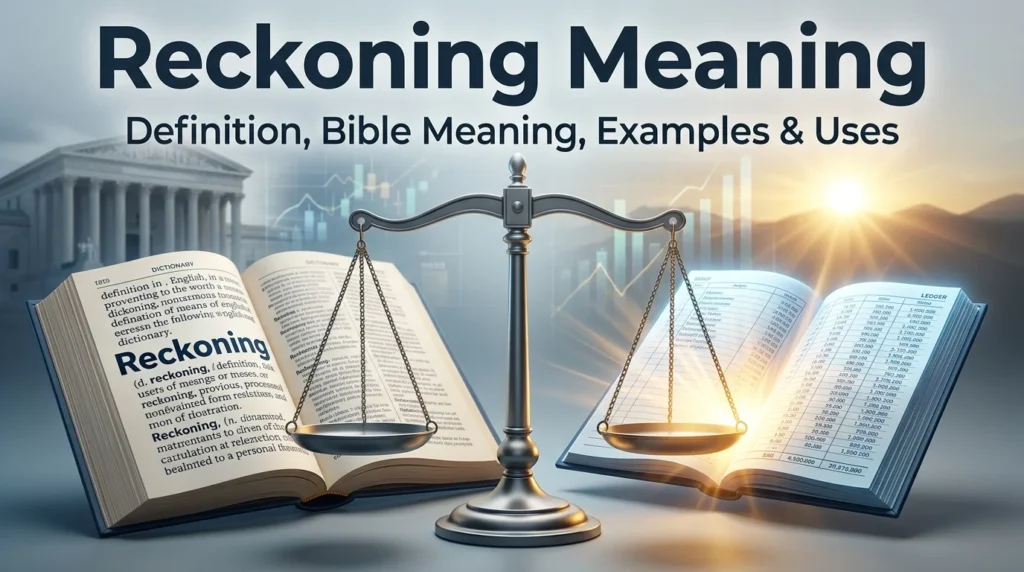

The word reckoning is one of those English terms that appears in many different situations, yet its meaning often depends on the context. You might hear it in phrases like Day of Reckoning, read it in the Bible, come across it in history books, or see it used in movies and news articles. Because of its wide range of uses, many people search for reckoning meaning, what does reckoning mean, and reckoning meaning in English to understand whether it refers to judgment, calculation, accountability, or something else entirely.
Understanding reckoning is important because it carries both literal and figurative meanings. In some contexts, it refers to settling accounts or making calculations, while in others it describes facing the consequences of one’s actions or going through a period of self-reflection. This complete guide explains the definition, history, biblical significance, pronunciation, examples, translations, and modern usage of the word in simple English. If you enjoy learning the meanings of English words, Bible terms, internet expressions, and trending vocabulary, Trendy Meaning is the perfect place to discover detailed yet easy-to-understand explanations.
Meaning & Definition
The reckoning meaning is the act of calculating, settling accounts, evaluating a situation, or facing the consequences of actions. Depending on the context, it can refer to a financial settlement, a personal realization, a moral judgment, or a time when someone must accept responsibility for what they have done. The word comes from the verb reckon, which means to calculate, estimate, consider, or think.
In modern English, reckoning is often used figuratively to describe an important moment of truth or accountability. Someone may experience a personal reckoning after making a serious mistake, while a company may face a financial reckoning after years of poor decisions. Because the word has both literal and symbolic meanings, it is commonly found in literature, history, religion, business, and everyday conversations.
Background
The history of the word reckoning goes back to Old English, where it was closely associated with counting, calculating, and settling financial accounts. Merchants and traders frequently used the word when balancing records or determining what someone owed. Over time, the meaning expanded beyond mathematics and finance to include ideas of responsibility, evaluation, and judgment.
As English evolved, writers and religious scholars began using reckoning in broader ways. It came to describe moments when individuals, societies, or nations had to confront the results of their actions. Today, the word appears in business, law, psychology, history, religion, and popular culture, making it one of the most versatile words in the English language.
Usage in Different Contexts
The word reckoning is used in many different fields, and its meaning changes slightly depending on the situation. In finance, it refers to settling accounts or calculating balances. In history, it may describe important turning points where nations or leaders face the consequences of previous decisions. In religious contexts, particularly Christianity, it often relates to divine judgment, accountability, or spiritual reflection.
In everyday English, people use reckoning to describe personal growth or difficult moments that require honesty and responsibility. Someone recovering from a major mistake may speak about having a personal reckoning, while journalists often describe economic crises as a financial reckoning. This flexibility makes the word useful in both formal and informal communication.
Reckoning Meaning in English
The reckoning meaning in English includes several related ideas such as calculation, settlement, accountability, judgment, evaluation, or facing consequences. While older dictionaries focused mainly on financial calculations, modern English also uses the word to describe emotional, moral, or social situations where someone must deal with the results of past actions.
For example, a business may face a financial reckoning after years of overspending, while an individual may experience an emotional reckoning after making a difficult life decision. Because the word combines practical and symbolic meanings, it is commonly used in books, newspapers, speeches, films, and academic writing. Understanding these different meanings helps English learners recognize the word in a variety of contexts.
What Does Reckoning Mean?
If you’re asking what does reckoning mean, the simplest answer is that it refers to a time of calculation, evaluation, or accountability. It often describes a moment when someone must accept responsibility for previous actions or deal with the consequences of important decisions. Although the word originally referred to counting money or balancing accounts, its modern meaning is much broader.
Today, reckoning can describe financial settlements, emotional realizations, moral responsibility, legal consequences, or spiritual judgment. The exact meaning depends entirely on the context. For this reason, the word frequently appears in discussions about history, politics, religion, psychology, and personal development, making it one of the richest and most meaningful words in English vocabulary.
Reckoning Meaning in the Bible
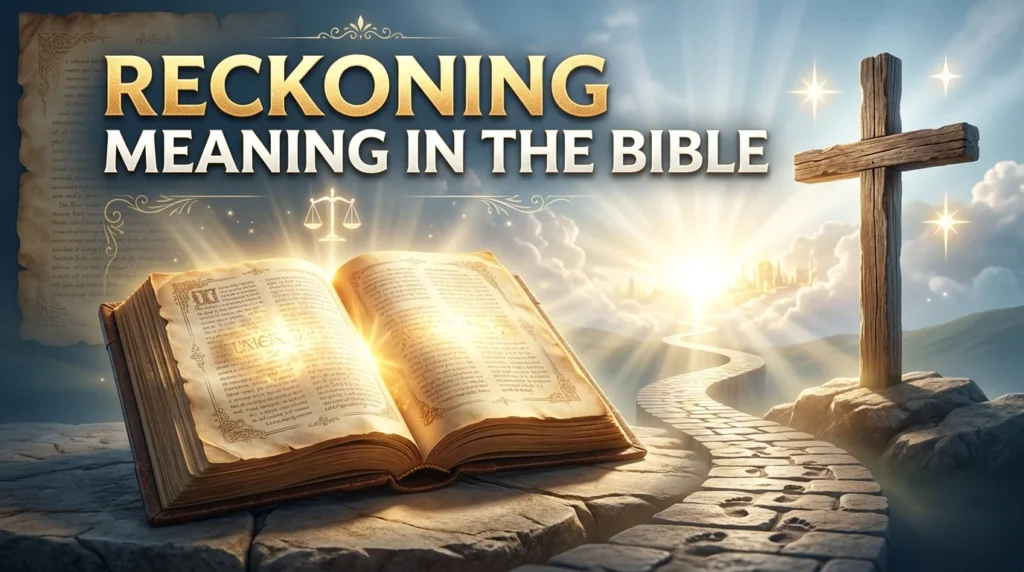
The reckoning meaning in the Bible is closely connected with judgment, accountability, and God’s justice. Biblical passages often use the idea of reckoning to describe a time when people are called to account for their actions. It represents both divine justice and personal responsibility, reminding believers that every action has consequences and that honesty, faith, and righteousness are important values.
However, biblical reckoning is not always portrayed as punishment alone. It can also represent forgiveness, redemption, and spiritual renewal for those who sincerely repent and seek God’s guidance. Because of this balanced message, the biblical concept of reckoning emphasizes both justice and mercy. This deeper spiritual meaning explains why the word continues to appear in sermons, Bible studies, religious books, and discussions about faith today.
Why Is Reckoning Still Relevant Today?
Although the word has ancient origins, reckoning remains highly relevant in the modern world. Governments face political reckonings, businesses experience financial reckonings, and individuals go through personal reckonings during major life changes. The word has become a powerful way to describe moments when truth, responsibility, and consequences cannot be avoided.
This broad application makes reckoning far more than a historical or religious term. It is a timeless concept that applies to personal growth, leadership, relationships, economics, and society as a whole. Learning its meaning not only improves your vocabulary but also helps you better understand books, news articles, speeches, and everyday conversations.
Reckoning Pronunciation
Many English learners search for reckoning pronunciation because the word is commonly used in books, movies, news reports, and religious discussions but is not always easy to pronounce correctly. It is pronounced as:
REK-uh-ning
IPA: /ˈrek.ə.nɪŋ/
The stress falls on the first syllable (REK). Practicing the pronunciation aloud will help you recognize the word more easily in conversations, podcasts, and videos. Since reckoning is frequently used in both formal and everyday English, mastering its pronunciation improves your speaking confidence and listening skills.
How to Use Reckoning in a Sentence
Understanding how to use reckoning in a sentence helps you apply the word naturally in different situations. Because reckoning has several meanings, it can refer to financial calculations, personal accountability, moral judgment, or emotional realization. The surrounding context determines its exact meaning, making it a flexible and expressive vocabulary word.
Here are some examples:
- The company faced a financial reckoning after years of overspending.
- Losing the championship became a personal reckoning for the athlete.
- The novel tells the story of a man’s emotional reckoning after a difficult decision.
- Many believe everyone will experience a Day of Reckoning someday.
- The investigation forced the organization into a public reckoning.
These examples show how the word can be used in business, literature, religion, and everyday conversations.
Reckoning Synonym and Antonym
Knowing the reckoning synonym and antonym helps you better understand the meaning and choose the right word for different situations. Common synonyms include judgment, accountability, settlement, calculation, evaluation, assessment, consequence, responsibility, reflection, and consideration. Although these words are similar, reckoning often emphasizes the process of facing consequences or accepting responsibility.
Common antonyms include avoidance, ignorance, escape, denial, neglect, carelessness, irresponsibility, and indifference. These words describe situations where someone avoids responsibility rather than confronting it. Understanding both synonyms and antonyms helps improve vocabulary and allows you to use the word more accurately in writing and conversation.
Difference Between Reckoning and Judgment
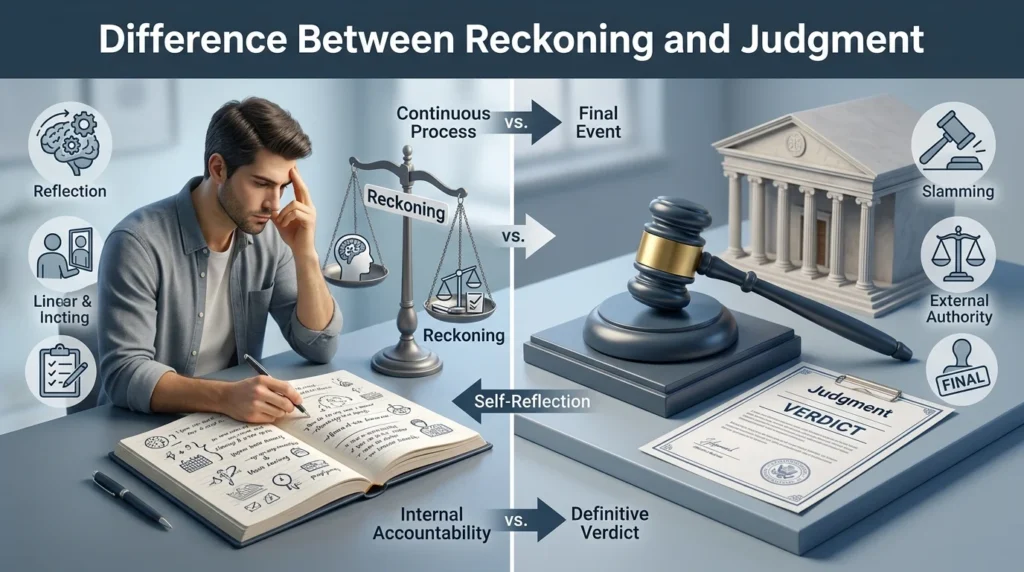
Many people think reckoning and judgment mean exactly the same thing, but there are important differences. Judgment usually refers to a final decision, verdict, or opinion made by a person, court, or authority. It focuses on the outcome or conclusion after evaluating facts or behavior. In religious contexts, judgment often refers to God’s final decision regarding human actions.
Reckoning, however, describes the process of facing, calculating, or accepting responsibility before or during that final outcome. It often includes self-reflection, accountability, and dealing with consequences. For example, a person may go through a personal reckoning before reaching a final judgment about their actions. This subtle distinction explains why both words are related but not interchangeable in every situation.
Word Origin & Etymology
The word reckoning comes from the Old English verb gerecenian, meaning to count, calculate, explain, or relate. Over centuries, the meaning expanded from mathematical calculations to include settling accounts, evaluating actions, and accepting responsibility. The related verb reckon still means to calculate, estimate, or consider something carefully.
Its historical development explains why reckoning appears in so many different contexts today. From accounting and business to religion and literature, the word has maintained its central idea of calculation and accountability while gaining additional symbolic meanings. This rich history has made reckoning one of the most versatile words in the English language.
Common Mistakes When Using Reckoning
One common mistake is assuming that reckoning only refers to religious judgment. Although it is often used in biblical contexts, the word also describes financial settlements, emotional realizations, historical turning points, and personal accountability. Limiting its meaning to religion overlooks many of its modern uses.
Another mistake is using reckoning as a direct replacement for judgment in every sentence. While the two words are related, reckoning focuses more on the process of confronting consequences, whereas judgment emphasizes the final decision. Understanding this difference allows you to choose the most accurate word based on the context.
Quick Summary
Here are the key points to remember:
- Reckoning means calculation, settlement, accountability, or facing consequences.
- It comes from the verb reckon, meaning to calculate or consider.
- The word is used in finance, religion, history, psychology, and everyday English.
- A Day of Reckoning refers to a time when actions have consequences.
- Reckoning often emphasizes responsibility and self-reflection.
- It is different from judgment, although the two ideas are closely connected.
Frequently Asked Questions
What does reckoning mean?
Reckoning means calculation, settlement, accountability, or facing the consequences of actions.
What is the simple meaning of reckoning?
The simple meaning is accepting responsibility or dealing with the results of something.
What does reckoning mean in the Bible?
In the Bible, reckoning often refers to God’s judgment, accountability, and justice.
What is the Day of Reckoning?
The Day of Reckoning is a time when people are held accountable for their actions, either figuratively or in a religious sense.
What is the reckoning meaning in English?
In English, reckoning means calculation, evaluation, settlement, or accountability.
What is the reckoning meaning in Urdu?
It commonly translates as حساب, جوابدہی, اعمال کا حساب, or حساب کتاب, depending on the context.
What is the reckoning meaning in Hindi?
Common Hindi translations include हिसाब, लेखा-जोखा, जवाबदेही, and परिणामों का सामना करना.
Is reckoning the same as judgment?
No. Reckoning focuses on facing responsibility and consequences, while judgment usually refers to the final decision or verdict.
How do you pronounce reckoning?
It is pronounced REK-uh-ning.
Can reckoning be used in business?
Yes. Businesses often use reckoning to describe financial evaluations or periods of accountability.
What are some synonyms of reckoning?
Common synonyms include judgment, settlement, accountability, evaluation, assessment, and calculation.
What is the opposite of reckoning?
Common antonyms include avoidance, denial, escape, ignorance, and irresponsibility.
Is reckoning a negative word?
Not always. It can describe difficult consequences, but it may also refer to positive self-reflection, personal growth, and learning.
Is reckoning still used today?
Yes. It appears frequently in journalism, business, politics, psychology, religion, and everyday English.
How can I remember the meaning of reckoning?
Think of reckoning as the moment when someone must face the truth, accept responsibility, or deal with the consequences of past actions.
Conclusion
The reckoning meaning extends far beyond simple calculation. While the word originally referred to counting or settling accounts, it has evolved to represent accountability, responsibility, self-reflection, and the consequences of actions. Whether you encounter it in finance, history, religion, literature, or everyday conversations, reckoning reminds us that every decision eventually leads to an outcome that must be acknowledged.
Throughout this guide, you’ve learned what does reckoning mean, reckoning meaning in English, reckoning meaning in the Bible, Day of Reckoning meaning, reckoning meaning in Urdu, reckoning meaning in Hindi, its pronunciation, examples, synonyms, antonyms, and the difference between reckoning and judgment. With this complete understanding, you can confidently recognize and use the word in a variety of contexts.
If you enjoy exploring the meanings of English words, internet slang, abbreviations, Bible terms, and trending expressions, visit Trendy Meaning. Our in-depth, easy-to-read guides explain complex vocabulary in simple language, helping you improve your English knowledge with confidence.
See Also:
Forsaken Meaning: Definition, Bible, Examples & Uses