

Have you ever come across the word forsaken in a book, a Bible verse, a movie, or even a text message and wondered what it truly means? Although it is an old English word, forsaken is still widely used in modern conversations, literature, and religious texts. Many people search for forsaken meaning, what does forsaken mean, and forsaken meaning in English because the word expresses deep emotions that cannot always be described with simpler vocabulary. It often represents feelings of abandonment, loneliness, rejection, or being left without help.
Understanding the meaning of forsaken is valuable whether you’re learning English, reading classic literature, studying the Bible, or simply expanding your vocabulary. This complete guide explains the definition, origin, pronunciation, biblical meaning, translations, synonyms, examples, and everyday usage of the word in simple English. You’ll also discover how the meaning changes depending on the context. If you enjoy learning the meanings of English words, Bible terms, internet expressions, and trending vocabulary, Trendy Meaning is an excellent place to explore detailed yet easy-to-understand explanations.
Meaning & Definition
The forsaken meaning is abandoned, deserted, left behind, or given up by someone who was expected to provide care, support, or companionship. The word describes a situation in which a person, place, or thing has been left alone, often creating feelings of loneliness, sadness, or rejection. It is the past participle of the verb forsake, which means to leave someone or something permanently or completely.
Although the word usually carries a negative emotional tone, its exact meaning depends on the context. In literature, it often describes lonely places or abandoned people. In religious writings, especially the Bible, it may express spiritual separation or feelings of being left without God’s presence. In modern English, people also use the word figuratively to describe emotional experiences rather than physical abandonment.
Background
The word forsaken has a long history that dates back to Old English. It comes from the verb forsake, which has been used for centuries to describe leaving, abandoning, or rejecting someone or something. Throughout history, writers, poets, and religious scholars have used the word because it conveys stronger emotions than simple alternatives like “left” or “abandoned.” Its emotional depth has helped it remain part of the English language for hundreds of years.
Over time, the meaning expanded beyond physical abandonment. Today, forsaken is used to describe emotional isolation, broken relationships, forgotten places, failed dreams, and spiritual struggles. Even though it is considered a formal or literary word, it continues to appear in novels, songs, films, sermons, and everyday conversations, making it an important part of advanced English vocabulary.
Usage in Different Contexts
The word forsaken appears in many different contexts, each adding a slightly different meaning. In literature, it often describes deserted villages, lonely landscapes, or characters who have been abandoned. In religious texts, particularly the Bible, it expresses feelings of separation, suffering, or spiritual testing. In everyday English, people may use the word figuratively to describe emotional pain, failed relationships, or situations where someone feels forgotten or unsupported.
The word is also common in movies, novels, music lyrics, and motivational writing because it creates a strong emotional image. Journalists may describe an abandoned neighborhood as “forsaken,” while authors may use it to show a character’s loneliness. Understanding the surrounding context helps determine whether the word refers to physical abandonment, emotional rejection, or spiritual separation.
Forsaken Meaning in English
The forsaken meaning in English is abandoned, deserted, neglected, or left alone. It usually describes a person, place, or thing that has been given up or left without care, attention, or support. The word often carries a feeling of sadness because it suggests that someone or something expected help but was instead left behind.
In modern English, forsaken is commonly used in both literal and figurative ways. A deserted house may be described as forsaken, while a person who feels ignored by friends may also say they feel forsaken. This flexibility allows the word to express emotional, physical, and symbolic forms of abandonment, making it a powerful part of the English language.
What Does Forsaken Mean?
If you’re asking what does forsaken mean, the simplest explanation is that it means to be abandoned, deserted, or left without support. It often describes situations where someone feels completely alone because the people they trusted or depended on are no longer there. The word emphasizes emotional loss rather than simply being physically alone.
However, the meaning changes depending on the context. In literature, it may describe an abandoned castle or forgotten town. In relationships, it can refer to someone feeling emotionally neglected. In religion, especially Christianity, the word often symbolizes spiritual suffering or a temporary feeling of separation from God. Understanding the context helps you interpret the intended meaning accurately.
Forsaken Meaning in the Bible

The forsaken meaning in the Bible carries deep spiritual significance. In biblical language, forsaken often means being abandoned, left, or seemingly separated from God’s presence during times of suffering or testing. One of the most well-known examples appears when Jesus says, “My God, my God, why have you forsaken me?” This verse expresses profound emotional and spiritual anguish rather than suggesting that God’s love had permanently disappeared.
Throughout the Bible, the word is also used to describe people who feel alone during difficult circumstances. However, biblical teachings repeatedly emphasize that feelings of being forsaken are often temporary and that faith, hope, and trust in God remain central themes. Because of this, the biblical meaning of forsaken is not only about abandonment but also about perseverance, restoration, and spiritual encouragement during life’s hardest moments.
Why Is Forsaken Such a Powerful Word?
Unlike simple words such as left or abandoned, forsaken carries strong emotional and literary weight. It often suggests that someone has not only been left behind but has also experienced deep loneliness, rejection, or disappointment. This emotional depth explains why authors, poets, songwriters, and religious writers continue to use the word even today.
Whether describing an isolated place, a struggling individual, or a moment of spiritual hardship, forsaken creates vivid imagery that resonates with readers. Understanding its full meaning helps improve vocabulary, reading comprehension, and appreciation of literature, making it an important word for both everyday English and advanced language learning.
Forsaken Meaning in Urdu
The forsaken meaning in Urdu is commonly translated as ترک کیا ہوا, چھوڑ دیا گیا, تنہا چھوڑا ہوا, لاوارث, or نظر انداز کیا گیا. The exact translation depends on the context in which the word is used. If someone has been abandoned by family or friends, ترک کیا ہوا or چھوڑ دیا گیا is the most suitable meaning. When describing a deserted place, words like ویران or سنسان may better express the intended idea.
Understanding the Urdu meaning helps bilingual learners recognize the emotional depth of the word. Forsaken is stronger than simply saying someone was left behind. It often implies sadness, loneliness, rejection, or the feeling of having no one to rely on. Whether you encounter the word in English books, movies, or Bible verses, knowing its Urdu translation makes its emotional message much clearer.
Forsaken Meaning in Hindi
The forsaken meaning in Hindi is generally translated as त्यागा हुआ, छोड़ा हुआ, परित्यक्त, उपेक्षित, or अकेला छोड़ दिया गया. These translations describe someone or something that has been abandoned, neglected, or left without care. The best Hindi equivalent depends on the sentence and the emotional tone of the context.
In literature and religious texts, forsaken often expresses deep emotional suffering rather than simple physical abandonment. For example, a person may feel त्यागा हुआ after losing the support of loved ones, while an abandoned building may be described as परित्यक्त. Understanding these different meanings helps Hindi speakers interpret English vocabulary more accurately in both everyday conversations and formal writing.
Forsaken Meaning in Text
The forsaken meaning in text is usually the same as its dictionary definition, but it is often used figuratively to describe emotions. In chats, social media posts, or text messages, someone might say they feel forsaken when they believe they have been ignored, forgotten, or emotionally abandoned by friends, family, or a partner. In these situations, the word expresses disappointment and loneliness rather than literal abandonment.
For example, someone might text, “I felt completely forsaken when nobody replied to my messages.” Here, the speaker is not physically alone but emotionally hurt because they expected support or attention. This modern usage shows how forsaken continues to describe emotional experiences even in casual digital communication.
Forsaken Meaning with Examples
Learning through examples is one of the easiest ways to understand the forsaken meaning. The word generally describes someone or something that has been abandoned, neglected, or left alone. Depending on the situation, it may refer to physical abandonment, emotional rejection, or spiritual hardship. Seeing the word used naturally helps learners understand both its literal and figurative meanings.
Here are some examples:
- The old house looked completely forsaken after many years of neglect.
- She felt forsaken when her closest friends stopped talking to her.
- The travelers discovered a forsaken village deep in the mountains.
- The novel tells the story of a forsaken child searching for hope.
- During difficult times, some people feel spiritually forsaken, even though their faith encourages them to remain hopeful.
These examples demonstrate how the word can describe places, emotions, people, and spiritual experiences.
Forsaken Synonym and Antonym
Knowing the forsaken synonym and antonym helps you understand the word more clearly and improve your English vocabulary. Common synonyms include abandoned, deserted, neglected, rejected, isolated, forgotten, left behind, unwanted, and ignored. Although these words share similar meanings, forsaken often carries a stronger emotional or literary tone.
The most common antonyms are supported, loved, protected, accepted, welcomed, cherished, helped, cared for, and accompanied. These words describe the opposite situation, where a person receives care, attention, or companionship. Understanding both synonyms and antonyms allows you to choose the most accurate word based on the context of your writing or conversation.
Common Synonyms of Forsaken
Choosing the right synonym depends on the situation. Some alternatives focus on physical abandonment, while others emphasize emotional pain.
Common synonyms include:
- Abandoned
- Deserted
- Neglected
- Rejected
- Forgotten
- Ignored
- Isolated
- Left behind
- Unwanted
- Lonely
Although these words are similar, forsaken often sounds more emotional and dramatic, making it popular in literature, poetry, and religious writing.
Opposite Words of Forsaken
Understanding opposite words makes the meaning even clearer. Instead of describing abandonment, these words express care, support, and acceptance.
Common antonyms include:
- Loved
- Accepted
- Protected
- Supported
- Welcomed
- Valued
- Helped
- Remembered
- Cared for
- Comforted
These words represent situations where people receive encouragement instead of feeling isolated or rejected.
How to Use Forsaken in a Sentence
Knowing how to use forsaken in a sentence helps you communicate more naturally in both spoken and written English. The word is usually used as an adjective or as the past participle of the verb forsake. It describes a person, place, or situation that has been abandoned, neglected, or left without support. Because it carries a strong emotional tone, it is often found in literature, speeches, and religious writing rather than casual conversation.
Here are some natural sentence examples:
- The forsaken village had been empty for decades.
- She felt forsaken after everyone ignored her calls.
- The old castle stood forsaken on the hill.
- He never wanted his family to feel forsaken.
- The poem describes a forsaken traveler searching for hope.
- During difficult times, some people feel forsaken, but those feelings do not always reflect reality.
These examples show that forsaken can describe physical abandonment as well as emotional or spiritual experiences.
Forsaken Pronunciation
Many English learners search for forsaken pronunciation because they are unsure how to say the word correctly. It is commonly pronounced as:
for-SAY-kuhn
IPA: /fɔːrˈseɪ.kən/
The stress falls on the second syllable (SAY). Practicing the pronunciation aloud helps improve both speaking confidence and listening comprehension. Since the word appears frequently in literature, movies, sermons, and Bible readings, learning the correct pronunciation is useful for students and advanced English learners alike.
Difference Between Forsaken and Abandoned
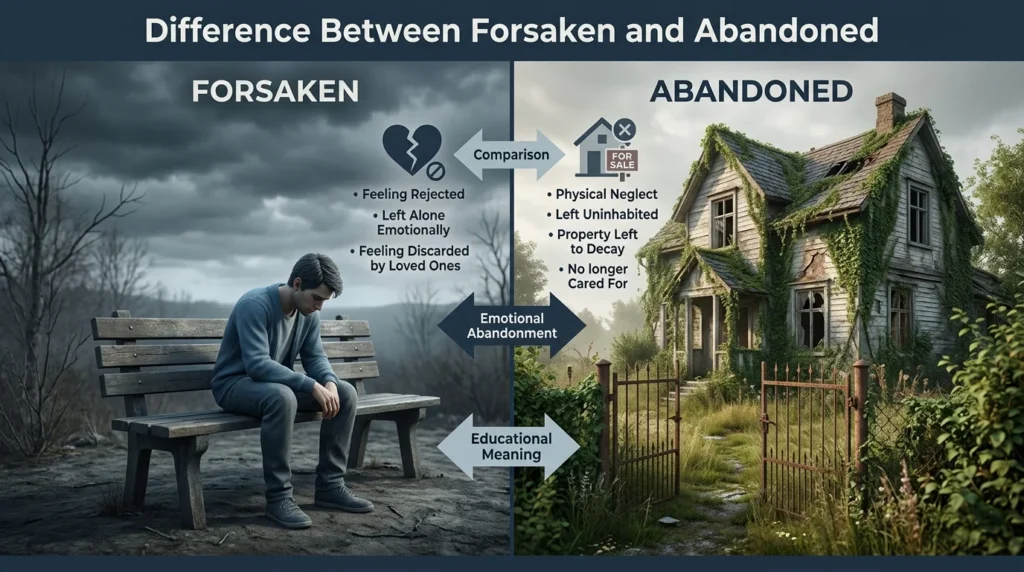
Many people think forsaken and abandoned have exactly the same meaning, but there is a subtle difference. Abandoned usually refers to someone or something that has been physically left behind or no longer cared for. It is commonly used for buildings, vehicles, pets, projects, or places. While it can describe people, it often focuses on the action of leaving rather than the emotional impact.
Forsaken, on the other hand, emphasizes the emotional or spiritual feeling of being left alone, rejected, or forgotten. It often appears in literature and religious contexts because it conveys deeper emotions than abandoned. For example, an abandoned house simply has no owner living in it, while a forsaken person suggests someone experiencing loneliness, rejection, or emotional suffering. Understanding this difference helps you choose the right word for the situation.
Word Origin & Etymology
The word forsaken comes from the Old English verb forsacan, meaning to reject, renounce, or give up. Over time, the spelling and pronunciation evolved into the modern verb forsake, whose past participle is forsaken. Although the word has existed for centuries, its core meaning has remained remarkably consistent throughout English history.
Its historical roots explain why forsaken sounds more formal and literary than many modern alternatives. Writers, poets, translators, and religious scholars have preserved the word because it expresses powerful emotions in a single term. Even today, it remains common in classic literature, Bible translations, novels, speeches, and inspirational writing.
Common Mistakes When Using Forsaken
One common mistake is using forsaken when a simpler word like left or abandoned would be more appropriate. Because forsaken has a stronger emotional meaning, it should be reserved for situations involving deep loneliness, rejection, neglect, or spiritual struggle rather than ordinary events.
Another mistake is assuming that forsaken always refers to physical abandonment. In reality, it often describes emotional or symbolic experiences. A person may feel forsaken even while surrounded by family and friends if they believe no one understands or supports them. Paying attention to context helps ensure the word is used naturally and accurately.
Quick Summary
Here are the most important facts to remember:
- Forsaken means abandoned, deserted, neglected, or left alone.
- It is the past participle of the verb forsake.
- The word often expresses emotional, spiritual, or physical abandonment.
- It appears frequently in the Bible, literature, poetry, and formal English.
- Common synonyms include abandoned, deserted, neglected, and rejected.
- Common antonyms include supported, loved, protected, and accepted.
- The word carries a stronger emotional meaning than abandoned.
Frequently Asked Questions
What does forsaken mean?
Forsaken means abandoned, deserted, neglected, or left without support or care.
What is the simple meaning of forsaken?
The simple meaning is left alone or abandoned.
What does forsaken mean in the Bible?
In the Bible, it often refers to feelings of abandonment or spiritual separation during times of suffering or testing.
What is the forsaken meaning in English?
In English, forsaken means abandoned, deserted, or neglected.
What is the forsaken meaning in Urdu?
It commonly translates to ترک کیا ہوا, چھوڑ دیا گیا, or لاوارث depending on the context.
What is the forsaken meaning in Hindi?
Common Hindi translations include त्यागा हुआ, छोड़ा हुआ, and परित्यक्त.
Is forsaken the same as abandoned?
Not exactly. Forsaken usually carries a stronger emotional or spiritual meaning than abandoned.
How do you pronounce forsaken?
It is pronounced for-SAY-kuhn.
Can forsaken describe a place?
Yes. A deserted building, village, or road can be described as forsaken.
Can a person feel forsaken?
Yes. Someone may feel forsaken when they experience loneliness, rejection, or emotional neglect.
What are some synonyms of forsaken?
Common synonyms include abandoned, deserted, neglected, forgotten, and rejected.
What is the opposite of forsaken?
Common antonyms include supported, accepted, loved, protected, and cared for.
Is forsaken a negative word?
Yes. It generally has a negative meaning because it refers to abandonment or rejection.
Is forsaken still used in modern English?
Yes. It is still used in literature, religious texts, speeches, and formal writing.
How can I remember the meaning of forsaken?
Think of someone who has been left alone without support or care. This simple image captures the core meaning of the word.
Conclusion
The forsaken meaning goes far beyond simply being left behind. It describes a deep sense of abandonment, rejection, neglect, or loneliness that can affect people emotionally, physically, or spiritually. Whether you encountered the word in a novel, a Bible verse, a conversation, or while learning English, understanding its full meaning helps you appreciate its emotional depth and use it correctly in different situations.
Throughout this guide, you’ve learned what does forsaken mean, forsaken meaning in English, forsaken meaning in the Bible, forsaken meaning in Urdu, forsaken meaning in Hindi, its pronunciation, examples, synonyms, antonyms, and the difference between forsaken and abandoned. With this complete understanding, you’ll be able to recognize and use the word confidently in both everyday English and formal writing.
If you enjoy learning the meanings of English words, internet slang, abbreviations, Bible terms, and trending expressions, be sure to visit Trendy Meaning. Our detailed, easy-to-read guides simplify complex vocabulary and help you expand your knowledge with accurate, reader-friendly explanations.
See Also:
Pluribus Meaning: Definition, Latin Translation & Uses