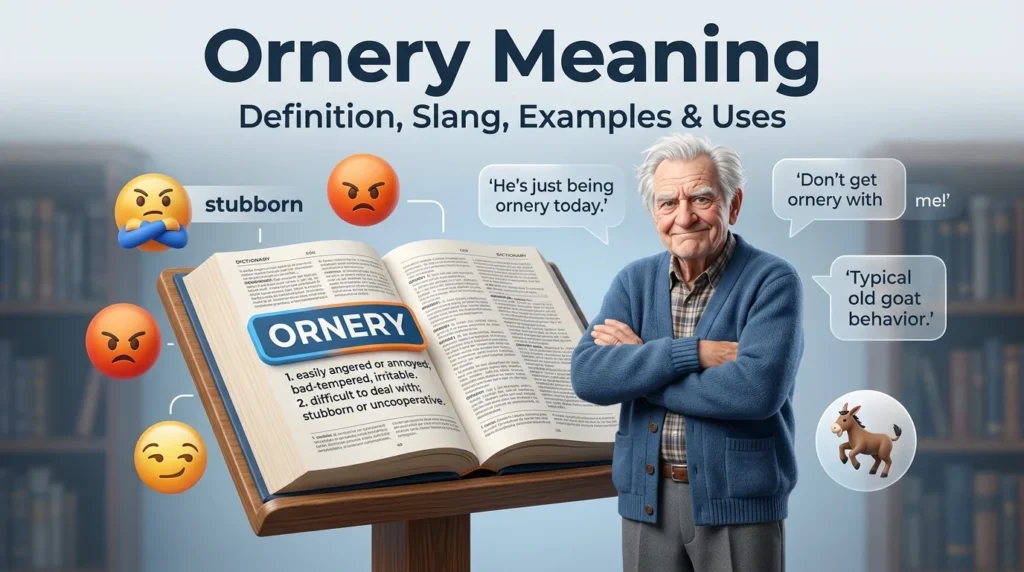

The word ornery is a common adjective in American English, but it often confuses English learners because its meaning changes slightly depending on the context. Some people use it to describe someone who is stubborn or difficult, while others use it in a humorous way to refer to a person with a playful but grumpy personality. This is why many people search for ornery meaning, what does ornery mean, and ornery meaning in English to understand exactly how the word is used in real conversations.
Although ornery usually describes someone who is bad-tempered, cranky, or unwilling to cooperate, it is not always used as a serious insult. In many parts of the United States, especially in the South and Midwest, the word can be used affectionately to describe a person who likes to argue, tease others, or behave mischievously. This complete guide explains the definition, origin, pronunciation, examples, translations, and modern usage of ornery in simple English. If you enjoy learning the meanings of English words, internet slang, and trending expressions, Trendy Meaning is the perfect place to explore clear and detailed explanations.
Meaning & Definition
The ornery meaning is bad-tempered, stubborn, difficult to deal with, or intentionally uncooperative. It is an adjective used to describe people who are easily annoyed, argumentative, or unwilling to follow instructions. In informal American English, however, the word can also describe someone who is playfully mischievous rather than genuinely unpleasant.
The meaning of ornery depends on the tone of the conversation. When someone says, “He’s feeling ornery today,” they usually mean the person is acting grumpy, cranky, or difficult. In family conversations, especially in rural America, grandparents may affectionately call a child ornery because they are energetic, playful, and always getting into harmless trouble. Understanding the context is the key to interpreting the word correctly.
Background
The word ornery has an interesting history in American English. It developed as a regional pronunciation of the word ordinary during the nineteenth century. Over time, its meaning changed completely. Instead of describing something normal or average, ornery began referring to someone who was difficult, ill-tempered, stubborn, or troublesome. This unique evolution makes it one of the most recognizable examples of how language changes over time.
Today, ornery is most commonly heard in the United States, especially in Southern and Midwestern regions. It appears frequently in everyday conversations, movies, novels, television shows, and country music. Although it is considered informal English, native speakers still use it regularly to describe people with challenging personalities or playful attitudes.
Usage in Different Contexts
The word ornery can be used in several different contexts, and its meaning changes depending on the situation. In everyday conversations, it usually describes someone who is grumpy, stubborn, or difficult to please. Parents may use it when talking about children who refuse to listen, while coworkers might describe a colleague who constantly argues about small issues.
In some regions of the United States, ornery has a more positive or humorous meaning. Instead of criticizing someone, speakers may use it affectionately to describe a person who enjoys teasing others or behaving mischievously. This friendly usage explains why the word does not always carry a negative meaning. Learning these contextual differences helps English learners understand how native speakers naturally use the word.
Ornery Meaning in English
The ornery meaning in English is bad-tempered, stubborn, cranky, difficult, or unwilling to cooperate. It is mainly used in American English and often describes someone’s personality or behavior rather than a temporary mood. Although dictionaries define it as unpleasant or difficult, many native speakers use it informally with a friendly or humorous tone.
For example, someone might say, “My grandfather gets a little ornery when he misses his morning coffee.” In this sentence, the speaker is not insulting their grandfather but simply describing his grumpy behavior in an affectionate way. This flexible meaning makes ornery an interesting and expressive word in modern English.
What Does Ornery Mean?
If you’re wondering what does ornery mean, the simplest answer is that it describes someone who is grumpy, stubborn, difficult, or argumentative. However, unlike stronger insults, ornery often suggests that the person’s behavior is temporary or even amusing rather than truly mean. This is why the word is commonly used among friends and family members.
Depending on the context, ornery can also describe playful behavior. A child who constantly plays harmless pranks or refuses to follow simple instructions might be called ornery without implying serious bad behavior. Because the word combines ideas of stubbornness, irritation, and mischievousness, it has become a popular descriptive adjective in American English.
Ornery Meaning in Slang
The ornery meaning in slang is slightly different from its dictionary definition. In informal speech, especially in the United States, ornery often refers to someone who enjoys causing harmless trouble, teasing friends, or acting mischievously. Instead of describing an angry or unpleasant person, it can describe someone with a playful attitude who likes to challenge others for fun.
For example, a grandparent might laugh and say, “That little boy is so ornery,” after watching a child play practical jokes or ignore simple instructions. In this case, the word expresses affection rather than criticism. This slang usage shows why understanding tone and context is important when interpreting the meaning of ornery in conversations, movies, social media, and everyday life.
Why Is Ornery Still Common Today?
Although ornery has existed for more than a century, it remains popular because it describes personality traits that people easily recognize. Journalists, authors, movie writers, and everyday speakers continue using the word to describe characters who are stubborn, humorous, or difficult in a memorable way.
Its popularity also comes from its flexibility. Unlike harsher adjectives, ornery can express annoyance, affection, humor, or playful criticism depending on the situation. This versatility has helped the word remain an important part of informal American English and a useful addition to every English learner’s vocabulary.
Ornery Meaning in Text
The ornery meaning in text is generally the same as its everyday English meaning, but it is often used in a lighter and more humorous way. In text messages, online chats, and social media posts, someone may describe a friend, family member, or pet as ornery when they are acting stubborn, grumpy, or mischievous. In most cases, the word is not meant as a harsh insult but as a playful description of someone’s behavior.
For example, someone might text, “My dog is feeling ornery today and won’t listen to anyone.” Another person might say, “He’s just being ornery because he didn’t get enough sleep.” In both examples, the word describes temporary behavior rather than a person’s permanent personality. This modern usage makes ornery a popular adjective in casual digital conversations.
Ornery Meaning in Urdu
The ornery meaning in Urdu can be translated as ضدی, چڑچڑا, بد مزاج, اکھڑ, or مشکل مزاج, depending on the context. If someone is being difficult or refusing to cooperate, ضدی or اکھڑ is often the most accurate translation. When the word describes someone who is easily annoyed, چڑچڑا or بد مزاج better captures the intended meaning.
In some situations, ornery can also describe playful mischief rather than genuine anger. In those cases, the Urdu meaning may be closer to شرارتی مگر ضدی rather than simply bad-tempered. Understanding the context helps Urdu speakers choose the most suitable translation and interpret the word correctly in conversations, books, movies, and online content.
Ornery Meaning in Hindi
The ornery meaning in Hindi is commonly translated as जिद्दी, चिड़चिड़ा, बदमिजाज, झगड़ालू, or अड़ियल. The best translation depends on how the word is used. If someone is refusing to cooperate, जिद्दी or अड़ियल is appropriate. If they are easily irritated or unpleasant, चिड़चिड़ा or बदमिजाज is a better choice.
In American English, however, ornery can sometimes describe a person who is playfully mischievous rather than genuinely unpleasant. In such situations, Hindi speakers may understand it as शरारती लेकिन प्यारा. Recognizing this friendly usage helps learners understand why native speakers often use ornery with humor instead of criticism.
Ornery Pronunciation
Many English learners search for ornery pronunciation because the spelling and pronunciation do not always seem obvious. The word is commonly pronounced as:
OR-nuh-ree
IPA: /ˈɔːr.nər.i/
The stress falls on the first syllable (OR). In some regions of the United States, native speakers pronounce it slightly differently, but OR-nuh-ree is the standard pronunciation taught in most dictionaries. Practicing the word aloud helps improve both speaking confidence and listening comprehension when watching American movies or talking with native English speakers.
How to Use Ornery in a Sentence

Understanding how to use ornery in a sentence makes it easier to include the word naturally in conversations and writing. Ornery is usually used as an adjective before a noun or after a linking verb such as is, was, or seems. It commonly describes people, children, pets, or even animals that are acting stubborn, cranky, or difficult.
Here are some natural examples:
- My grandfather becomes ornery when someone interrupts his afternoon nap.
- The little boy was feeling ornery and refused to clean his room.
- Our old dog gets ornery whenever strangers visit the house.
- She can be ornery, but she has a kind heart.
- The customer became ornery after waiting for an hour.
These examples show that ornery usually refers to someone’s temporary attitude or personality rather than describing serious bad behavior.
Ornery Meaning with Examples
Learning the ornery meaning with examples helps you understand how native speakers naturally use the word. Although ornery often describes stubborn or bad-tempered behavior, it can also express playful mischief depending on the speaker’s tone. This flexibility makes it a useful adjective in everyday American English.
Here are more examples:
- The ornery horse refused to move despite every effort.
- My younger brother becomes ornery when he is hungry.
- Everyone laughed because the old man was being ornery in a funny way.
- The child gave his parents an ornery smile before hiding their keys.
- The movie features an ornery character who argues with everyone but secretly cares about them.
These examples demonstrate that ornery can describe people, children, animals, and fictional characters, making it a versatile word for both casual conversations and storytelling.
When Native English Speakers Use Ornery
Native English speakers often use ornery when they want to describe someone as difficult without sounding overly harsh. Instead of calling a person rude or mean, they may say the person is ornery, suggesting that the behavior is temporary, humorous, or simply part of their personality.
This is especially common in Southern and Midwestern American English, where the word is frequently used among family members and friends. Because of this cultural usage, ornery often sounds friendlier than many other adjectives that describe difficult behavior. Learning this nuance helps English learners understand conversations more naturally.
Ornery Synonym and Antonym
Understanding the ornery synonym and antonym helps you use the word more accurately and expand your English vocabulary. Common synonyms include grumpy, cranky, stubborn, cantankerous, bad-tempered, ill-tempered, argumentative, difficult, irritable, and uncooperative. While these words share similar meanings, ornery often has a lighter or more humorous tone, especially in American English.
Common antonyms include friendly, pleasant, cheerful, cooperative, agreeable, kind, easygoing, patient, polite, and good-natured. These words describe people who are calm, helpful, and easy to get along with. Learning both synonyms and antonyms makes it easier to choose the right word depending on the situation and the tone you want to express.
Difference Between Ornery and Stubborn
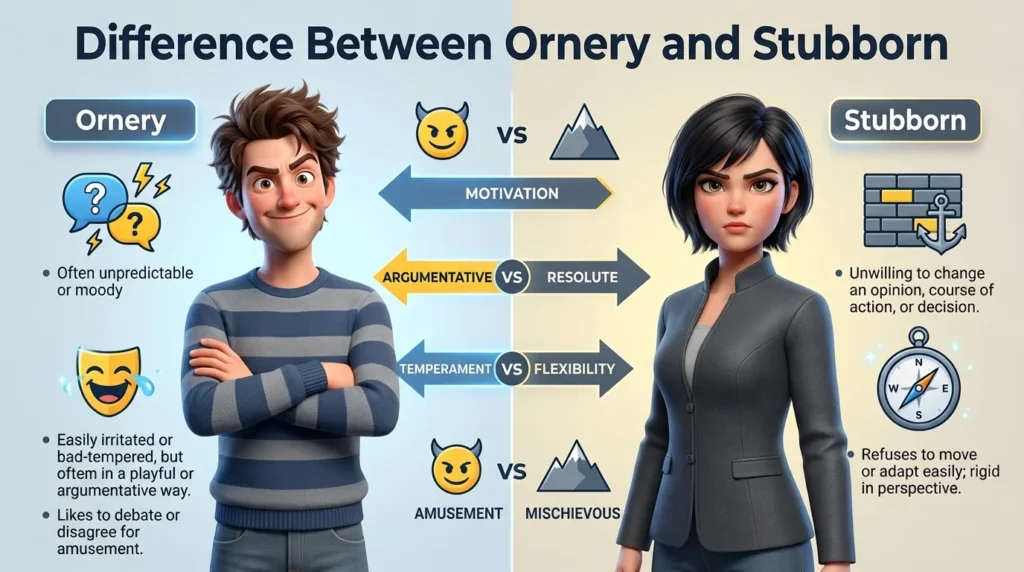
Many people think ornery and stubborn mean the same thing, but they are not completely identical. Stubborn describes someone who refuses to change their opinion or behavior, even when presented with good reasons. It focuses on determination and unwillingness to compromise. A stubborn person may remain polite while refusing to agree with others.
Ornery, however, goes beyond stubbornness. It often suggests that a person is grumpy, cranky, argumentative, or intentionally difficult. An ornery person may complain, tease, or resist cooperation simply because they are in a bad mood or enjoy being difficult. In many American families, the word is also used affectionately to describe someone with a playful but mischievous personality. This makes ornery a broader and more expressive word than stubborn.
Is Ornery a Bad Word?
Many English learners ask, “Is ornery a bad word?” The answer is not necessarily. Although ornery can describe someone who is difficult, grumpy, or bad-tempered, it is usually considered a mild and informal word rather than a serious insult. Native English speakers often use it with humor or affection, especially when talking about family members, friends, or pets.
For example, calling a child ornery often means the child is playful, mischievous, and full of energy rather than truly rude or disrespectful. Likewise, an elderly person may be described as ornery because they like to argue or complain in a harmless way. The tone of the conversation determines whether the word sounds critical or affectionate.
Word Origin & Etymology
The word ornery has a unique history. It developed in the United States during the nineteenth century as a regional pronunciation of the word ordinary. Over time, its meaning gradually shifted. Instead of referring to something normal or average, people began using ornery to describe someone who was unpleasant, stubborn, or difficult to deal with.
Today, ornery is recognized as a distinct word with its own meaning. It remains especially common in Southern and Midwestern American English, where it continues to describe both bad-tempered and playfully mischievous behavior. Its unusual history makes it one of the most interesting examples of how spoken language can transform the meaning of a word over time.
Common Mistakes When Using Ornery
One common mistake is believing that ornery always means angry or mean. While it can describe someone who is difficult, the word often carries a friendly or humorous tone. Many native speakers use it affectionately, particularly when talking about children, grandparents, or pets. Ignoring this cultural nuance can lead to misunderstanding the speaker’s intention.
Another mistake is using ornery in formal writing or professional documents. Since it is mainly an informal American English word, it is usually better suited for conversations, stories, novels, and casual communication. In formal contexts, words such as difficult, uncooperative, or ill-tempered may be more appropriate.
Quick Summary
Here are the key facts to remember:
- Ornery means grumpy, stubborn, cranky, difficult, or mischievous.
- It is mainly used in American English.
- The word is informal and often has a humorous or affectionate tone.
- It can describe people, children, pets, or even animals.
- Common synonyms include grumpy, cranky, cantankerous, and stubborn.
- Common antonyms include friendly, pleasant, cheerful, and cooperative.
- Context and tone determine whether the word sounds negative or playful.
Frequently Asked Questions
What does ornery mean?
Ornery means bad-tempered, stubborn, cranky, difficult, or playfully mischievous.
What is the simple meaning of ornery?
The simple meaning is someone who is grumpy or difficult to deal with.
Is ornery a bad word?
No. It is generally an informal word and is often used humorously or affectionately rather than as a serious insult.
What is the ornery meaning in English?
In English, ornery means bad-tempered, stubborn, difficult, or cranky.
What is the ornery meaning in slang?
In slang, ornery often describes someone who is playfully mischievous or enjoys teasing others.
What is the ornery meaning in Urdu?
It commonly translates as ضدی, چڑچڑا, بد مزاج, or اکھڑ, depending on the context.
What is the ornery meaning in Hindi?
Common Hindi translations include जिद्दी, चिड़चिड़ा, बदमिजाज, and अड़ियल.
How do you pronounce ornery?
It is pronounced OR-nuh-ree.
How do you use ornery in a sentence?
Example: My grandfather gets a little ornery when he misses his morning coffee.
What are some synonyms of ornery?
Common synonyms include grumpy, cranky, cantankerous, stubborn, irritable, and argumentative.
What is the opposite of ornery?
Common antonyms include friendly, cheerful, pleasant, easygoing, and cooperative.
What is the difference between ornery and stubborn?
Stubborn means refusing to change your opinion, while ornery usually includes being grumpy, argumentative, or intentionally difficult.
Can ornery describe a child?
Yes. It is often used affectionately to describe a playful, mischievous, or stubborn child.
Is ornery used outside the United States?
Yes, but it is much more common in American English than in other English-speaking countries.
Is ornery still used today?
Yes. It remains a popular informal adjective in American conversations, movies, books, and television.
Conclusion
The ornery meaning is much richer than simply describing someone as stubborn or bad-tempered. Depending on the situation, it can refer to a person who is grumpy, argumentative, mischievous, or playfully difficult. Because the word often carries a humorous or affectionate tone, especially in American English, understanding the context is essential for interpreting its true meaning.
Throughout this guide, you’ve learned what does ornery mean, ornery meaning in English, ornery meaning in slang, ornery meaning in text, ornery meaning in Urdu, ornery meaning in Hindi, its pronunciation, examples, synonyms, antonyms, and the difference between ornery and stubborn. With this knowledge, you can confidently understand and use the word in everyday conversations, books, movies, and online discussions.
If you enjoy learning the meanings of English words, internet slang, abbreviations, and trending expressions, visit Trendy Meaning. Our detailed, easy-to-read guides explain vocabulary in simple language, helping you improve your English skills while exploring the latest words and expressions from around the world.
See Also:
Reckoning Meaning: Definition, Bible, Examples & Uses