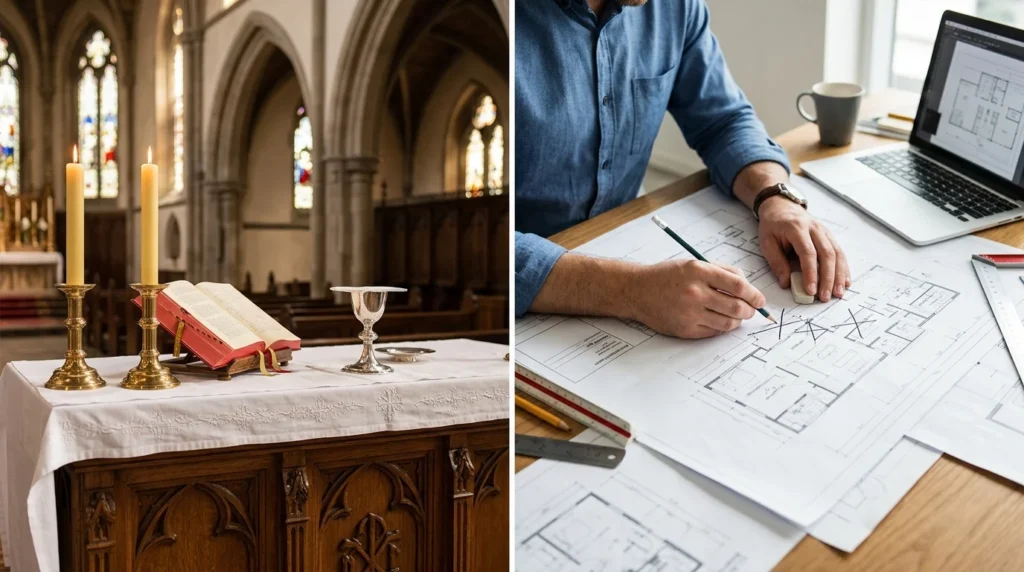

Altar and alter sound alike in many varieties of English, but they have completely different meanings and grammatical roles. Altar is a noun referring to a sacred table, structure, or place used in religious ceremonies. Alter is a verb meaning to change, modify, or make something different.
Quick Answer
Altar is a noun for a sacred table or structure used in religious ceremonies, while alter is a verb meaning “to change or modify something.” For example, “The couple stood before the altar” uses the noun correctly, while “We need to alter the schedule” uses the verb correctly. The two words are pronounced the same in many varieties of English, so their meaning and grammatical role provide the main clue.
What Is the Difference Between Altar and Alter?
The difference is simple: altar names a thing, while alter describes an action.
An altar is a structure with a flat top, often resembling a table, that is used in religious ceremonies or as a focus for religious objects. The word commonly appears in contexts involving churches, temples, worship, rituals, offerings, and weddings. It is a noun.
Alter means to change something, usually by modifying its appearance, characteristics, structure, condition, or arrangement. It can be used for physical things, plans, opinions, schedules, clothing, documents, and many other subjects. It is a verb.
The easiest distinction is:
- Altar = a religious structure or place.
- Alter = to change or modify.
Why Altar vs Alter Matters
These words are easy to confuse because they look almost identical and can sound identical. A spelling mistake can completely change the meaning of a sentence.
For example, consider this sentence:
“The couple stood before the alter.”
The intended word is almost certainly altar, because the sentence refers to a wedding location. Writing alter changes the sentence into something that does not make grammatical or semantic sense in that context.
The reverse mistake is equally confusing:
“We need to altar the schedule.”
The correct word is alter because the sentence describes an action: changing the schedule.
Using the right spelling matters in emails, school assignments, workplace documents, articles, social media posts, and formal writing because readers rely on context and spelling to understand exactly what you mean.
The Core Rule
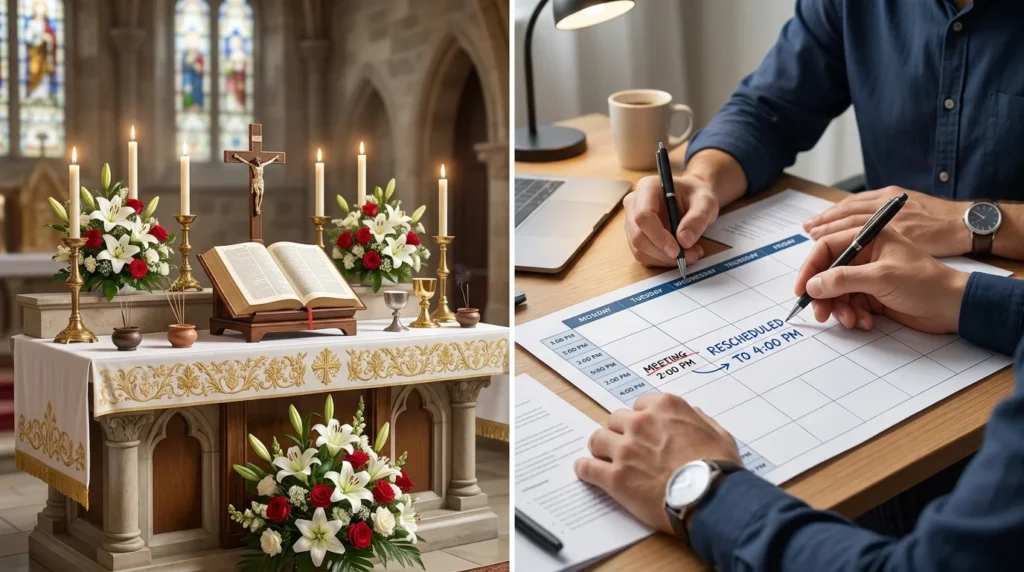
Use altar when you mean a sacred table, platform, or structure associated with religious ceremonies. Use alter when you mean to change or modify something.
| Word | Part of Speech | Basic Meaning |
|---|---|---|
| altar | Noun | A sacred table, structure, or place used in religious ceremonies |
| alter | Verb | To change, modify, or make something different |
A useful memory trick is:
Altar has “altar” as a place you might find in a church. Alter has “alter” as an action you take when you change something.
How to Use Altar
Altar is a countable noun. It refers to a physical structure or designated place associated with religious ceremonies. It can appear with articles and other determiners such as the, an, this, or the church’s.
For example:
- The priest stood beside the altar.
- Flowers decorated the altar.
- The ancient temple contained several altars.
- The couple exchanged vows at the altar.
The plural form is altars.
The word can also occur in familiar expressions related to marriage. For example, go to the altar, lead someone to the altar, and leave someone at the altar are established expressions, especially in discussions of marriage.
How to Use Alter
Alter is a verb meaning to change something or cause something to become different. The change may be small or significant, depending on the context.
You can alter:
- a plan
- a schedule
- a document
- a design
- a piece of clothing
- an opinion
- a route
- a building
- a decision
- your appearance
For example, “We had to alter our plans” means that the plans had to be changed. Similarly, “The tailor altered my jacket” means the tailor changed the jacket, usually to improve its fit.
The related noun is alteration, meaning a change or modification. For example, “The designer made several alterations to the dress.”
See Also: Every Person or Every People: What Is the Difference?
Correct Examples of Altar and Alter
1. Conversation
“The church has a beautiful wooden altar.”
“We may need to alter our plans if the weather gets worse.”
2. Wedding
“The couple stood together at the altar.”
3. Email
“Please let me know if you want to alter the proposed meeting time.”
4. Workplace
“The company decided to alter its schedule for the holiday.”
5. School Writing
“The ancient people built an altar for religious ceremonies.”
6. Academic Writing
“The discovery may alter our understanding of the historical site.”
7. Social Media
“The old temple still has an impressive stone altar.”
8. Clothing
“The tailor will alter the sleeves before the event.”
9. Planning
“We had to alter the travel route because the road was closed.”
10. Religious Context
“Candles were placed around the altar before the ceremony began.”
11. Professional Report
“The new evidence could alter the recommendations in the report.”
12. Everyday English
“I don’t want to alter the recipe too much.”
Incorrect vs. Correct: Altar and Alter
| ❌ Incorrect | ✅ Correct | Why |
|---|---|---|
| The couple stood before the alter. | The couple stood before the altar. | The sentence refers to the sacred structure associated with a wedding. |
| We need to altar the schedule. | We need to alter the schedule. | The sentence needs a verb meaning “change.” |
| The priest approached the alter. | The priest approached the altar. | The word refers to a religious structure. |
| They decided to altar the design. | They decided to alter the design. | “Alter” is the verb meaning “modify.” |
| Flowers were placed on the alter. | Flowers were placed on the altar. | The sentence describes a religious object or structure. |
| The company will altar its policy. | The company will alter its policy. | The policy is being changed, so the verb “alter” is required. |
| The ancient alter was made of stone. | The ancient altar was made of stone. | The word is a noun referring to a religious structure. |
| She asked the tailor to altar her dress. | She asked the tailor to alter her dress. | The tailor is being asked to modify the dress. |
| The ceremony took place beside the alter. | The ceremony took place beside the altar. | The context is religious, so “altar” is needed. |
| The new information may altar our conclusion. | The new information may alter our conclusion. | The conclusion may be changed, so “alter” is the correct verb. |
| They decorated the alter with flowers. | They decorated the altar with flowers. | The sentence refers to a religious structure. |
| We should altar the proposal. | We should alter the proposal. | The proposal needs to be modified. |
Why People Confuse Altar and Alter
The main reason for the confusion is that altar and alter are extremely similar in spelling and pronunciation. In many varieties of English, they are pronounced alike, making them homophones: words that sound the same but have different meanings and spellings. Cambridge gives the same US pronunciation for both words, while their meanings and grammatical roles remain different.
Because you cannot always hear the difference, writers must rely on meaning and spelling.
Similar Spelling
Both words begin with alt- and differ by only one letter. That makes a typing mistake easy, particularly when writing quickly.
Similar Pronunciation
In many forms of English, the words are pronounced the same or very similarly. That means listening alone may not tell you which spelling to use.
Autocomplete and Spellcheck
Spellcheck tools can detect many spelling errors, but they cannot always determine whether altar or alter fits the intended meaning. Both are legitimate English words, so a correctly spelled but contextually wrong word may pass a basic spelling check.
Overgeneralization
A learner may remember that both words sound like “awl-ter” and assume they are different spellings of the same word. They are not. Their meanings and grammatical functions are different.
Translation Interference
Learners who speak another language may also confuse the words when their first language uses one word or expression for concepts that English separates into different forms. Learning the meaning and grammatical role of each English word is more reliable than translating them mechanically.
Common Mistakes Checklist
- Using alter for a religious structure: Remember that a religious altar is a noun.
- Using altar for an action: If you mean “change,” use the verb alter.
- Choosing based only on pronunciation: The words may sound identical, so use the sentence’s meaning.
- Trusting spellcheck completely: Both altar and alter are correctly spelled English words.
- Forgetting the part of speech: Altar is a noun; alter is primarily a verb.
- Confusing wedding language: A couple stands at or goes to the altar, not the alter.
- Writing “alter the plan” incorrectly: When something needs to be changed, the correct verb is alter.
Altar vs. Alter in Real English
Altar in Natural Everyday English
Altar is grammatically correct and natural when discussing religious ceremonies, places of worship, historical rituals, or marriage expressions such as “at the altar.” It is not normally used as a general synonym for a table. The meaning is connected to religious or ceremonial use. In ordinary conversation, speakers generally choose altar only when that specific context is intended.
Alter in Natural Everyday English
Alter is a normal and widely used verb for talking about changes or modifications. It works naturally with plans, schedules, clothing, designs, documents, opinions, routes, and many abstract ideas. For example, “We need to alter the schedule” sounds completely natural. The word can describe either relatively small modifications or more substantial changes depending on context.
Why “Alter” Cannot Replace “Altar”
Although the two words sound similar, they do not belong to the same grammatical category in their ordinary uses. Altar identifies a thing, while alter describes an action. Saying “They stood before the alter” does not simply use an alternative spelling; it substitutes a verb for the noun required by the sentence.
American vs. British English
There is no major American-versus-British spelling distinction between altar and alter. The same spellings are used in both varieties. The words can have somewhat different pronunciation details across accents, but the core distinction in meaning and spelling remains the same. Cambridge lists both words in American and British pronunciation forms.
Formal vs. Informal Usage
Both altar and alter are standard English words and can be used in formal and informal writing. There is no need to choose one spelling based on formality. The important issue is meaning: use altar for the religious or ceremonial noun and alter for the verb meaning “change.”
Altar vs. Alter Comparison Table
| Feature | Altar | Alter |
|---|---|---|
| Part of speech | Noun | Verb |
| Basic meaning | A sacred table, structure, or place | To change or modify |
| Common context | Religion, worship, ceremonies, weddings | Plans, designs, clothing, opinions, schedules |
| Plural/related form | Altars | Altered, altering, alteration |
| Example | They stood at the altar. | We need to alter the plan. |
| Can it mean “change”? | No | Yes |
| Can it refer to a religious structure? | Yes | No |
Real-Life Situations
In an Interview
“The new evidence could alter the way the company approaches the problem.”
Here, alter means change. The sentence is discussing an action or effect, not a religious structure.
In a Meeting
“Should we alter the timeline before sending the proposal?”
Again, alter is the correct verb because the timeline may be changed.
In an Email
“Please tell me if you would like to alter any part of the document.”
The word refers to modifying the document.
In a Text Message
“We might have to alter our plans tonight.”
This is a natural everyday use of alter.
In an Exam
“The couple exchanged their vows at the altar.”
Because the sentence refers to a wedding setting, altar is the correct noun.
In Historical Writing
“Archaeologists discovered an ancient stone altar at the site.”
Here, altar refers to a physical structure connected with religious practice.
How to Remember Altar vs. Alter

Use this simple two-question test:
- Am I talking about a sacred structure or religious place? Use altar.
- Am I talking about changing or modifying something? Use alter.
You can also remember the sentence pair:
“The couple stood at the altar, but they had to alter their plans.”
The first altar is a thing. The second alter is an action.
Quick Practice: Choose Altar or Alter
- The wedding ceremony took place at the ______.
- We may need to ______ the schedule.
- The priest stood beside the ______.
- The designer decided to ______ the original plan.
- Flowers were placed on the ______.
- The company may ______ its policies.
- The ancient temple contained a stone ______.
- She asked the tailor to ______ her dress.
Answers: 1. altar, 2. alter, 3. altar, 4. alter, 5. altar, 6. alter, 7. altar, 8. alter.
Frequently Asked Questions
Is altar or alter correct?
Both are correct English words, but they have different meanings. Altar is a noun referring to a sacred structure or place used in religious ceremonies. Alter is a verb meaning to change or modify something.
What is the easiest way to remember altar vs. alter?
Remember that altar is the religious noun, while alter is the action of changing something. A useful sentence is: “They stood at the altar and decided to alter their plans.”
Are altar and alter pronounced the same?
They are pronounced the same in many varieties of English. For example, Cambridge gives the same US pronunciation for both words. This is why their spelling and meaning are especially important when writing.
Is altar a noun or a verb?
Altar is a noun in its standard modern use. It refers to a structure or place associated with religious ceremonies.
Is alter a noun or a verb?
Alter is primarily a verb meaning “to change” or “to modify.” Its related noun is alteration.
Is it “at the altar” or “at the alter”?
The correct expression is “at the altar.” In wedding contexts, the altar refers to the religious or ceremonial structure where the couple traditionally stands during the ceremony.
Is it “alter the plan” or “altar the plan”?
The correct expression is “alter the plan.” The verb alter means to change or modify something, so it is the appropriate word when discussing a plan.
What is the plural of altar?
The plural of altar is altars. For example: “The temple contained several ancient altars.”
What is the noun form of alter?
The common related noun is alteration, which means a change or modification. For example: “The designer made several alterations to the dress.”
Can spellcheck tell the difference between altar and alter?
Not reliably. Because both altar and alter are correctly spelled English words, a basic spellchecker may not identify a contextually incorrect choice. Meaning and sentence context are essential.
Does altar only refer to Christian churches?
No. An altar can refer to a structure used in religious ceremonies in different traditions. The word is not limited to Christianity, although it is also commonly associated with Christian churches and wedding expressions.
Quick Summary
Altar and alter are different words with different meanings. Altar is a noun that refers to a sacred table, structure, or ceremonial place used in religious contexts. Alter is a verb meaning to change or modify something. The words sound the same in many varieties of English, which makes them easy to confuse in writing. Use altar when talking about a religious structure, such as in “They stood at the altar.” Use alter when describing a change, as in “We need to alter the schedule.” The simplest memory rule is: altar is a thing; alter is an action.
See Also: Manipulate Meaning: Definition, Psychology & Examples