
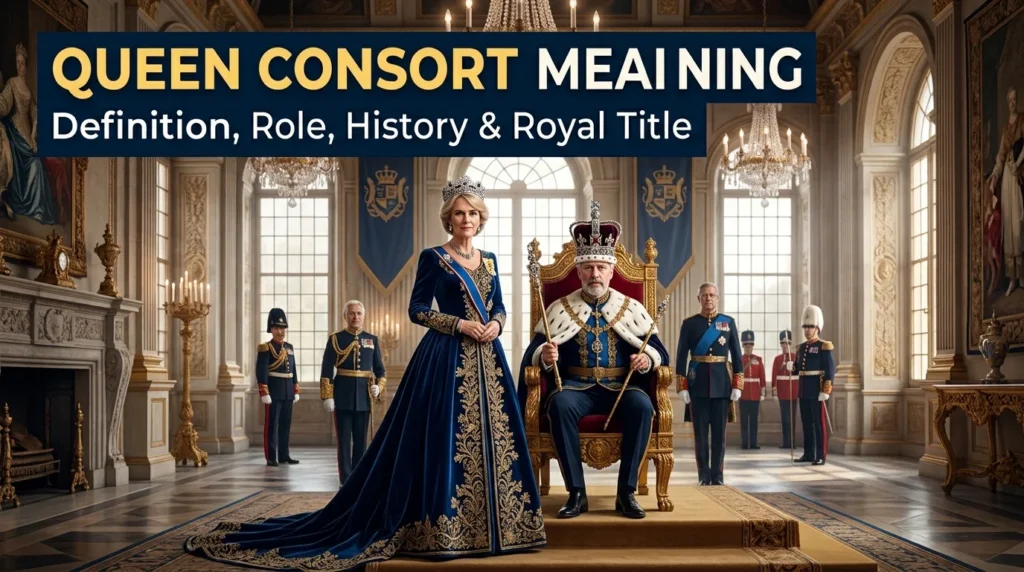

Royal titles often sound similar, but they do not always mean the same thing. One title that frequently causes confusion is Queen Consort. Many people hear the term during royal ceremonies, coronations, or news about the British Royal Family and wonder what it actually means. Does a queen consort rule a country? Is she the same as a queen? Why isn’t she called the monarch? These are some of the most common questions people ask when searching for queen consort meaning, queen consort meaning in English, or what is a queen consort.
Understanding this royal title is easier than it may seem. A queen consort is closely connected to the reigning king, but her position, authority, and responsibilities are different from those of a reigning queen. Throughout history, queen consorts have played important ceremonial, cultural, and charitable roles in monarchies around the world. This guide explains the meaning of queen consort in simple English, explores its historical background, and shows how the title is used in modern monarchies with clear explanations and practical examples.
Meaning & Definition
The queen consort meaning refers to the wife of a reigning king. She receives the title of queen because of her marriage to the monarch, not because she inherits or rules the throne herself. In most constitutional and historical monarchies, a queen consort supports the king in official duties, represents the royal family at public events, and participates in ceremonial occasions. Although she carries the title of queen, she is not the sovereign ruler of the nation.
It is important to understand that a queen consort does not possess the same constitutional authority as a reigning monarch. Her title reflects her royal status through marriage rather than political power. In simple words, if a king is the head of the monarchy, his wife is generally known as the queen consort. This distinction helps explain why the title is different from Queen Regnant, who becomes queen through inheritance and rules in her own right.
Background
The title Queen Consort has existed for centuries and has been part of many royal traditions across Europe and other monarchies. Historically, the wife of a reigning king was given the title to recognize her position within the royal household and her role in supporting the monarch. While customs have changed over time, the purpose of the title has remained largely the same—to identify the king’s spouse without granting her sovereign authority over the kingdom.
Throughout history, queen consorts have influenced culture, education, diplomacy, charity, and public life. Although they did not usually make laws or govern the country, many became respected public figures because of their dedication to social causes and their support of the monarchy. Modern constitutional monarchies continue to use the title, making it one of the most recognized royal titles in the world today.
Usage in Different Contexts
The term Queen Consort appears in many different contexts, including history books, royal news, documentaries, educational materials, and discussions about constitutional monarchies. Whenever a reigning king is married, his wife is generally referred to as the queen consort. News organizations often use the title during coronations, state ceremonies, royal tours, and official public engagements to distinguish her role from that of the reigning monarch.
The title is also common in academic discussions about monarchy, royal succession, and political history. Teachers and historians use it to explain the structure of royal families and the difference between inherited authority and ceremonial status. Because the title carries historical and constitutional significance, understanding its meaning helps readers interpret royal events more accurately and appreciate how monarchies function in different countries.
Queen Consort Meaning in English
If you are searching for queen consort meaning in English, the simplest explanation is the wife of a king who is currently reigning. She becomes queen through marriage rather than inheritance and does not become the country’s ruling monarch. The word consort simply means a spouse, particularly the husband or wife of a monarch. Together, the phrase queen consort describes the female spouse of the king.
In modern English, the term is commonly used in newspapers, documentaries, history books, educational websites, and discussions about royal families. While the queen consort often participates in public ceremonies, charitable work, and official engagements, her constitutional role is different from that of the sovereign ruler. Understanding this distinction helps English learners and readers interpret royal titles correctly.
What Is a Queen Consort?
Many people ask, what is a queen consort? A queen consort is the woman who holds the title of queen because she is married to the reigning king. She shares the king’s royal status but does not automatically receive the power to govern the country. Instead, her responsibilities usually involve supporting the monarch, representing the royal family, attending official events, promoting charitable organizations, and preserving royal traditions.
A queen consort is often one of the most recognizable members of a royal family because of her public appearances and ceremonial duties. Although she may influence society through charity work, education, healthcare, and cultural initiatives, she does not normally exercise the constitutional powers reserved for the reigning monarch. This distinction is one of the defining characteristics of the title.
What Does Queen Consort Mean?
If you’re wondering what does queen consort mean, the answer is straightforward. The title means the queen who is married to the king, rather than a queen who inherited the throne. Her royal title comes from her marriage, while the king’s authority comes from succession or another constitutional process recognized by the monarchy. This difference explains why a queen consort is respected as a senior royal but is not considered the sovereign.
For example, when a prince becomes king, his wife may become the queen consort. She accompanies the king during official ceremonies, welcomes visiting leaders, supports charitable causes, and represents the monarchy at national and international events. Although she carries the title of queen, the nation’s constitutional authority remains with the reigning monarch. Understanding this distinction helps explain one of the most commonly misunderstood titles in royal history.
Queen Consort Meaning with Examples
The easiest way to understand the queen consort meaning is by looking at real-life examples. A queen consort is always the wife of the reigning king and receives her royal title through marriage rather than inheritance. She supports the monarch during official duties, attends state ceremonies, participates in royal tours, and often becomes involved in charitable organizations. Although she is addressed as “Queen,” she does not become the sovereign ruler of the country.
Here are a few simple examples:
- The queen consort accompanied the king during the state visit.
- She became queen consort after her husband was crowned king.
- The queen consort welcomed foreign leaders at the royal palace.
- Her charitable work made her one of the most respected queen consorts in modern history.
- The queen consort attended the coronation ceremony beside the king.
These examples show that the title describes a royal spouse rather than a reigning monarch.
Queen Consort Meaning and Pronunciation
Many English learners search for queen consort meaning and pronunciation because the word consort is unfamiliar. The correct pronunciation is QUEEN KON-sort, with the stress placed on the first syllable of consort.
Pronunciation: /ˌkwiːn ˈkɒn.sɔːrt/ (British English)
The word consort means spouse or partner, especially the husband or wife of a monarch. Therefore, Queen Consort literally means the wife of the reigning king. Once you understand the meaning of consort, the complete royal title becomes much easier to remember and use correctly.
Queen Consort Meaning in Monarchy
In a monarchy, the queen consort plays an important ceremonial and symbolic role. She supports the reigning king by attending official engagements, representing the royal family at public events, and promoting charitable causes. Although she is one of the highest-ranking members of the royal household, she does not inherit the throne or exercise sovereign authority.
Modern constitutional monarchies clearly distinguish between the reigning monarch and the queen consort. While the king performs constitutional duties as the head of state, the queen consort focuses on public service, cultural events, diplomacy, and supporting national organizations. This separation helps preserve the constitutional structure of the monarchy.
Queen Consort Meaning in History
Throughout history, queen consorts have played significant roles in shaping royal families and influencing society. Although most did not govern directly, many became trusted advisers, patrons of education, supporters of the arts, and leaders of charitable initiatives. Their influence often extended beyond palace walls through diplomacy, humanitarian work, and cultural development.
In European monarchies, the title of queen consort became an established tradition that recognized the wife of the reigning king without granting her sovereign power. Historical records show that many queen consorts earned respect through wisdom, public service, and dedication to their people, even though constitutional authority remained with the king.
Queen Consort Meaning in Royal Family
Within a royal family, the queen consort is one of the most senior and respected members. She supports the king during official ceremonies, welcomes visiting dignitaries, participates in royal celebrations, and represents the monarchy at important national events. Her presence symbolizes continuity, stability, and support for the reigning monarch.
The queen consort also serves as a role model through charity work, community engagement, and public appearances. Although she is not the head of the royal family, she often becomes one of its most recognizable and admired figures because of her commitment to public service and royal traditions.
Queen Consort Meaning in a Sentence
Learning the word through sentences makes it easier to understand and remember. Below are several examples that demonstrate the correct use of queen consort in different situations.
- The queen consort attended the coronation beside the king.
- She became queen consort after marrying the reigning monarch.
- The queen consort visited children’s hospitals during the royal tour.
- Historians studied the influence of the queen consort on the royal court.
- The queen consort represented the royal family at the national celebration.
- Her role as queen consort focused on service rather than political authority.
These examples show that the title is always connected with the wife of a reigning king.
Queen Consort Duties and Responsibilities

The queen consort duties and responsibilities vary from one monarchy to another, but they are generally ceremonial, charitable, and representative rather than political. A queen consort attends state banquets, welcomes foreign leaders, supports national charities, participates in cultural events, and accompanies the king during important public engagements. She also helps strengthen the image of the monarchy through community service and public outreach.
In modern monarchies, many queen consorts become patrons of hospitals, educational institutions, environmental organizations, and humanitarian projects. Their work often focuses on improving society while representing the values and traditions of the royal family. Although they do not make government decisions, their public influence can inspire positive social change.
Queen Consort Title Explained
The queen consort title exists to identify the wife of the reigning king while clearly distinguishing her from a reigning queen. The word queen reflects her royal status, while consort explains that her position comes through marriage rather than inheritance. This distinction prevents confusion between a queen who rules and a queen who supports the monarch.
The title has been used for centuries in many monarchies and remains an important part of royal protocol today. It reflects tradition, constitutional practice, and the structure of hereditary monarchies. Understanding this title helps readers better understand royal ceremonies, coronations, and historical events.
Queen Consort vs Queen Regnant
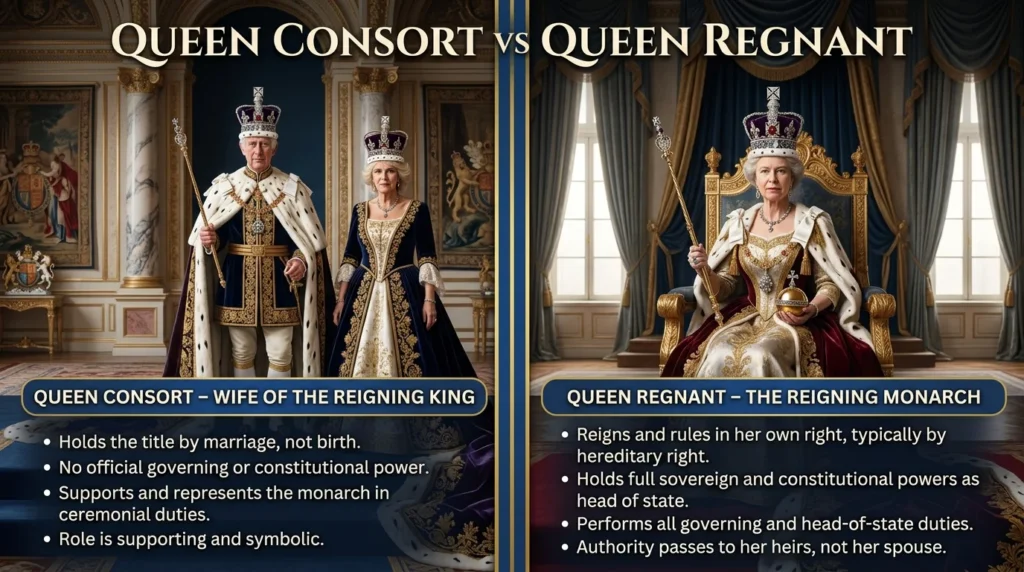
The difference between a queen consort and a queen regnant is one of the most important concepts in royal history. A queen consort becomes queen by marrying the reigning king and supports him in ceremonial and public duties. She does not inherit the throne and is not the sovereign ruler.
A queen regnant, however, inherits or legally succeeds to the throne and rules the kingdom in her own right. She possesses the same constitutional authority as a king. In simple terms, a queen consort is the king’s wife, while a queen regnant is the monarch herself. Understanding this distinction removes one of the biggest misconceptions surrounding royal titles.
Can a Queen Consort Rule a Country?
One of the most common questions people ask is whether a queen consort can rule a country. In most constitutional and hereditary monarchies, the answer is no. A queen consort receives her title through marriage to the reigning king, not through inheritance or succession. Because of this, she does not automatically receive the constitutional powers of the monarch, such as approving laws, appointing governments, or acting as the official head of state.
However, history includes rare situations where a queen consort acted as a regent. A regent temporarily performs the monarch’s duties when the king is too young, absent, or unable to rule. Even in these cases, the queen consort governs only on behalf of the monarch and does not become the sovereign ruler. This distinction is essential for understanding how modern monarchies operate.
What Happens if the King Dies?
Many people wonder what happens to a queen consort when the reigning king dies. In most monarchies, she does not inherit the throne. Instead, the next eligible heir—usually the king’s eldest child or the person next in the line of succession—becomes the new monarch according to the country’s succession laws.
After the king’s death, the former queen consort may continue to perform ceremonial duties or may receive a different royal title, depending on the traditions of that monarchy. In some royal families, she may later be referred to as the Queen Dowager if the title is officially recognized. Although her status remains highly respected, the authority of the monarchy passes to the rightful successor rather than to the queen consort.
Famous Queen Consorts in History
History has been shaped by many remarkable queen consorts who supported their monarchs while making meaningful contributions to society. Although they were not sovereign rulers, many became influential through charity work, diplomacy, education, healthcare, and cultural development. Their dedication helped strengthen public trust in the monarchy and left lasting historical legacies.
Several queen consorts are remembered for promoting social reforms, supporting the arts, encouraging education, and representing their countries with dignity during important historical events. Their stories demonstrate that influence does not always require political power. Through compassion, leadership, and public service, many queen consorts earned admiration that extended far beyond the royal court.
Common Misconceptions About a Queen Consort
A common misunderstanding is that every woman called Queen automatically rules a country. In reality, a queen consort does not become the monarch simply because she holds the title of queen. Her position comes through marriage to the reigning king, while the constitutional authority remains with the sovereign.
Another misconception is that a queen consort has no responsibilities. Although she does not govern the nation, she often carries out an extensive schedule of public engagements, charity work, cultural initiatives, diplomatic events, and royal ceremonies. Her contributions help support the monarchy and strengthen its relationship with the public.
Related Royal Terms
Understanding a few related royal terms makes the meaning of queen consort even clearer.
- King – The reigning male monarch.
- Queen Regnant – A queen who rules in her own right.
- Queen Dowager – The widow of a deceased king.
- Prince Consort – The husband of a reigning queen.
- Monarchy – A system of government led by a monarch.
- Crown – A symbol of royal authority.
- Succession – The process of inheriting the throne.
- Coronation – The official ceremony in which a monarch is crowned.
- Royal Family – The family members of the reigning monarch.
- Royal Household – The organization that supports the monarch and senior royals.
Learning these terms helps you better understand books, documentaries, news reports, and discussions about royal history.
Frequently Asked Questions
What is a queen consort?
A queen consort is the wife of the reigning king. She receives the title of queen through marriage but does not rule the country in her own right.
What does queen consort mean?
Queen consort means the female spouse of a reigning king. Her title reflects her royal status through marriage rather than inheritance.
What is the difference between a queen consort and a queen regnant?
A queen consort is married to the king, while a queen regnant inherits the throne and rules as the monarch.
Does a queen consort have political power?
In most modern monarchies, a queen consort does not have constitutional or political authority. Her role is mainly ceremonial, representative, and charitable.
Can a queen consort inherit the throne?
No. The throne passes according to the country’s succession laws, not through the queen consort.
Why is it called queen consort?
The word consort means spouse. Therefore, queen consort simply means the wife or spouse of the reigning king.
What are the duties of a queen consort?
Her duties usually include attending royal ceremonies, supporting charitable organizations, representing the royal family, welcoming foreign dignitaries, and accompanying the king during official engagements.
How do you pronounce queen consort?
It is commonly pronounced as Queen KON-sort.
Can a queen consort become queen regnant?
No. A queen regnant becomes monarch through inheritance or legal succession, not through marriage.
How do you use queen consort in a sentence?
Example: The queen consort accompanied the king during the official state visit and attended several charitable events.
Conclusion
Understanding the queen consort meaning helps explain one of the most important titles in a monarchy. A queen consort is the wife of the reigning king, and although she shares the royal title of queen, she does not become the sovereign ruler. Her responsibilities usually focus on public service, ceremonial duties, charity work, diplomacy, and representing the royal family. Knowing the difference between a queen consort and a queen regnant makes it much easier to understand royal history, constitutional monarchies, and modern royal traditions.
If you enjoy learning about English vocabulary, historical terms, royal titles, internet slang, abbreviations, and commonly searched word meanings, Trendy Meaning is the perfect place to continue exploring. Every guide is written in simple, reader-friendly English with practical examples and detailed explanations, making it easier to understand even complex terms. Whenever you want to discover the meaning of a new word or phrase, visit Trendy Meaning for clear, reliable, and easy-to-read content.
See Also:
Downing Meaning: Definition, Uses, Examples & Pronunciation
Proactive Meaning Explained with Examples & Uses
Dichotomy Meaning: Definition, Examples & Simple Explanation