
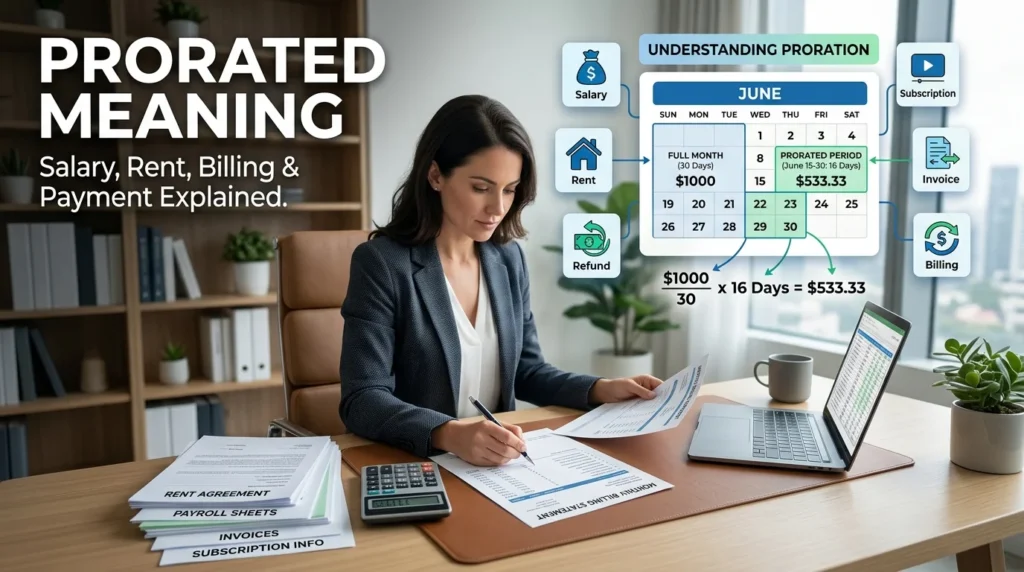

Have you ever looked at a bill, salary slip, rent agreement, or subscription invoice and noticed the word prorated? If so, you may have wondered what it actually means and why the amount is different from the full price. This financial term appears in everyday situations, especially when a service, payment, or contract starts or ends in the middle of a billing period. Understanding the prorated meaning can help you avoid confusion and make smarter financial decisions.
Whether you’re starting a new job, moving into a rental property, subscribing to an online service, or reviewing an invoice, knowing how prorated amounts work is extremely useful. In this guide, you’ll learn the prorated meaning in English, how it is used in salary, rent, billing, and payments, along with simple explanations, practical examples, and real-life scenarios that make the concept easy to understand.
Meaning & Definition
The prorated meaning refers to calculating or adjusting an amount based on the portion of time, service, or usage involved instead of charging or paying the full amount. In simple words, if you use only part of a service or work only part of a pay period, you pay or receive only the amount that corresponds to that portion rather than the complete charge.
The term is widely used in finance, accounting, payroll, subscriptions, insurance, rent, and utility billing. For example, if a monthly subscription costs $30 but you begin using it halfway through the month, you may only be charged about $15 as a prorated amount. This ensures that payments remain fair and accurately reflect the actual period of use.
Background
The concept of proration has existed for many years in accounting and financial management. Businesses, landlords, employers, and service providers use prorated calculations to divide costs fairly whenever a full billing cycle or contract period is not completed. Instead of charging everyone the same amount regardless of usage, proration adjusts the payment according to the actual time or service received.
Today, prorated calculations are common across many industries. Companies use them for employee salaries, rental agreements, streaming subscriptions, insurance premiums, internet services, mobile phone plans, and utility bills. As modern billing systems have become more flexible, prorated payments have become a standard practice that helps both businesses and customers avoid overpaying or underpaying.
Usage in Different Contexts
The word prorated can appear in many different financial and business situations. Employers may use it when calculating a new employee’s first paycheck, landlords often apply it to rent when a tenant moves in during the middle of the month, and subscription companies use prorated billing when customers upgrade or downgrade their plans before the billing cycle ends.
You may also see prorated amounts on invoices, utility bills, insurance policies, tuition fees, and service contracts. Although the situations vary, the meaning remains the same: the amount is adjusted according to the portion of time, usage, or service involved. Understanding this common principle makes financial documents much easier to interpret.
Prorated Meaning in English
If you’re searching for the prorated meaning in English, the simplest explanation is calculated proportionally based on time, usage, or quantity. Rather than paying or receiving the full amount, only the appropriate portion is calculated. This makes the payment fair for both the customer and the service provider.
In everyday English, the word is commonly used in workplaces, rental agreements, banking, accounting, payroll, billing systems, and subscription services. Whenever a payment is adjusted because a full period was not completed, it is usually described as a prorated payment, prorated charge, or prorated amount.
What Does Prorated Mean?
Many people ask, what does prorated mean? Simply put, it means dividing a payment, charge, refund, or salary according to the exact amount of time or service used. Instead of paying the complete price, you only pay for the portion that applies to you. This calculation ensures fairness and accuracy in financial transactions.
For example, imagine your monthly rent is $1,200, but you move into your apartment halfway through the month. Instead of paying the full month’s rent, the landlord calculates a prorated rent, meaning you pay only for the days you actually lived in the property. The same principle applies to salaries, subscriptions, insurance premiums, utility bills, and many other financial situations.
Prorated Meaning in Salary

The prorated meaning in salary refers to paying an employee based on the actual number of days or hours they worked instead of the full salary for the pay period. This commonly happens when someone joins a company after the payroll cycle has started, leaves before the end of the month, or works part-time instead of full-time. Rather than paying the complete monthly salary, employers calculate only the amount the employee has earned.
For example, imagine an employee’s monthly salary is $3,000, but they start work on the 16th of a 30-day month. Since they worked only half the month, their employer may calculate a prorated salary of approximately $1,500 before taxes and deductions. This approach ensures that both the employer and employee are treated fairly based on the actual period worked.
Prorated Meaning in Rent
The prorated meaning in rent describes paying rent only for the days you actually occupy a rental property instead of paying for an entire month. Landlords frequently use prorated rent when tenants move in or move out during the middle of a month. This prevents tenants from paying for days when they did not live in the property.
For instance, if your monthly rent is $1,200 and you move into the apartment on the 16th of a 30-day month, the landlord calculates the daily rental rate and charges only for the remaining 15 days. Prorated rent is considered a fair and standard practice in residential and commercial lease agreements.
Prorated Meaning in Billing
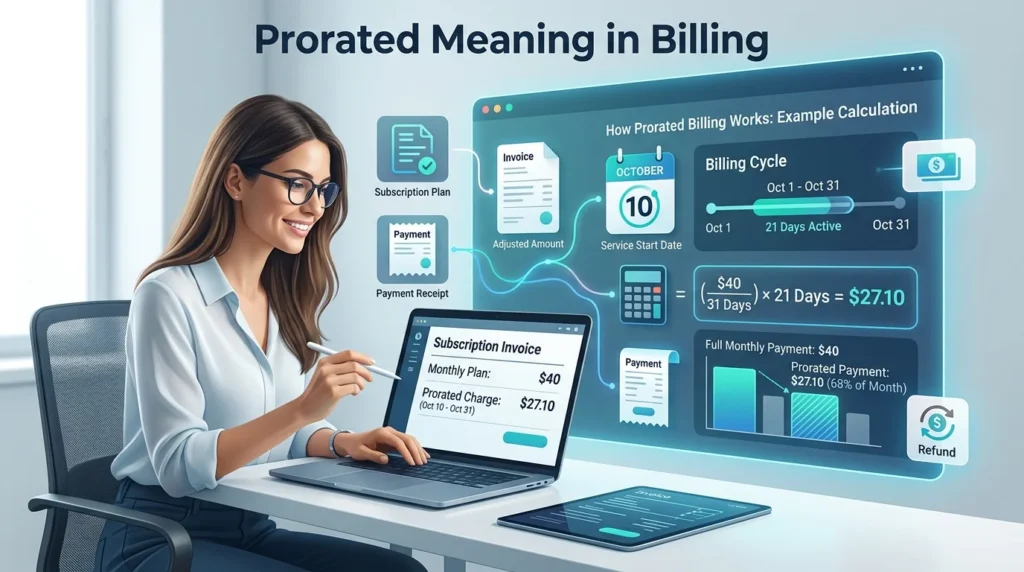
The prorated meaning in billing refers to adjusting charges according to the amount of time or service a customer actually uses. Companies that offer internet services, mobile phone plans, streaming subscriptions, cloud software, and membership programs often apply prorated billing when customers activate, upgrade, downgrade, or cancel services during a billing cycle.
For example, if you subscribe to an online service halfway through the month, you may only be billed for the remaining days instead of paying the full monthly fee. Likewise, upgrading a subscription plan may result in a prorated charge that reflects only the additional cost for the unused portion of the billing period.
Prorated Meaning with Examples
Understanding the prorated meaning becomes much easier when you look at practical examples. The idea is always the same: the amount is adjusted based on actual usage or time instead of charging or paying the full amount. This method ensures fairness in financial transactions across different situations.
Here are a few common examples:
- An employee receives a prorated salary after joining the company in the middle of the month.
- A tenant pays prorated rent after moving into an apartment on the 20th of the month.
- A customer receives a prorated refund after canceling a yearly subscription early.
- A software company charges a prorated amount when a customer upgrades their plan before the next billing date.
- A utility provider calculates a prorated bill when service begins after the normal billing cycle has started.
These examples show how proration is used in everyday financial situations.
Prorated Meaning and Pronunciation
Many English learners search for prorated meaning and pronunciation because the word is often seen in contracts, invoices, and payroll documents. The correct pronunciation is pro-RAY-ted.
Pronunciation: /proʊˈreɪ.tɪd/
The word comes from pro rata, a Latin phrase meaning in proportion. In modern English, prorated simply means calculated proportionally according to time, usage, quantity, or another measurable factor. Once you understand this basic concept, the word becomes much easier to recognize in financial and business documents.
Prorated Meaning in a Sentence
Using the word in sentences is one of the easiest ways to remember its meaning and apply it correctly in everyday English. Since prorated is mainly used in financial and workplace contexts, it often appears in discussions about salaries, billing, rent, subscriptions, and refunds.
Examples:
- My first paycheck was prorated because I started work halfway through the month.
- The landlord charged a prorated rent for the remaining days of the month.
- We received a prorated refund after canceling the annual membership.
- The phone company applied a prorated billing adjustment to our invoice.
- The insurance provider calculated a prorated premium based on the policy start date.
- The customer paid only the prorated amount for the upgraded subscription.
Prorated Payment Meaning
A prorated payment is a payment that has been adjusted to match the exact portion of time, service, or usage rather than the full contract amount. Businesses use prorated payments to ensure customers and employees pay or receive only what is fair. This approach is common in payroll, rental agreements, insurance, tuition fees, memberships, and subscription-based services.
For example, if a gym membership costs $60 per month but you join halfway through the month, you might pay only $30 as a prorated payment. Instead of paying for days when you could not use the service, your payment reflects only the period during which you were actually a member.
Prorated Amount Meaning
The prorated amount is the final figure calculated after adjusting a payment according to the time or service used. It is not necessarily a discount; rather, it is a fair calculation based on proportional usage. Whether the amount increases or decreases depends on the specific situation and the terms of the agreement.
For instance, if an annual software subscription costs $240, and you upgrade your plan with six months remaining, the company may calculate a prorated amount for the remaining billing period instead of charging the full annual price again. This calculation keeps billing accurate and transparent for both businesses and customers.
How Is a Prorated Amount Calculated?
Understanding how a prorated amount is calculated makes the concept much easier to apply in real life. In most cases, businesses first determine the cost per day, hour, or billing unit and then multiply it by the number of days or units actually used. This method ensures that customers or employees pay only for the portion they received rather than the entire billing period.
For example, if your monthly internet plan costs $90 and the month has 30 days, the daily cost is $3. If you use the service for only 10 days, the prorated amount is $30. This simple calculation is commonly used for salaries, rent, subscriptions, insurance premiums, utility bills, and service contracts because it provides a fair and transparent payment structure.
Prorated vs. Pro Rata
Many people think prorated and pro rata are different, but they are closely related. Pro rata is a Latin phrase meaning “in proportion.” The word prorated is derived from this phrase and refers to the actual calculation or adjustment made according to that proportion.
For example, if you pay only for the days you use a service, the charge is prorated because it has been calculated pro rata. In everyday English, most businesses use the word prorated on invoices, payroll statements, rent agreements, and subscription bills because it is easier for customers to understand.
Prorated vs. Full Payment
The difference between a prorated payment and a full payment is simple. A full payment covers the entire billing period, contract term, or service regardless of how much of it you actually use. A prorated payment, however, is adjusted to reflect only the time or portion that applies to you.
For instance, if you rent an apartment from the first day of the month, you usually pay the full monthly rent. But if you move in halfway through the month, you normally pay only the prorated rent for the remaining days. This approach makes billing fair and prevents customers from paying for services they never received.
Advantages of Prorated Billing
Prorated billing offers several benefits for both businesses and customers. It creates fairness by ensuring that people pay only for the services, products, or time they actually use. This method also improves customer satisfaction because it eliminates unnecessary charges and provides greater billing transparency.
Businesses benefit as well because prorated billing simplifies account management when customers upgrade subscriptions, change plans, move into rental properties, or begin employment during a billing cycle. It reduces billing disputes and helps maintain trust by making payment calculations clear and accurate.
Common Mistakes About Prorated Payments
One common misconception is that a prorated amount is the same as a discount. In reality, prorating is not a promotional offer or price reduction. It is simply a proportional calculation based on time, usage, or service received. The amount may be lower than the full price, but that is because only part of the service was used.
Another mistake is assuming that every company calculates prorated charges in exactly the same way. Different employers, landlords, service providers, and subscription platforms may use different billing methods or formulas. Always review the contract or billing policy to understand how the prorated amount has been calculated.
Frequently Asked Questions
What does prorated mean?
Prorated means an amount has been adjusted according to the portion of time, service, or usage instead of charging or paying the full amount.
What is a prorated payment?
A prorated payment is a payment calculated proportionally based on the actual time or service used.
What is prorated salary?
Prorated salary is the amount an employee earns when they work only part of a pay period instead of the entire month or payroll cycle.
What is prorated rent?
Prorated rent is rent calculated for only the days a tenant occupies a rental property rather than the full month’s rent.
What is prorated billing?
Prorated billing adjusts charges when a customer starts, upgrades, downgrades, or cancels a service during the billing period.
How is a prorated amount calculated?
A prorated amount is usually calculated by determining the daily or hourly rate and multiplying it by the number of days or hours used.
Is prorated the same as pro rata?
Almost. Pro rata means “in proportion,” while prorated refers to an amount that has already been calculated using that proportional method.
Is prorated good or bad?
Prorated billing is generally beneficial because it ensures fairness. Customers pay only for what they actually use, while businesses receive accurate compensation.
How do you use prorated in a sentence?
Example: The company issued a prorated refund after I canceled my annual subscription before the renewal date.
Where is prorated commonly used?
Prorated calculations are commonly used in payroll, rent, subscriptions, insurance, utility bills, tuition fees, memberships, and service contracts.
Conclusion
Understanding the prorated meaning helps you make sense of many everyday financial situations. Whether you are reviewing a salary slip, paying rent, subscribing to an online service, or checking an invoice, a prorated amount simply means the payment has been adjusted according to the actual time, usage, or service involved. Instead of paying or receiving the full amount, the calculation is made proportionally to ensure fairness for everyone.
Now that you know what prorated means, how prorated payments are calculated, and where they are commonly used, you’ll be able to read contracts, bills, and payroll documents with greater confidence. If you’re looking for more easy-to-understand explanations of English words, financial terms, internet slang, abbreviations, and everyday vocabulary, Trendy Meaning is the perfect place to explore. Our guides are designed to make complex terms simple, practical, and easy for everyone to understand.
See Also:
Queen Consort Meaning: Definition, Role & Royal Title