

If you’ve searched for antonym meaning, you’re probably wondering what this important language term means and how it is used in English. Antonyms are an essential part of vocabulary because they help people understand differences between words and express ideas more clearly.
In simple terms, an antonym is a word that has the opposite meaning of another word. For example, “hot” is an antonym of “cold,” and “happy” is an antonym of “sad.”
In this guide, Trendy Meaning explains what does antonym mean, its definition, types, examples, origin, and common uses.
Meaning & Definition

The antonym meaning is a word that represents the opposite meaning of another word.
Common examples include:
- Big ↔ Small
- Fast ↔ Slow
- Good ↔ Bad
- Open ↔ Closed
- Love ↔ Hate
- Day ↔ Night
Antonyms help create contrast and make communication more effective.
Antonym Meaning in English
The antonym meaning in English is “a word with the opposite meaning of another word.”
Example:
“Hot” and “cold” are antonyms.
Meaning:
They describe opposite temperatures.
What Does Antonym Mean?
When people ask what does antonym mean, they usually want to know the opposite of a word.
An antonym is a vocabulary word that expresses a completely different or opposite idea. Writers, speakers, teachers, and students use antonyms to compare things, explain differences, and improve language skills.
For example:
“Light” and “dark” are antonyms because they represent opposite conditions.
Simple Explanation
Think of antonym as meaning:
- Opposite word
- Reverse meaning
- Contrasting word
- Word with opposite definition
- Opposite idea
Whenever two words have opposite meanings, they can be antonyms.
Antonym Definition With Examples
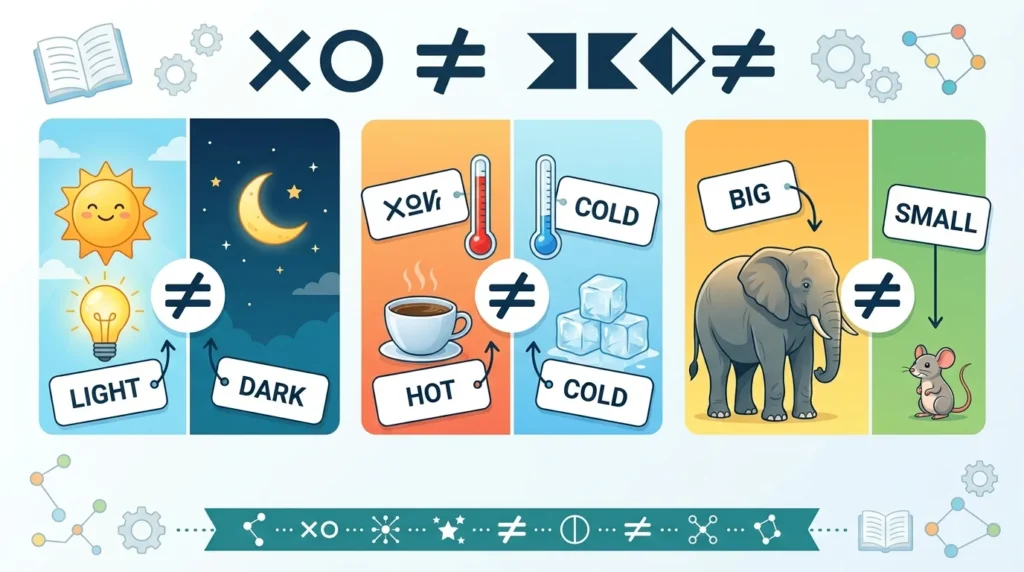
The antonym definition is a word that has a meaning opposite to another word.
Examples of Antonyms
Happy ↔ Sad
Happy means feeling joy, while sad means feeling unhappy.
Easy ↔ Difficult
Easy means simple, while difficult means hard.
Increase ↔ Decrease
Increase means becoming larger, while decrease means becoming smaller.
Accept ↔ Reject
Accept means to agree or receive, while reject means to refuse.
Background
Antonyms have been an important part of language development for centuries. Understanding opposite meanings helps people organize vocabulary and communicate ideas more accurately.
In education, antonyms are commonly taught to improve reading comprehension, writing ability, and vocabulary knowledge.
Origin and History of Antonym
The word antonym comes from Greek roots. It is formed from:
- anti = against or opposite
- onym = name or word
Together, antonym means “a word with an opposite meaning.”
The term became popular in English during the 19th century as the study of language and vocabulary developed.
Types of Antonyms
There are different types of antonyms based on how words show opposite meanings.
Gradable Antonyms
Gradable antonyms describe opposite ends of a scale and can have degrees between them.
Examples:
- Hot ↔ Cold
- Big ↔ Small
- Rich ↔ Poor
Something can be slightly hot or extremely hot, showing different levels.
Complementary Antonyms
Complementary antonyms represent complete opposites where one meaning excludes the other.
Examples:
- Alive ↔ Dead
- True ↔ False
- Present ↔ Absent
There is usually no middle option.
Relational Antonyms
Relational antonyms describe opposite relationships.
Examples:
- Buy ↔ Sell
- Teacher ↔ Student
- Parent ↔ Child
One word depends on the other for its meaning.
Usage in Different Contexts
Antonyms are used in many areas of communication.
Antonyms in Writing
Writers use antonyms to create contrast and make sentences more interesting.
Example:
“The room changed from dark to bright.”
Antonyms in Education
Teachers use antonyms to help students expand vocabulary and understand word meanings.
Example:
“Students learn that ‘early’ is the opposite of ‘late.'”
Antonyms in Everyday Conversation
People use antonyms naturally while comparing situations.
Example:
“The movie was not good; it was bad.”
Antonym vs Synonym Difference
Antonyms and synonyms are both important vocabulary terms, but they have opposite purposes.
Antonym
An antonym is a word that has the opposite meaning of another word.
Example:
Happy ↔ Sad
Happy means feeling joy, while sad means feeling unhappy.
Synonym
A synonym is a word that has the same or a similar meaning as another word.
Example:
Happy ↔ Joyful
Both words express a positive feeling.
Simple difference:
Antonym = Opposite meaning.
Synonym = Similar meaning.
Common Examples of Antonyms
Here are some commonly used antonyms:
- Hot ↔ Cold
- New ↔ Old
- Fast ↔ Slow
- Strong ↔ Weak
- Light ↔ Heavy
- Begin ↔ End
- Give ↔ Take
- Inside ↔ Outside
- Clean ↔ Dirty
- Friend ↔ Enemy
- Success ↔ Failure
- Expand ↔ Contract
These opposite word pairs help make language clearer and more expressive.
Importance of Antonyms
Antonyms are useful for improving communication and vocabulary skills.
Improves Vocabulary
Learning antonyms helps people understand more words and their relationships.
Makes Writing Better
Writers use antonyms to create contrast and explain ideas effectively.
Helps With Learning
Students use antonyms to remember word meanings more easily.
Improves Communication
Using opposite words helps people describe differences clearly.
How to Find an Antonym
Finding an antonym means identifying a word with the opposite meaning.
Steps:
- Understand the meaning of the original word.
- Think about the opposite idea.
- Choose a word that expresses the reverse meaning.
Examples:
Word: “Beautiful”
Antonym: “Ugly”
Word: “Accept”
Antonym: “Reject”
Word: “Ancient”
Antonym: “Modern”
How to Use Antonym Correctly
Use the word antonym when talking about opposite words.
Examples:
“Cold is an antonym of hot.”
“The teacher asked students to find the antonyms of these words.”
“Learning antonyms improves vocabulary.”
“Fast and slow are common antonyms.”
Frequently Asked Questions
What does antonym mean?
An antonym is a word that has the opposite meaning of another word.
What is an example of an antonym?
Examples include hot and cold, happy and sad, and big and small.
What is the difference between antonyms and synonyms?
Antonyms have opposite meanings, while synonyms have similar meanings.
Why are antonyms important?
Antonyms help improve vocabulary, writing skills, reading comprehension, and communication.
Can one word have multiple antonyms?
Yes. Many words can have different antonyms depending on the context.
Conclusion
The antonym meaning refers to a word that has the opposite meaning of another word. Antonyms help people understand contrasts, improve vocabulary, and communicate ideas more clearly. From simple examples like hot and cold to complex word relationships, antonyms play an important role in English language learning. Understanding what does antonym mean makes it easier to build stronger vocabulary and express ideas effectively.
At Trendy Meaning, we explain English words, grammar terms, internet slang, symbols, names, and modern vocabulary with simple definitions, examples, and real-world meanings to make learning easier.
See Also:
Implosion Meaning: Definition, Examples & Science Explained