

Balloon is the correct spelling when you mean an inflatable object filled with air or gas, such as a party balloon or hot-air balloon. Ballon is also a real English word, but it has specialized meanings. It can refer to a large, round brandy glass and is also used in ballet terminology. For ordinary everyday use, such as parties and decorations, use balloon.
What Is the Difference Between Ballon and Balloon?
Balloon is the common modern English word for an inflatable object made from a thin material and filled with air or another gas. It can also be used as a verb meaning to become larger or increase rapidly. For example, “She bought a red balloon” and “Costs continued to balloon.”
Ballon, despite looking like a misspelling of balloon, is also found as an English word with specific meanings. In English dictionaries, ballon can refer to a large, round glass used for drinking brandy. It also occurs in ballet terminology, where it describes a dancer’s appearance of lightness or buoyancy when jumping.
Therefore, the answer depends on what you mean. If you are talking about a party decoration, floating object, or inflatable device, balloon is the word you want. If you encounter ballon in a specialized context, it may be intentional rather than a spelling mistake.
Why It Matters
The extra o changes more than the appearance of the word. In everyday English, balloon is the familiar spelling readers expect for the inflatable object. Writing “ballon” in a sentence such as “We bought ten ballon for the party” will normally be understood as a spelling error.
However, automatically calling every use of ballon wrong would also be inaccurate. The word has established specialized meanings. Understanding that distinction is especially useful when reading dictionaries, older material, ballet terminology, or descriptions of particular types of glassware.
- Party decoration: balloon
- Hot-air aircraft: balloon
- Inflatable medical device: balloon
- Rapidly increasing: balloon
- Brandy glass: ballon
- Ballet terminology: ballon
The Core Rule
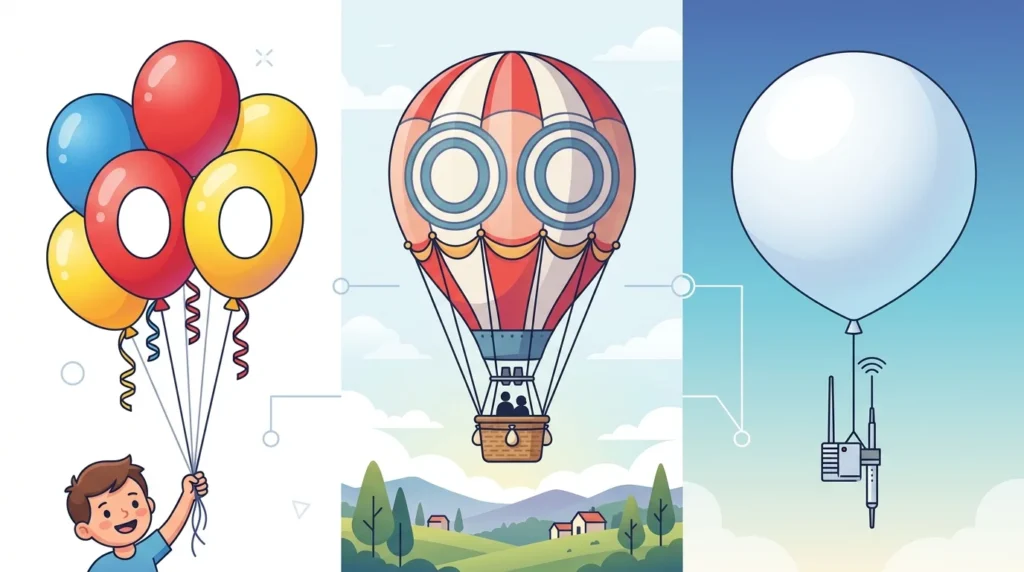
Use “balloon” for the ordinary inflatable object and related modern meanings. Use “ballon” only when the specialized meaning specifically calls for it.
The standard everyday spelling contains two o’s after the l:
balloon
For example:
The children released the balloons into the air.
But in a specialized context, ballon can be correct:
The bartender served the brandy in a large ballon.
The important point is that ballon and balloon are not simply two interchangeable spellings of the same everyday word.
See Also: Smoothe vs Smooth Meaning and Differences: Which Is Correct?
How to Use Balloon
Balloon as a Noun
As a noun, balloon commonly refers to a thin container that is inflated with air or gas. Balloons can be used for decoration, entertainment, scientific purposes, medical procedures, and transportation.
Examples include:
- She tied a balloon to the chair.
- The children played with colorful balloons.
- A weather balloon was launched early in the morning.
- They watched a hot-air balloon rise above the valley.
The word can also appear in compounds such as weather balloon, hot-air balloon, speech balloon, and balloon payment, depending on the context.
Balloon as a Verb
Balloon can also function as a verb. One common meaning is to become larger, especially quickly.
For example:
The project costs ballooned after several changes.
More naturally, you could say:
The project costs ballooned after several changes.
It can also describe something becoming bigger and rounder, such as fabric filling with air. In another specialized use, balloon can mean to travel in a balloon.
Balloon in Compound Expressions
The standard spelling balloon appears in many familiar expressions:
- balloon animal
- balloon ride
- balloon festival
- hot-air balloon
- weather balloon
- speech balloon
- thought balloon
- balloon payment
- balloon catheter
The exact meaning depends on the noun or phrase surrounding it.
How to Use Ballon
Ballon is much less common than balloon in general English. It should not be used as an ordinary alternative spelling for a party balloon or hot-air balloon.
Ballon as a Type of Glass
In English, ballon can refer to a large, round glass typically used for drinking brandy. This is a specialized noun rather than the normal word for an inflatable balloon.
For example:
The brandy was served in a large ballon.
In this sentence, changing ballon to balloon would change the intended word and meaning.
Ballon in Ballet
Ballon is also used in ballet terminology. In this context, it relates to the appearance of lightness or buoyancy in a dancer’s jumps. This is a specialized artistic term rather than the everyday noun referring to an inflatable object.
Because this usage belongs to a particular field, most general English learners will encounter balloon much more often than ballon.
Correct Examples
Conversation
“Can you give me a blue balloon for the party?”
“Please make sure the balloons are delivered before the event begins.”
School
“The students used a balloon to demonstrate how air takes up space.”
Workplace
“The budget began to balloon after several unexpected expenses.”
Social Media
“These balloons made the birthday setup look amazing.”
Academic Writing
“The researchers released a weather balloon to collect atmospheric data.”
Travel
“We booked a hot-air balloon ride at sunrise.”
Medical Context
“The procedure uses a small balloon to widen the narrowed area.”
Entertainment
“The performer created a dog from several balloons.”
Business
“The company’s expenses continued to balloon during the expansion.”
Incorrect vs. Correct
| ❌ Incorrect or Unclear | ✅ Correct | Why |
|---|---|---|
| We bought ten ballon for the party. | We bought ten balloons for the party. | The ordinary party decoration is spelled “balloon.” |
| She held a red ballon. | She held a red balloon. | “Balloon” is the standard spelling for the inflatable object. |
| The hot-air ballon rose slowly. | The hot-air balloon rose slowly. | The aircraft is called a “balloon.” |
| He gave his daughter a ballon. | He gave his daughter a balloon. | The everyday children’s toy uses the spelling “balloon.” |
| The weather ballon collected data. | The weather balloon collected data. | “Weather balloon” is the standard compound. |
| They decorated the room with ballon. | They decorated the room with balloons. | The plural of the ordinary word is “balloons.” |
| The speech ballon contained the character’s words. | The speech balloon contained the character’s words. | The comic-book term uses “balloon.” |
| The balloon glass was filled with brandy. | The ballon was filled with brandy. | “Ballon” can specifically refer to a large round brandy glass. |
| The dancer showed beautiful balloon during the jump. | The dancer showed beautiful ballon during the jump. | “Ballon” is a specialized ballet term. |
| The company costs ballooned because of delays. | The company’s costs ballooned because of delays. | “Ballooned” is the verb form meaning increased rapidly. |
Why Do People Make This Mistake?
They Hear Only One Strong “O” Sound
The pronunciation of balloon does not make the doubled spelling especially obvious to every learner. When people learn words mainly through speech, they may write ballon because the second o is not strongly represented in the way they hear the word.
Spelling Patterns Can Be Confusing
English contains many words in which doubled letters are not easy to predict from pronunciation alone. Learners may therefore remember the sound of balloon correctly while forgetting whether the written form contains one or two o’s.
Ballon Is a Real Word
This creates an unusual source of confusion. A search for ballon does not always produce only spelling corrections because ballon has genuine dictionary uses. That can make learners wonder whether it is simply another spelling of balloon. It is not interchangeable with the ordinary word.
Typing and Autocomplete
Search engines, keyboards, and spellcheckers can sometimes correct or suggest words automatically. However, a correction tool does not always explain why one form belongs in a particular context. Learning the meaning of each word is more reliable than depending entirely on autocomplete.
Translation Interference
Learners may also transfer the spelling of the equivalent word from another language into English. This can be especially likely when the word is familiar in speech but less familiar in writing.
Common Mistakes Checklist
- Using ballon for a party decoration: Write balloon.
- Forgetting the second o: Remember the standard spelling is balloon.
- Treating ballon and balloon as interchangeable: They have different established uses.
- Assuming ballon is always wrong: It is a real English word in specialized contexts.
- Using ballon for a hot-air balloon: Use balloon.
- Confusing the noun and verb: Both are spelled balloon in ordinary uses.
- Writing “balloned”: The correct past tense is ballooned.
Ballon vs. Balloon in Real English
Balloon — Natural Everyday English
Balloon is the natural and standard word for the inflatable object people use at parties, events, celebrations, and scientific activities. It is also normal as a verb when something increases rapidly. Words such as “balloon,” “balloons,” and “ballooned” are common in contemporary English. If you are writing about an ordinary inflatable object, balloon is the form readers expect.
Ballon — Correct but Specialized
Ballon is grammatically and lexically valid in specific contexts, but it is not the ordinary spelling of the familiar inflatable object. A reader encountering “ballon” may initially suspect a typo unless the surrounding context indicates a specialized meaning, such as a brandy glass or ballet terminology. Its correctness therefore depends strongly on context.
See Also: Estranged Meaning: Definition, Relationships, Examples & Usage Explained
Ballon — Not a General Alternative Spelling
It would be misleading to say that ballon and balloon are simply two acceptable spellings of the same everyday word. They are not normally interchangeable. “Balloon” names the common inflatable object, while “ballon” has separate specialized uses in English. Choosing the correct form means identifying the meaning you intend before choosing the spelling.
American vs. British English
There is no ordinary American-versus-British spelling difference between balloon and ballon. The standard everyday word is balloon in both varieties.
The specialized English uses of ballon should not be confused with a regional spelling difference. In other words, American English does not normally use ballon instead of balloon for a party decoration or hot-air balloon.
Formal vs. Informal Usage
Balloon is suitable in both informal and formal English. The spelling does not change according to register.
For example:
- Informal: “The kids popped all the balloons.”
- Neutral: “The balloon rose into the air.”
- Formal: “The weather balloon was used to collect atmospheric measurements.”
Ballon should only be used when its specialized meaning is intended. It is not a more formal version of balloon.
Ballon vs. Balloon Comparison Table

| Feature | Ballon | Balloon |
|---|---|---|
| Common everyday spelling | No | Yes |
| Party decoration | No | Yes |
| Hot-air aircraft | No | Yes |
| Weather device | No | Yes |
| Verb meaning “increase rapidly” | No | Yes |
| Large round brandy glass | Yes | No |
| Ballet terminology | Yes | No |
| Recommended for general English learners | Only in specialized contexts | Yes |
Real-Life Situations
In an Interview
“Our operating costs ballooned after the company expanded.”
Here, ballooned is a verb meaning that the costs increased rapidly.
In a Meeting
“The event space needs more balloons before the guests arrive.”
The word refers to ordinary decorative objects.
In an Email
“Please confirm that the balloon delivery will arrive before noon.”
Here, balloon is used in its ordinary modern sense.
In a Text Message
“Don’t forget the balloons for the birthday party!”
Balloons is the normal plural form.
In an Exam
If a question asks for the correct spelling of the object you inflate for a party, choose balloon. If a passage is discussing a specialized ballet term or a particular type of brandy glass, ballon may be the intended word.
See Also: Flack Meaning: Definition, Uses, Examples & Flack vs Flak
Easy Way to Remember the Difference
Use this simple memory rule:
- Party or air? Choose balloon.
- Rapid increase? Choose balloon.
- Brandy glass or ballet terminology? Check whether ballon is intended.
The easiest everyday memory trick is:
“The floating balloon has two O’s.”
If you are talking about the familiar object that floats, decorate parties, or carries people in a basket, remember the spelling balloon.
Practice Quiz
Choose the correct word for each sentence.
- We bought twenty ______ for the birthday party. (ballon / balloon)
- The hot-air ______ rose above the mountains. (ballon / balloon)
- The company’s expenses began to ______ rapidly. (ballon / balloon)
- The children released their ______ into the sky. (ballons / balloons)
- The dancer demonstrated excellent ______ during the jump. (ballon / balloon)
- The brandy was served in a large ______. (ballon / balloon)
- The weather ______ collected information about the atmosphere. (ballon / balloon)
- The cost of the project ______ after several changes. (balloned / ballooned)
Answers: 1. balloon, 2. balloon, 3. balloon, 4. balloons, 5. ballon, 6. ballon, 7. balloon, 8. ballooned.
Frequently Asked Questions
Is ballon a correct word?
Yes. “Ballon” is a real English word in specialized contexts. It can refer to a large, round brandy glass and is also used in ballet terminology. It is not, however, the standard spelling for an ordinary inflatable balloon.
Is ballon or balloon correct?
Both can be correct, but they are used differently. Balloon is the standard word for the familiar inflatable object and related meanings. Ballon has specialized meanings, including a type of brandy glass and a ballet term.
What is the correct spelling for a party balloon?
The correct spelling is balloon. For example: “We decorated the room with colorful balloons.”
Why does balloon have two o’s?
Balloon is the established spelling of the English word. Its spelling cannot be reliably predicted simply from pronunciation, so it is useful to learn the complete form as a vocabulary item.
Is ballon a misspelling of balloon?
It can be a misspelling when someone intends to write balloon, but ballon is not always a mistake. It has established specialized meanings in English, so context determines whether it is correct.
What does ballon mean in English?
In English, ballon can mean a large, round glass used for drinking brandy. It is also used in ballet terminology to describe a quality of lightness or buoyancy in a dancer’s movement.
What is the plural of balloon?
The plural is balloons. For example: “The room was decorated with balloons.”
Can balloon be a verb?
Yes. As a verb, balloon can mean to become larger, especially quickly. For example: “The costs ballooned during the project.” It can also describe traveling by balloon.
Is ballon used in ballet?
Yes. Ballon is a ballet term associated with the appearance of lightness or buoyancy in a dancer’s jumps. It is a specialized use rather than the everyday word for an inflatable object.
Is ballon used for a brandy glass?
Yes. English dictionaries use ballon for a large, round glass typically used for drinking brandy.
Is balloon the same in American and British English?
Yes. Balloon is the standard spelling in both American and British English for the ordinary inflatable object.
What is the easiest way to remember ballon vs. balloon?
For ordinary everyday English, remember that the floating object is balloon with two o’s after the l. Reserve ballon for specialized contexts such as ballet terminology or the particular type of brandy glass.
Quick Summary
Balloon is the standard modern spelling for the familiar inflatable object used as a decoration, toy, scientific device, or aircraft. It can also be a verb meaning to become larger or increase rapidly. Ballon is not simply an alternative spelling of balloon. It is a real but specialized English word that can refer to a large, round brandy glass and is also used in ballet terminology. Therefore, use balloon for ordinary everyday situations such as parties, hot-air balloons, weather balloons, and rapid increases in size or cost. Use ballon only when its specific specialized meaning is intended. Context determines which spelling is correct.
See Also: Poirot Meaning: Definition, Origin, Character & Literary Significance