

Drier is usually the comparative form of dry, meaning “more dry” or “less moist,” while dryer is commonly a noun for a machine that removes moisture. For example, “The clothes are drier today” uses drier as an adjective, while “Put the clothes in the dryer” uses dryer as a noun. However, drier can also be a noun meaning a dryer, so the distinction is based on meaning and grammatical role rather than spelling alone.
What Is the Difference Between Drier and Dryer?
Drier and dryer are closely related words, and they are pronounced alike or very similarly in standard English. Their most common uses are different.
Drier is normally the comparative form of the adjective dry. It describes something that has less moisture than something else.
For example:
“This towel is drier than the other one.”
“The climate here is drier than it was last year.”
Dryer is commonly a noun meaning a machine that makes something dry, such as a clothes dryer or hair dryer.
“The clothes are in the dryer.”
There is an important exception: drier is also a recognized noun variant of dryer. Major dictionaries list drier as a noun meaning a machine that dries things.
Why the Difference Matters
Choosing the right form makes your meaning immediately clear. This matters in everyday writing, workplace communication, product descriptions, instructions, school assignments, and professional documents.
Compare these sentences:
“The air is drier today.”
Here, drier describes the air.
“The air-dryer is broken.”
Here, dryer refers to a machine.
Using the wrong form can make a sentence look careless, especially when the word is being used as a comparative adjective or as the name of an appliance.
At the same time, it is important not to treat drier as automatically wrong when referring to a machine. Dictionaries recognize drier as a noun variant of dryer.
The Core Rule
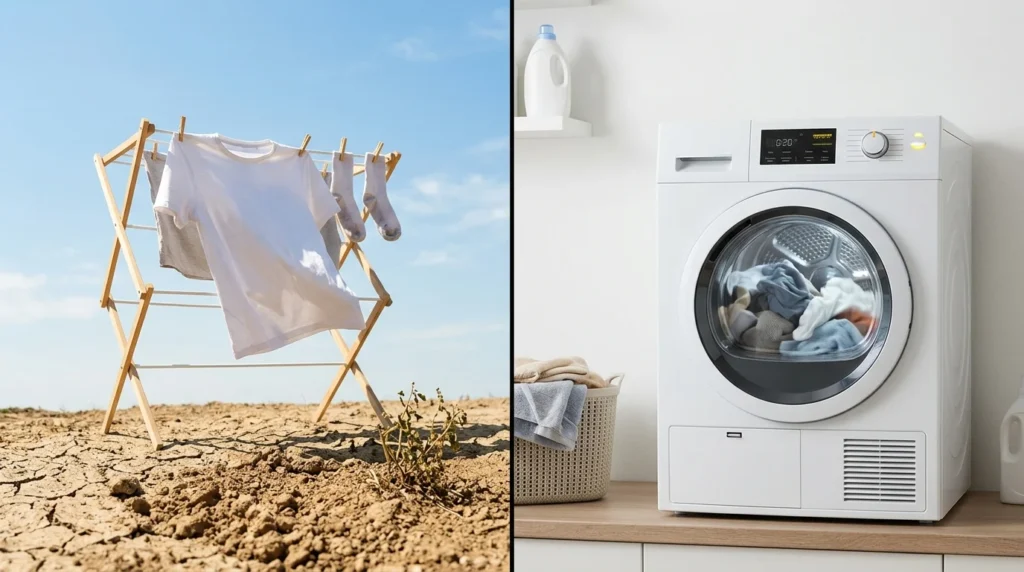
Use “drier” when you mean “more dry” or “less moist.” Use “dryer” when you mean a machine that dries something. But remember that “drier” is also an accepted noun variant for a drying machine.
- drier = usually “more dry” or “less moist”
- dryer = commonly a machine that dries something
- drier = also a recognized noun meaning a dryer
- drier and dryer are not simply a case of one being correct and the other being wrong
The safest choice for general writing when you mean the appliance is usually dryer, because it is widely recognized and unambiguous.
How to Use Drier and Dryer
Use Drier for a Comparison
When you are comparing two things and saying that one contains less moisture, drier is the normal comparative form of dry.
Examples:
- The towel is drier than it was this morning.
- This climate is drier than the coastal region.
- The soil becomes drier during summer.
- Today’s weather feels drier than yesterday’s.
Cambridge lists drier as the comparative form of dry.
Use Drier for Dryness in a Broader Sense
Drier does not have to describe literal water or moisture. The adjective dry has several meanings, so its comparative form can describe other qualities too.
For example:
“Her humor is drier than his.”
Here, drier refers to a style of humor rather than physical moisture.
Similarly, you can describe writing, wit, tone, weather, climate, soil, food, skin, or other things as drier when the meaning of dry allows comparison.
Use Dryer for a Machine
Dryer is commonly used as a noun for a machine that removes moisture.
Common examples include:
- clothes dryer
- hair dryer
- grain dryer
- hand dryer
- spin dryer
For example:
“Put the wet towels in the dryer.”
Cambridge and Oxford both define dryer as a machine for drying something.
Drier Can Also Mean a Drying Machine
This is the exception that many simplified grammar explanations leave out. Drier can also function as a noun meaning a machine that dries something.
Cambridge lists drier as a noun meaning “a dryer,” while Oxford likewise lists drier as another form of the noun dryer.
Therefore, the sentence “Put the clothes in the drier” can be grammatically valid. However, “dryer” is often the clearer choice when you specifically mean the appliance.
Correct Examples
Conversation
“The towels are drier now, so you can use them.”
“The office air feels drier since we turned on the heating.”
School
“The desert has a drier climate than the rainforest.”
Workplace
“Please check whether the hand dryer near the entrance is working.”
Social Media
“My hair gets much drier during the winter.”
Academic Writing
“The northern region has a drier climate than the southern region.”
Household Instructions
“Place the wet clothes in the dryer after washing them.”
Weather Report
“The second half of the week should be drier than the first.”
Food
“The cake became drier after being left in the oven too long.”
Humor
“His writing has a drier sense of humor than hers.”
See Also: Excel or Excell Differences: Which Spelling Is Correct?
Incorrect vs. Correct
| ❌ Incorrect or unclear | ✅ Better choice | Why |
|---|---|---|
| The desert is dryer than the coast. | The desert is drier than the coast. | Here the word is the comparative adjective meaning “more dry.” |
| Put the clothes in the drier. | Put the clothes in the dryer. | Dryer is the clearer and more common spelling for the appliance. |
| My skin is dryer in winter. | My skin is drier in winter. | The word describes skin that is more dry, so the comparative adjective is needed. |
| Her humor is dryer than his. | Her humor is drier than his. | The word describes a comparative quality of humor. |
| The towels are in the drier. | The towels are in the dryer. | Dryer is the conventional noun spelling for the machine. |
| This region is dryer than the other. | This region is drier than the other. | The sentence compares two climates or regions by dryness. |
| I need a new drier for my hair. | I need a new hair dryer. | Hair dryer is the standard, familiar term for the appliance. |
| The soil becomes dryer during drought. | The soil becomes drier during drought. | Drier is the comparative adjective. |
| We bought a clothes drier. | We bought a clothes dryer. | Clothes dryer is the usual modern spelling for the machine. |
| The weather will be dryer next week. | The weather will be drier next week. | The sentence compares the amount of moisture or rainfall. |
| This towel is dryer than that one. | This towel is drier than that one. | The adjective dry takes the comparative form drier. |
| He bought a new drier for the laundry room. | He bought a new dryer for the laundry room. | Dryer is the clearer general-purpose spelling for the appliance. |
Why People Make This Mistake
The Words Sound the Same
One reason drier and dryer are confusing is that they are pronounced the same or very similarly in ordinary English. When two words sound alike but have different spellings, writers cannot rely on pronunciation alone to choose the correct form.
The Words Come From the Same Root
Both words are connected to dry. The comparative adjective is drier, while the noun dryer is formed from the verb dry plus -er. Their similar origins naturally make the spellings easy to mix up.
The Spelling Pattern Can Be Confusing
Many learners remember the rule that adjectives ending in y often change y to i before a comparative ending: dry → drier. But they may then see dryer on appliance labels and assume one spelling must be incorrect.
In reality, both spellings have legitimate uses.
People Learn the Simplified Rule
A common teaching shortcut is “drier is the adjective and dryer is the machine.” That is useful for beginners, but it leaves out the dictionary-recognized noun drier. Cambridge and Oxford both recognize drier as a noun meaning a drying machine.
Spellcheck Does Not Always Explain Meaning
Both drier and dryer are legitimate English words, so a spellchecker may accept either one. The real question is not simply whether the word is spelled correctly. You must determine which meaning you intend.
See Also: Busses vs Buses Differences: Meaning and Correct Usage
Common Mistakes Checklist
- Using dryer when comparing dryness: Use drier when you mean “more dry.”
- Assuming drier can never mean a machine: Dictionaries recognize drier as a noun variant of dryer.
- Assuming dryer is always wrong: Dryer is the standard familiar spelling for many drying machines.
- Forgetting the comparative rule: dry → drier → driest.
- Relying on pronunciation: The two forms can sound the same, so context matters.
- Calling drier a spelling mistake: It can be correct as both a comparative adjective and, in dictionary-recognized usage, a noun.
Drier and Dryer in Real English
“The weather is drier this year.” — Natural and standard
This is ordinary English because drier compares the amount of moisture or rainfall with another time or period. The word functions as the comparative form of dry. Cambridge explicitly lists drier as the comparative form of dry, making this use straightforward and standard.
“Put the clothes in the dryer.” — Natural and standard
This is the familiar everyday way to refer to a machine that dries clothes. Dryer is a noun, and dictionaries define it as a machine that dries things. In British English, tumble dryer is especially common for the clothes appliance.
“Put the clothes in the drier.” — Grammatically possible and dictionary-supported
This sentence is not automatically wrong. Drier is also recorded as a noun meaning a dryer. However, many readers are more accustomed to the spelling dryer when the word refers to an appliance. For clear general-purpose writing, especially for an international audience, dryer is usually the less ambiguous choice.
“My hair is dryer today.” — Usually not the intended spelling
If the intended meaning is “my hair is more dry,” drier is the normal comparative form. Dryer would normally be interpreted as the noun referring to a drying machine, so writing “my hair is dryer” can create unnecessary confusion. The clearer sentence is “My hair is drier today.”
American vs. British English
There is a genuine usage distinction worth knowing, but it is not a simple “American = dryer, British = drier” rule.
Both British and American English use drier as the comparative form of dry. Cambridge lists the comparative form as drier in both its UK and US dictionary information.
For the appliance noun, dryer is widely used, while drier is also recognized as an alternative noun spelling. British English commonly uses tumble dryer for the clothes appliance, while American English commonly uses dryer.
So, do not treat drier as exclusively British or dryer as exclusively American. The context and noun/adjective function matter more.
See Also: Appreciate It or Appreciated It: What Is the Difference?
Formal and Informal Usage
Neither drier nor dryer is inherently formal or informal. Both can appear in professional, academic, technical, and everyday writing.
For example:
- Academic: “The region has a drier climate than the surrounding areas.”
- Professional: “The dryer should be inspected before further use.”
- Everyday: “My hair is drier today.”
- Instructions: “Place the clothes in the dryer.”
The important distinction is meaning, not register.
Drier vs. Dryer Comparison Table
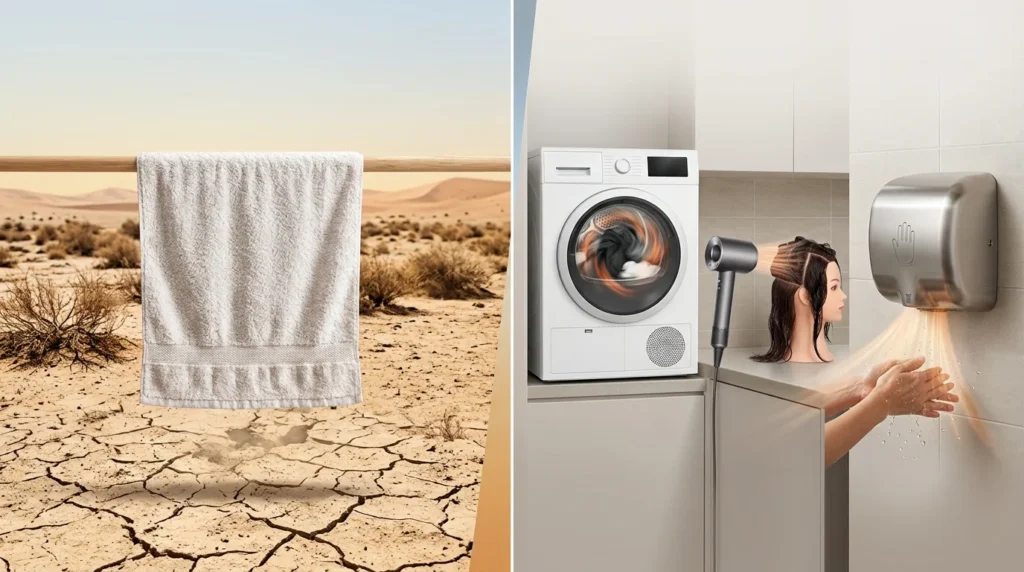
| Feature | Drier | Dryer |
|---|---|---|
| Common part of speech | Comparative adjective | Noun |
| Main adjective meaning | More dry; less moist | Not normally used as this comparative |
| Machine meaning | Yes, as an alternative noun | Yes, common noun |
| Example | The air is drier. | The clothes are in the dryer. |
| Comparative of “dry” | Yes | No |
| Hair appliance | Possible but less usual | Hair dryer is common |
| Clothes appliance | Recognized alternative | Common spelling |
| Pronunciation | Same or very similar | Same or very similar |
Drier vs. Dryer in Common Phrases
| Phrase | Preferred Form | Meaning |
|---|---|---|
| drier weather | drier | Weather with less moisture or rain |
| drier climate | drier | A climate that is more dry |
| drier soil | drier | Soil containing less moisture |
| drier humor | drier | More understated or deadpan humor |
| hair dryer | dryer | A machine used to dry hair |
| clothes dryer | dryer | A machine used to dry clothes |
| tumble dryer | dryer | A machine that dries clothes by tumbling them |
| hand dryer | dryer | A machine used to dry hands |
Real-Life Situations
In an Interview
“This position requires working in a drier climate than I am used to.”
Here, drier compares one climate with another.
In a Meeting
“The storage room is much drier after we fixed the ventilation.”
Drier describes a change in moisture level.
In an Email
“Please confirm whether the new dryer has been installed.”
Dryer refers to a machine.
In a Text Message
“My hair is drier than usual today.”
Drier is the comparative adjective.
In an Exam
“The interior region has a drier climate than the coast.”
This is a standard comparative use of drier.
In Product Instructions
“Do not place the appliance near the dryer.”
Here, dryer identifies a machine.
How to Remember Drier vs. Dryer
Use this simple memory trick:
If you can replace the word with “more dry,” choose “drier.”
For example:
“This room is drier.”
→ “This room is more dry.”
That tells you the comparative adjective drier is appropriate.
If you can replace the word with “a machine that dries,” then dryer is a natural choice.
“The clothes are in the dryer.”
→ “The clothes are in the machine that dries them.”
See Also: Puns or Jokes: What Is the Difference?
A Simple Decision Guide
- Ask whether you are comparing dryness.
- If the answer is yes, use drier.
- Ask whether you mean a machine that dries something.
- If the answer is yes, dryer is the common choice.
- Remember that drier can also be a noun meaning a drying machine.
- For general writing, use dryer for the appliance when you want the clearest and most familiar spelling.
Frequently Asked Questions
Is drier or dryer correct?
Both can be correct, but they are commonly used for different purposes. Drier is the normal comparative form of dry, while dryer is commonly a noun for a machine that dries things. Drier is also recognized as a noun variant meaning a dryer.
Is “drier” the comparative of “dry”?
Yes. Dry → drier → driest is the standard comparative and superlative pattern. Cambridge lists drier as the comparative form of dry.
Is “dryer” a real word?
Yes. Dryer is a standard noun for a machine that dries something, such as a hair dryer or clothes dryer.
Can “drier” mean a machine?
Yes. This is an important exception to the simplified rule. Cambridge and Oxford both recognize drier as a noun meaning a machine that dries something.
Is “hair drier” correct?
Yes, hair drier can be found as a valid noun form because drier can mean a drying machine. However, hair dryer is the more familiar spelling and is the safer choice when you want maximum clarity.
Is “clothes drier” correct?
Yes, it can be correct. Drier is recognized as an alternative noun spelling for a drying machine. However, clothes dryer is the more familiar general spelling.
Why is it “drier” instead of “dryer” when comparing dryness?
The standard comparative form of the adjective dry is drier. The spelling reflects the normal change from final y to i before the comparative ending: dry → drier.
Is “dryer weather” correct?
When you mean weather that is more dry, the standard form is drier weather. For example, “We are expecting drier weather next week.” Here, drier is the comparative adjective.
Is “drier” British and “dryer” American?
No. That is too simple. Both varieties use drier as the comparative form of dry, and dryer is widely used for the machine. British English commonly uses tumble dryer for a clothes-drying appliance.
Do drier and dryer sound the same?
They are pronounced the same or very similarly in standard English varieties. This is one reason the two spellings are easy to confuse. Their spelling and grammatical role must therefore be understood from context.
Which spelling should I use for a machine?
Dryer is generally the clearest and most familiar choice when referring to a machine. Although drier is also dictionary-supported as a noun, dryer avoids unnecessary ambiguity for many readers.
What is the easiest way to remember drier and dryer?
Use drier when you can replace it with “more dry.” Use dryer when you mean the machine. Then remember that drier can also be used as an alternative noun for a drying machine.
Quick Summary
Drier and dryer are both legitimate English words, but their most common uses differ. Drier is the comparative form of dry, meaning “more dry” or “less moist,” as in “The soil is drier.” Dryer is commonly a noun for a machine that dries things, such as a clothes dryer or hair dryer. However, drier is also an accepted noun variant meaning a drying machine, so it is not always wrong when used for an appliance. For clear general writing, drier is usually the best choice for comparisons, while dryer is the familiar choice for machines. The easiest test is simple: if you mean “more dry,” choose drier.
See Also: Smoothe vs Smooth Meaning and Differences: Which Is Correct?