


If you’ve searched for lapis lazuli meaning, you’re probably curious about this beautiful deep-blue gemstone and what it represents. Lapis lazuli has been admired for thousands of years for its striking color, historical importance, and symbolic meanings in different cultures.
In simple terms, lapis lazuli is a semi-precious blue gemstone that symbolizes wisdom, truth, inner peace, knowledge, and self-expression. It has been used in jewelry, artwork, and spiritual practices since ancient times.
In this guide, Trendy Meaning explains what does lapis lazuli mean, its symbolism, history, properties, and common uses.
Meaning & Definition

The lapis lazuli meaning refers to both the gemstone itself and the symbolic qualities associated with it.
Lapis lazuli is primarily known as a deep-blue metamorphic rock composed mainly of the mineral lazurite.
It is commonly associated with:
- Wisdom
- Truth
- Knowledge
- Honesty
- Inner peace
- Self-awareness
These meanings come from cultural traditions and symbolism rather than scientific evidence.
Lapis Lazuli Meaning in English
In English, lapis lazuli refers to a vivid blue ornamental stone that has been valued for thousands of years.
The name comes from:
- Lapis = Stone (Latin)
- Lazuli = Blue or sky (derived from Persian and Arabic origins)
Together, the name means “blue stone.”
What Does Lapis Lazuli Mean?
When people ask what does lapis lazuli mean, they may be referring to either the gemstone’s literal definition or its symbolic significance.
Traditionally, lapis lazuli represents:
- Wisdom
- Truth
- Intellectual growth
- Confidence
- Clear communication
- Spiritual awareness
Many cultures believed the stone encouraged honesty and insight.
Simple Explanation
Think of lapis lazuli as representing:
- Wisdom
- Truth
- Learning
- Peace
- Confidence
- Self-expression
Its symbolic meaning varies depending on cultural and spiritual traditions.
Lapis Lazuli Definition With Examples
The lapis lazuli definition is a deep-blue semi-precious gemstone prized for its beauty and historical significance.
Examples of Lapis Lazuli in Sentences
“She wore a lapis lazuli necklace.”
“The ancient sculpture was decorated with lapis lazuli.”
“Lapis lazuli has long symbolized wisdom.”
“The artist used powdered lapis lazuli to create vibrant blue paint.”
These examples show both the physical and symbolic uses of the stone.
Background
Lapis lazuli has been treasured for more than 6,000 years. Ancient civilizations used it in jewelry, religious objects, royal decorations, and works of art.
It was especially valued in ancient Egypt, Mesopotamia, Persia, Greece, and Rome because of its rich blue color and rarity.
Origin and History of Lapis Lazuli
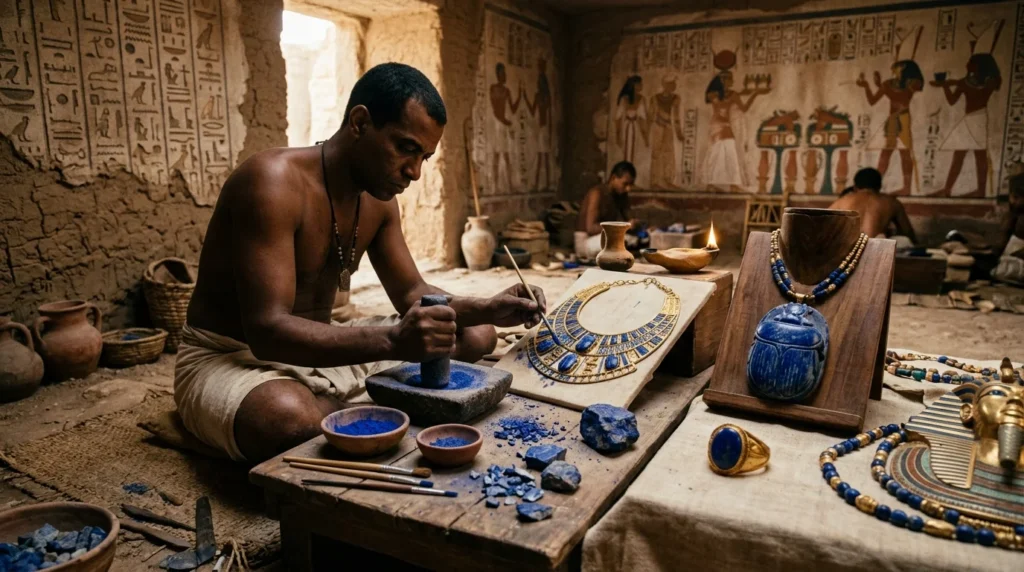
Historically, much of the world’s finest lapis lazuli came from mines in present-day Afghanistan, where it has been extracted for thousands of years.
Ancient Egyptians used it in jewelry, burial masks, and decorative objects, while Renaissance artists ground the stone into powder to create the brilliant blue pigment known as ultramarine.
Today, lapis lazuli remains a popular gemstone for jewelry and decorative art.
Usage in Different Contexts
Lapis lazuli is appreciated in many different fields.
Lapis Lazuli in Jewelry
The gemstone is commonly used in rings, necklaces, bracelets, and earrings.
Example:
“A lapis lazuli pendant makes an elegant accessory.”
Lapis Lazuli in Art
Artists historically used powdered lapis lazuli to produce high-quality blue pigments.
Example:
“Many Renaissance paintings contain ultramarine made from lapis lazuli.”
Lapis Lazuli in Symbolism
Many traditions associate the stone with wisdom, honesty, and self-expression.
Example:
“Some people choose lapis lazuli as a symbol of truth and personal growth.”
Lapis Lazuli in Modern Culture
Today, the gemstone is admired for its beauty and is often collected, gifted, or worn as jewelry.
Lapis Lazuli Symbolism
Throughout history, lapis lazuli has been associated with positive qualities and personal growth.
Common symbolic meanings include:
- Wisdom
- Truth
- Honesty
- Knowledge
- Self-confidence
- Clear communication
- Inner peace
These meanings come from cultural and historical traditions rather than proven scientific facts.
Lapis Lazuli vs Sapphire Difference
Although both stones are blue, they are different gemstones.
Lapis Lazuli
A deep-blue metamorphic rock composed mainly of lazurite, often containing golden flecks of pyrite and white calcite.
Example:
“Lapis lazuli has a rich royal-blue appearance.”
Sapphire
A precious gemstone made from the mineral corundum, valued for its hardness and brilliance.
Example:
“Blue sapphire is commonly used in engagement rings.”
Simple difference:
Lapis lazuli = ornamental blue stone.
Sapphire = precious gemstone made of corundum.
Common Uses of Lapis Lazuli
Lapis lazuli is widely used for:
- Jewelry
- Decorative carvings
- Sculptures
- Home décor
- Museum collections
- Luxury accessories
- Historical artwork
It continues to be one of the world’s most recognizable blue stones.
Synonyms and Related Terms
While lapis lazuli is a unique gemstone, related terms include:
- Blue gemstone
- Lazurite stone
- Ornamental stone
- Decorative gemstone
- Semi-precious stone
These terms describe similar categories rather than exact synonyms.
How to Use Lapis Lazuli Correctly
Use the term lapis lazuli when referring to the gemstone or discussing its historical or symbolic significance.
Examples:
“She purchased a lapis lazuli bracelet.”
“The museum displayed ancient lapis lazuli artifacts.”
“Artists once used lapis lazuli to create ultramarine pigment.”
“The gemstone is admired for its deep-blue color.”
Frequently Asked Questions
What is lapis lazuli meaning?
Lapis lazuli symbolizes wisdom, truth, knowledge, honesty, and self-expression. It is also the name of a deep-blue semi-precious gemstone.
What does lapis lazuli symbolize?
Traditionally, it symbolizes wisdom, inner peace, confidence, truth, and intellectual growth.
Is lapis lazuli a precious stone?
No. Lapis lazuli is generally classified as a semi-precious gemstone.
Where is lapis lazuli found?
Some of the world’s finest lapis lazuli has been mined in Afghanistan for thousands of years. It is also found in several other countries.
Why is lapis lazuli famous?
It is famous for its deep-blue color, historical importance, use in jewelry and art, and traditional symbolic meanings.
Conclusion
The lapis lazuli meaning combines both the beauty of a deep-blue gemstone and centuries of symbolism connected with wisdom, truth, knowledge, and self-expression. From ancient civilizations to modern jewelry, lapis lazuli has remained one of the world’s most admired ornamental stones. Understanding what does lapis lazuli mean, its history, symbolism, and uses helps you appreciate why it continues to be valued across cultures.
At Trendy Meaning, we explain English words, gemstones, internet slang, cultural terms, and modern vocabulary with simple definitions, practical examples, and real-world usage to make learning easier.
See Also:
Culotte Meaning: Definition, Fashion, History & Styling Guide