

Losing is the correct spelling when you mean failing to win, no longer having something, or experiencing a loss. Loosing is also a real English word, but it has a different meaning: it is the present participle of loose, meaning to release, set free, or make something less tight. Because the two words look and sound similar, they are often confused. In everyday writing, losing is usually the word you need when talking about loss.
Quick Answer
Use losing when you mean experiencing a loss, failing to win, or no longer having something. Use loosing when you mean releasing something or making it loose. For example, “I am losing my keys” is correct, while “The knight is loosing an arrow” means the knight is releasing an arrow. The key difference is that losing comes from lose, while loosing comes from loose.
What Does Losing Mean?
Losing is the present participle or gerund form of the verb lose. It can describe failing to win, no longer having something, missing an opportunity, becoming unable to find something, or experiencing a reduction or defeat.
The verb lose changes to losing when -ing is added. The final e in lose is removed before adding -ing.
Examples of Losing
- I am losing my patience.
- Our team is losing the match.
- She is worried about losing her job.
- He keeps losing his keys.
- We are losing valuable time.
- The company is losing customers.
What Does Loosing Mean?
Loosing is the present participle or gerund form of the verb loose. It means releasing something, setting something free, or making something less tight or confined.
The word loose is different from lose. Although they look similar, they have different meanings. For example, someone can loose an arrow, meaning they release it from a bow.
Examples of Loosing
- The archer is loosing an arrow.
- The dog escaped after loosing itself from the chain.
- The soldiers were loosing the horses from the stable.
- The rope was loosing its grip.
Loosing is grammatically valid, but it is much less common than losing. In everyday English, you are far more likely to need losing.
See Also:
Loosing vs Losing: The Core Difference

The simplest way to understand the difference is to identify the base verb.
| Word | Base Verb | Meaning | Example |
|---|---|---|---|
| Losing | Lose | Failing to keep, win, find, or maintain something | She is losing her phone. |
| Loosing | Loose | Releasing or making something less tight | He is loosing the arrow. |
Therefore, if your sentence is about loss, defeat, disappearance, or failure to keep something, use losing. If it is about release or loosening something, loosing may be appropriate.
Is Losing or Loosing Correct?
Both are correct words, but they are not interchangeable. Losing is the correct choice when the meaning comes from lose. Loosing is correct when the meaning comes from loose.
For example:
- “I am losing money.” — Correct.
- “The archer is loosing an arrow.” — Correct.
If you write “I am loosing money,” the spelling changes the intended verb and makes the sentence incorrect for the usual meaning.
Why Do People Confuse Loosing and Losing?
The confusion mainly comes from the close spelling and pronunciation of lose and loose. Both words begin with the same letters, and adding -ing produces forms that differ by only one letter: losing and loosing.
Another reason is that learners may incorrectly assume that the double o in loose should remain when forming every related word. This produces loosing when the intended word is actually losing.
How to Use Losing Correctly
Use losing whenever you need the -ing form of lose.
- Use losing for failing to win.
- Use losing when something is no longer in your possession.
- Use losing for becoming unable to find something.
- Use losing for experiencing a reduction or decline.
- Use losing when talking about missing or wasting an opportunity.
Correct Examples with Losing
- We are losing the game.
- She is losing confidence.
- I am losing interest in the project.
- He is losing weight.
- They are losing money every month.
- Stop losing your keys.
- The business is losing customers.
- She is afraid of losing her opportunity.
- We are losing valuable time.
- The team is losing by two points.
How to Use Loosing Correctly
Use loosing when you mean the action of releasing something or setting it free. This form is relatively uncommon in modern everyday conversation.
You are most likely to encounter loosing in literary, historical, or specialized contexts, especially when someone is releasing an arrow or another object.
Correct Examples with Loosing
- The archer is loosing another arrow.
- The hunter prepared for loosing the dogs.
- The character was loosing the bird from its cage.
In many everyday situations, English speakers would choose a different expression, such as releasing, because loosing is uncommon.
Incorrect vs Correct Examples
| Incorrect | Correct | Why |
|---|---|---|
| I am loosing my keys. | I am losing my keys. | You mean you can no longer find or keep the keys. |
| We are loosing the match. | We are losing the match. | The team is failing to win. |
| She is loosing money. | She is losing money. | The meaning is experiencing financial loss. |
| He is loosing his job. | He is losing his job. | The meaning is no longer keeping his job. |
| I keep loosing my phone. | I keep losing my phone. | The intended verb is lose. |
| They are loosing customers. | They are losing customers. | The company is experiencing a decline in customers. |
| We are loosing time. | We are losing time. | The meaning is wasting or running out of time. |
| She is loosing confidence. | She is losing confidence. | The meaning is becoming less confident. |
| The archer is losing an arrow. | The archer is loosing an arrow. | Here, “loosing” means releasing the arrow. |
| The dog is losing itself from the chain. | The dog is loosing itself from the chain. | The intended meaning is releasing itself. |
Losing in Real English
Losing is extremely common in modern English. You will see it in conversations, emails, news reports, sports discussions, business writing, academic writing, and social media.
Common expressions include losing weight, losing money, losing time, losing patience, losing interest, losing control, and losing a game.
Loosing, by contrast, is much less common. Although it is a legitimate word, modern writers often use releasing, setting free, or loosening depending on the intended meaning.
See Also:
Lose vs Loose
Understanding lose and loose makes the difference between losing and loosing much easier.
| Word | Part of Speech | Meaning | Example |
|---|---|---|---|
| Lose | Verb | Fail to keep, find, or win | Don’t lose your keys. |
| Loose | Adjective / Verb | Not tight; release or set free | The rope is loose. |
| Losing | Verb form / Gerund | Experiencing loss or failure | He is losing the game. |
| Loosing | Verb form / Gerund | Releasing or setting free | She is loosing the bird. |
Losing vs Loosing in Different Situations
In Conversation
“I’m losing my patience” is correct when you mean your patience is decreasing. “I’m loosing my patience” is incorrect because the intended verb is lose.
In Sports
Use losing when a team or player is not winning. For example, “Our team is losing the match.”
In Business
Use losing for financial or commercial decline. For example, “The company is losing customers.”
In Historical or Literary Writing
Loosing can appear when a writer describes releasing something. For example, “The archer was loosing an arrow.”
In Emails
Use losing in ordinary professional situations involving loss, deadlines, customers, money, time, or opportunities.
Common Mistakes Checklist
- ❌ “I am loosing my wallet.”
- ✅ “I am losing my wallet.”
- ❌ “Our team is loosing.”
- ✅ “Our team is losing.”
- ❌ “We are loosing money.”
- ✅ “We are losing money.”
- Remember that lose → losing.
- Remember that loose → loosing.
- Do not use loosing simply because loose contains two o’s.
American vs British English
There is no major American-versus-British spelling difference between losing and loosing. The distinction is based on meaning rather than regional spelling.
Both American and British English use losing for the normal -ing form of lose. Loosing can be used when it genuinely comes from the verb loose, although it is uncommon.
See Also:
Formal vs Informal Usage
Losing is appropriate in both formal and informal English. It is a normal everyday word and requires no special level of formality.
Loosing is grammatically valid when it has the meaning of releasing something, but its uncommon nature means that another word may often sound more natural in contemporary writing.
How to Remember Losing vs Loosing
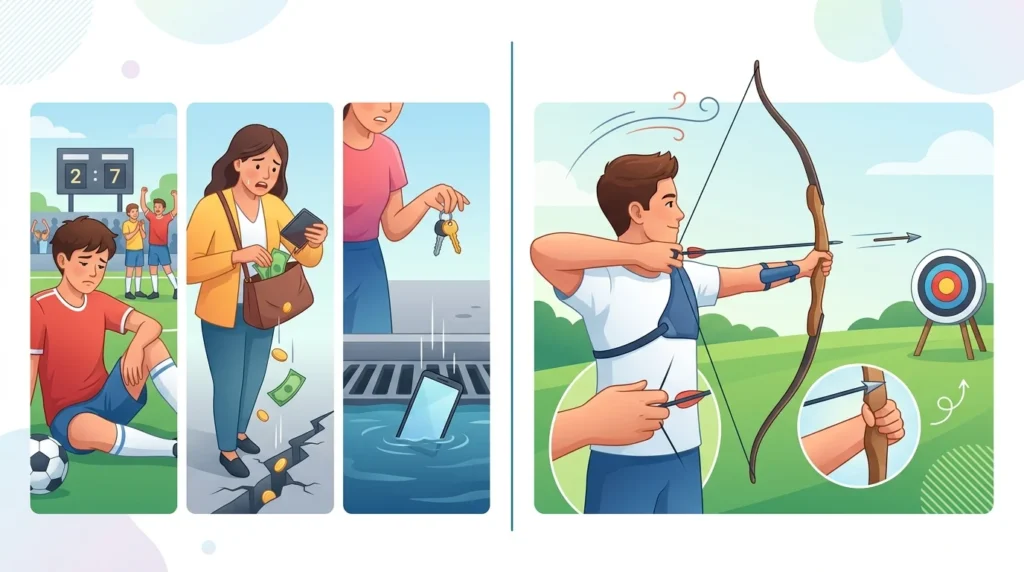
Use this simple memory trick:
Lose a letter, lose something.
Lose → losing
If you are talking about something disappearing, being lost, failing to win, or no longer being possessed, choose losing.
If you mean releasing something, think of loose → loosing.
Related Word Forms
| Base Word | Present Form | Past Form | Past Participle |
|---|---|---|---|
| lose | losing | lost | lost |
| loose | loosing | loosed | loosed |
Notice the difference: lose becomes losing, while loose becomes loosing.
Frequently Asked Questions
Is losing or loosing correct?
Both are correct words, but they have different meanings. Losing comes from lose and refers to experiencing loss or failing to keep or win something. Loosing comes from loose and means releasing or setting something free.
Is loosing a real word?
Yes. Loosing is a real English word. It is the present participle of loose, meaning to release or set free. However, it is much less common than losing.
Why is losing spelled with one o?
Losing comes from the verb lose. When -ing is added, the final silent e is removed: lose → losing. The double o belongs to the separate word loose.
Is “I am loosing weight” correct?
No. The standard expression is “I am losing weight.” Weight is being reduced, so the verb is lose, not loose.
Is “losing an arrow” correct?
Usually, if you mean releasing an arrow, the traditional verb is loosing: “The archer is loosing an arrow.” In everyday modern English, releasing an arrow may sound more natural.
What is the difference between lose and loose?
Lose means to no longer have something, fail to win, or experience a loss. Loose usually means not tight and can also be a verb meaning to release or set free.
What is the past tense of lose?
The past tense of lose is lost. For example, “She lost her keys yesterday.”
What is the -ing form of lose?
The -ing form of lose is losing, not loosing.
What is the -ing form of loose?
The -ing form of the verb loose is loosing. It means releasing or setting something free.
How can I easily remember losing?
Remember: lose → losing. If your sentence is about loss, defeat, disappearance, or no longer having something, use losing.
Quick Summary
Losing and loosing are both real English words, but they come from different verbs. Losing comes from lose and means experiencing a loss, failing to win, no longer having something, or becoming unable to find something. Loosing comes from loose and means releasing or setting something free. In everyday English, losing is far more common. If you are writing “losing weight,” “losing money,” “losing a game,” or “losing my keys,” use the single-o form. Use loosing only when you genuinely mean releasing or setting something free.
See Also:
ASL Meaning Slang: Text, Snapchat, TikTok & Chat Guide