
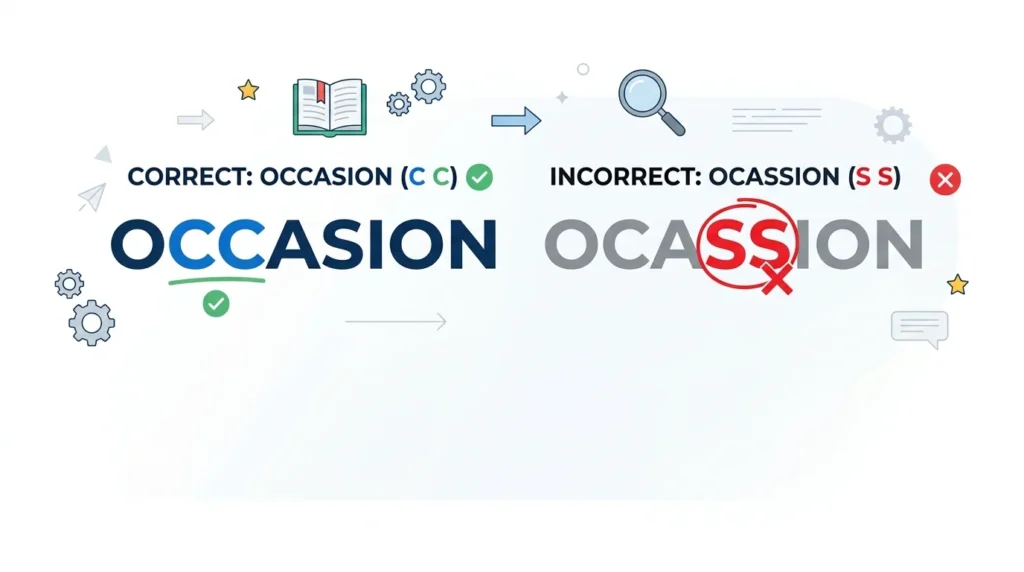

Occasion is the correct spelling, while ocassion is a misspelling. The correct word is spelled O-C-C-A-S-I-O-N, with two c’s and one s. It can mean a particular time, a special event, or an opportunity or reason for something. “Ocassion” does not have a separate meaning in standard English and should not be used in formal, academic, professional, or everyday writing.
What Is the Difference Between Occasion and Ocassion?
The difference is spelling rather than meaning. Occasion is a standard English word, whereas ocassion is an incorrect spelling of that word. If you are writing about a birthday, wedding, ceremony, particular event, or specific time, use occasion.
For example, you would write, “It was a memorable occasion,” not “It was a memorable ocassion.” The two forms may look almost identical, but changing the position of the doubled letters turns the correct spelling into an error.
| Form | Status | Meaning | Example |
|---|---|---|---|
| occasion | Correct | A particular time, event, or opportunity | It was a special occasion. |
| ocassion | Incorrect | Misspelling of “occasion” | Do not use this spelling. |
Quick Answer
Occasion is correct, and ocassion is incorrect. The word “occasion” has two c’s followed by one s: O-C-C-A-S-I-O-N. Use it when referring to a particular time, special event, ceremony, or opportunity. “Ocassion” is simply a common spelling mistake and should be corrected wherever it appears.
What Does Occasion Mean?
Occasion is primarily a noun. It can describe a particular time when something happens, a special or important event, or a suitable opportunity or reason for doing something. The exact meaning depends on the sentence.
Occasion as a Particular Time
Occasion can refer to a specific time or instance when something happened.
- We have met on several occasions.
- She called me on one occasion.
- I remember that occasion clearly.
In these examples, “occasion” means a particular instance or time.
Occasion as a Special Event
Occasion can also mean an important or special event, such as a wedding, birthday, graduation, anniversary, or ceremony.
- The wedding was a beautiful occasion.
- Her graduation was a proud occasion for the family.
- They bought new clothes for the special occasion.
Occasion as an Opportunity or Reason
In some contexts, occasion means an opportunity or a reason for something to happen.
- The meeting gave us an occasion to discuss the problem.
- The announcement provided an occasion for celebration.
- We had no occasion to doubt his explanation.
So, “occasion” is more flexible than simply meaning “celebration.” Its meaning changes according to context.
Why Is Occasion Correct?
The standard spelling is occasion, with the letters arranged as O-C-C-A-S-I-O-N. The spelling is established in English and is reflected in standard dictionaries. Its history also traces back through French to Latin forms containing the doubled c.
However, you do not need to memorize the Latin history every time you write the word. For everyday writing, the most useful thing to remember is the letter pattern:
OCC + ASION = OCCASION
The important point is that the two c’s come before the a, while there is only one s later in the word.
The Core Rule
Use “occasion” every time you mean the standard English word for a particular time, event, or opportunity. “Ocassion” is not an alternative spelling.
Remember: OCCASION = double C + single S.
How to Use Occasion Correctly
The word “occasion” appears in many common expressions. Learning these phrases can make the correct spelling easier to remember because you begin to recognize the word as a complete pattern rather than trying to construct it letter by letter.
“On Occasion”
On occasion means sometimes or from time to time.
Example: I still visit that restaurant on occasion.
“On Several Occasions”
This means several different times.
Example: We discussed the issue on several occasions.
“Special Occasion”
This refers to an important or memorable event.
Example: She bought a new dress for the special occasion.
“On This Occasion”
This phrase refers to a particular situation or event being discussed.
Example: On this occasion, we decided to stay home.
“Rise to the Occasion”
This expression means successfully dealing with a difficult or important situation.
Example: When the team needed a leader, Maria rose to the occasion.
Correct Examples of Occasion
Here are examples showing how “occasion” naturally appears in different types of writing.
- Conversation: “We have eaten there on several occasions.”
- Email: “Thank you for joining us on this special occasion.”
- School writing: “The graduation ceremony was an important occasion.”
- Workplace: “I have spoken with the client on several occasions.”
- Social media: “What a beautiful occasion to celebrate with family!”
- Academic writing: “The researchers observed similar results on more than one occasion.”
- Invitation: “We would be delighted to have you with us for this special occasion.”
- Personal message: “I will always remember that occasion.”
- Formal writing: “The ceremony marked an important occasion in the organization’s history.”
- Everyday English: “I only eat dessert on special occasions.”
Incorrect vs. Correct
| Incorrect | Correct | Why |
|---|---|---|
| ❌ It was a special ocassion. | ✅ It was a special occasion. | “Ocassion” is a misspelling. |
| ❌ We met on several ocassions. | ✅ We met on several occasions. | The standard spelling has two c’s and one s. |
| ❌ This is a happy ocassion. | ✅ This is a happy occasion. | The event is an occasion, not an “ocassion.” |
| ❌ Thank you for making this ocassion memorable. | ✅ Thank you for making this occasion memorable. | The correct noun is “occasion.” |
| ❌ We celebrate important ocassions together. | ✅ We celebrate important occasions together. | The plural keeps the same spelling pattern. |
| ❌ I remember that ocassion clearly. | ✅ I remember that occasion clearly. | The correct spelling contains double c. |
| ❌ She bought a dress for the ocassion. | ✅ She bought a dress for the occasion. | “Ocassion” is not a standard English spelling. |
| ❌ It happened on one ocassion. | ✅ It happened on one occasion. | Use “occasion” for a particular instance. |
| ❌ They prepared everything for the ocassion. | ✅ They prepared everything for the occasion. | The word requires two c’s and one s. |
| ❌ This was an important ocassion for everyone. | ✅ This was an important occasion for everyone. | The correct spelling is “occasion.” |
Why Do People Spell Occasion as Ocassion?
The mistake is understandable because the pronunciation does not clearly tell you which consonant should be doubled. In normal speech, the word sounds roughly like uh-KAY-zhun, so the written sequence of c’s and s’s is not obvious from pronunciation alone.
Phonetic Similarity
When people spell by sound, “occasion” can be difficult because the spelling does not closely mirror its pronunciation. The c and s are not pronounced in a way that makes the double-c pattern obvious.
Spelling Pattern Confusion
The word contains a double letter near the beginning and another consonant later in the same syllable sequence. This can cause writers to remember that “something is doubled” but place the doubling on the wrong letter.
Fast Typing
Typing quickly can turn a familiar word into a typo. A writer may know the correct spelling but accidentally type “ocassion” because the fingers produce the letters in the wrong order.
Autocorrect and Spellcheck
Spellcheck can identify many errors, but it should not replace knowledge of spelling. Different applications have different dictionaries, and a typo may sometimes survive unnoticed if it is not immediately flagged.
Translation Interference
English learners may also transfer spelling patterns from another language. If a similar word exists in a learner’s first language but follows a different spelling pattern, that can make “occasion” harder to remember.
Common Mistakes Checklist
- Writing “ocassion”: Remember that the correct form has two c’s, not two s’s.
- Writing “occassion”: Adding another s creates another misspelling.
- Writing “ocasion”: The second c must not be dropped.
- Relying only on pronunciation: The spoken form does not make the spelling pattern obvious.
- Forgetting the pattern in the plural: “Occasions” still begins with “occ.”
- Trusting memory without proofreading: Visually checking the word can catch the error before publication.
Occasion in Real English
Natural Everyday English
“Occasion” is completely natural in everyday English, especially in phrases such as “on occasion,” “special occasion,” and “on several occasions.” Native speakers and fluent users do not normally treat “ocassion” as a different word. It is simply a spelling error. The important distinction is therefore not between two vocabulary choices but between the accepted spelling and an incorrect written form.
Grammatically Correct but Context-Dependent
“Occasion” is grammatically correct in sentences describing events, times, or opportunities, but the best wording depends on the context. For example, “event” may be more direct when you mean a planned gathering, while “occasion” can emphasize the significance or particular circumstances. Choosing “occasion” is therefore sometimes a matter of meaning and style rather than grammar alone.
Formal and Everyday Use
“Occasion” works in both formal and informal English. You can use it in a business email, academic paper, conversation, invitation, or social media post. There is no need to avoid the word in casual writing. What matters is using the correct spelling and choosing the meaning that fits the sentence.
American vs. British English
There is no spelling difference between American and British English for this word. Both varieties use occasion. You should not change the spelling to “ocassion” based on the English variety you are using. Standard dictionaries give the same basic spelling in both varieties.
See Also: Clingy Meaning: Definition, Relationship & Text Explained
Formal vs. Informal Usage
“Occasion” is suitable in both formal and informal contexts. The word itself does not require a formal setting.
| Context | Natural Example |
|---|---|
| Formal | The ceremony was an important occasion. |
| Business | We have discussed this matter on several occasions. |
| Academic | The pattern appeared on more than one occasion. |
| Everyday | We go there on occasion. |
| Social | It was a wonderful occasion. |
Occasion vs. Ocassion: Easy Comparison
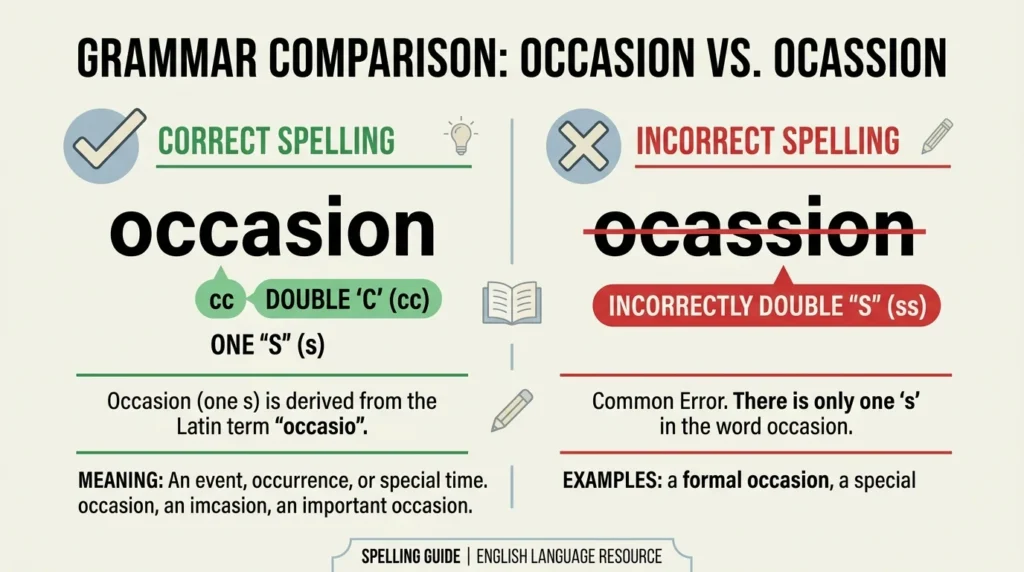
| Feature | Occasion | Ocassion |
|---|---|---|
| Spelling | Correct | Incorrect |
| Standard English word | Yes | No |
| Meaning | Time, event, opportunity, or reason | No separate standard meaning |
| Double letters | CC | Incorrectly uses SS |
| Formal writing | Use it | Do not use it |
| Academic writing | Correct | Incorrect |
| American English | Correct | Incorrect |
| British English | Correct | Incorrect |
Real-Life Situations
At Work
If you are writing to a colleague about a company event, write: “The award ceremony was an important occasion for our team.” Avoid “ocassion.”
In an Email
If you are thanking someone after an event, you might write: “Thank you for joining us on this special occasion.” This works naturally in a professional or personal email.
In a Text Message
A friend might say: “It was a really nice occasion.” Even in casual texting, the standard spelling remains “occasion.”
In an Exam
If you are writing an English exam and need to describe an important event, use “occasion.” A spelling mistake such as “ocassion” can be avoided by checking the double-c pattern before submitting your answer.
In an Invitation
Formal invitations often use phrases such as “for this special occasion.” The spelling should always be “occasion.”
See Also: Poirot Meaning: Definition, Origin, Character & Literary Significance
How to Remember the Spelling of Occasion
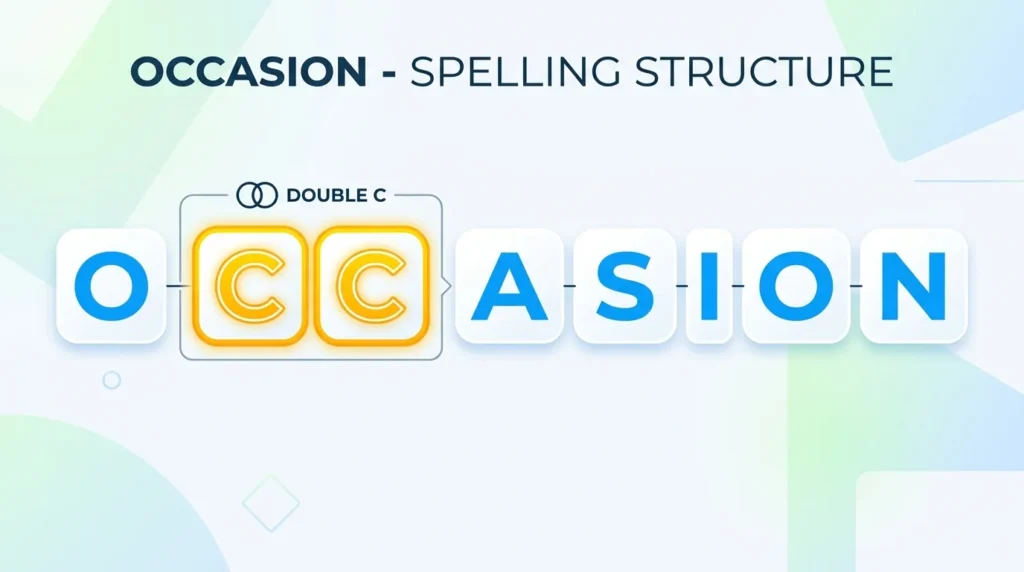
The simplest memory aid is to focus on the first three consonants:
OCCASION = OCC + ASION
Think: two C’s come before the A, and only one S follows.
Another useful technique is to visualize the word rather than relying on its sound:
O C C A S I O N
If you see O C A S S I O N, something is wrong. The doubled letters belong to the C, not the S.
A Quick Practice Quiz
Choose the correct spelling in each sentence.
- The wedding was a memorable (occasion / ocassion).
- We have spoken about this on several (occasions / ocassions).
- She bought a dress for the special (occasion / ocassion).
- I remember that (occasion / ocassion) very clearly.
- They gathered together for the important (occasion / ocassion).
Answers: 1. occasion, 2. occasions, 3. occasion, 4. occasion, 5. occasion.
Frequently Asked Questions
Is “ocassion” a correct spelling?
No. “Ocassion” is a misspelling of “occasion.” The standard English spelling is occasion.
How do you spell occasion correctly?
Spell it O-C-C-A-S-I-O-N. The word contains two c’s and one s.
Does occasion have two C’s or two S’s?
It has two C’s: occasion. It does not have two S’s.
Is occasion the same in American and British English?
Yes. The spelling is “occasion” in both American and British English.
Why is occasion often misspelled as ocassion?
The mistake likely comes from the difficulty of remembering which consonant is doubled. Pronunciation does not clearly reveal the written pattern, and fast typing can also cause the letters to be reversed.
What is the plural of occasion?
The plural is occasions. For example: “We have met on several occasions.”
What does “on occasion” mean?
“On occasion” means sometimes or from time to time. For example: “I still visit my old school on occasion.”
What does “special occasion” mean?
A “special occasion” is an important or memorable event, such as a wedding, birthday, anniversary, graduation, or celebration.
Is “occasion” a noun?
Yes. “Occasion” is commonly used as a noun. It can refer to a particular time, event, opportunity, or reason.
Can occasion be used as a verb?
Yes, although this use is less common in everyday English. As a verb, “occasion” can mean to cause something to happen. For example: “The announcement occasioned considerable discussion.”
What is the easiest way to remember occasion?
Remember OCCASION: two C’s and one S. A simple visual pattern is OCC + ASION.
Quick Summary
Occasion is the correct spelling, while ocassion is incorrect. “Occasion” is a noun that can describe a particular time, a special event, or an opportunity or reason for something. The spelling is the same in American and British English. The easiest way to remember it is to focus on the first part: OCCASION has two C’s followed by one S. Common expressions include “special occasion,” “on occasion,” “on several occasions,” and “on this occasion.” If you are unsure between “occasion” and “ocassion,” always choose occasion. There is no separate standard-English meaning or usage for “ocassion”; it is simply a spelling mistake.
See Also: