
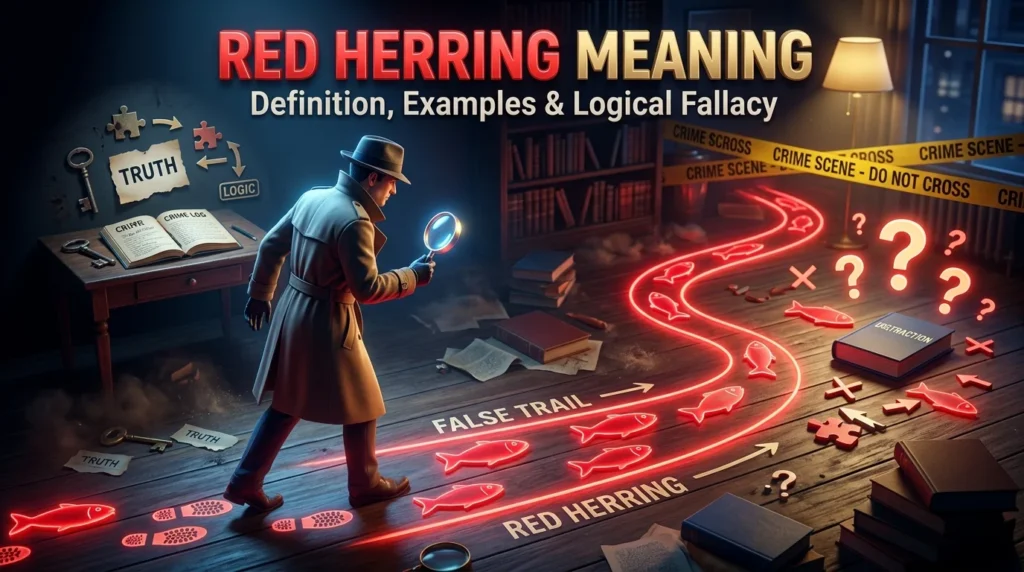

Have you ever been in a conversation where someone suddenly changed the subject to distract everyone from the real issue? Or perhaps you’ve watched a mystery movie where the audience is intentionally led toward the wrong suspect before the true culprit is revealed. These situations perfectly illustrate the red herring meaning, one of the most interesting idioms in the English language. Although the phrase literally refers to a type of smoked fish, its figurative meaning has nothing to do with seafood. Instead, it describes a false clue, misleading argument, or distraction that shifts attention away from the main topic.
If you’ve searched for red herring meaning, you’re probably trying to understand how this expression is used in literature, debates, conversations, text messages, and everyday English. This complete guide explains red herring meaning in English, what does red herring mean, red herring meaning in literature, pronunciation, sentence usage, examples, logical fallacies, and the difference between red herring and straw man. Whether you’re improving your vocabulary, studying English idioms, or learning critical thinking skills, this guide covers every important aspect. If you enjoy discovering the meanings of English words, idioms, abbreviations, and internet expressions, Trendy Meaning is your trusted source for easy-to-understand explanations.
Meaning & Definition
The red herring meaning refers to something that distracts people from the real issue, question, or topic. It can be a misleading clue, an irrelevant argument, or a deliberate attempt to divert attention away from what truly matters. Rather than helping solve a problem, a red herring creates confusion by encouraging people to focus on something unrelated or less important.
In simple English, a red herring is a distraction. It can appear in conversations, debates, news reports, detective stories, business discussions, politics, or everyday life. For example, if someone changes the subject during an argument to avoid answering a difficult question, they are introducing a red herring. Likewise, mystery novels often use false clues that lead readers toward the wrong suspect before revealing the actual solution. In every case, the purpose of a red herring is to shift attention away from the truth.
Background
The origin of the red herring dates back several centuries. Originally, a red herring was a strongly smoked fish that turned reddish in color and produced a powerful smell. According to a popular historical explanation, these fish were sometimes used to train hunting dogs by dragging them across a trail to distract the dogs or teach them to follow scents more carefully. Although historians continue to debate the exact origin of this story, the phrase gradually became associated with anything that intentionally distracts or misleads.
Over time, red herring evolved into a well-known English idiom used far beyond its original meaning. Today, it is widely recognized in literature, journalism, politics, law, philosophy, education, and everyday communication. Modern English speakers rarely think about the fish itself. Instead, they immediately understand the phrase as a symbol of distraction, false clues, or misleading information that diverts attention from the main issue.
Usage in Different Contexts
The red herring meaning remains consistent across different contexts, but its application changes depending on the situation. In literature and mystery novels, a red herring is a false clue designed to mislead readers until the story reaches its final twist. In debates or logical discussions, it refers to an irrelevant argument introduced to distract people from the original topic. In politics, public figures may use red herrings to shift attention away from difficult questions or controversial issues.
In everyday conversations, people use the expression whenever someone intentionally changes the subject or introduces unrelated information. Businesses may encounter red herrings during negotiations, while journalists may identify them in media discussions or interviews. Even social media users sometimes describe misleading online information as a red herring because it distracts audiences from the real issue. Understanding these different contexts helps you recognize the idiom wherever it appears.
Red Herring Meaning in English
The red herring meaning in English is a misleading clue, irrelevant argument, or distraction that takes attention away from the real subject. It is an idiomatic expression rather than a literal phrase, meaning its figurative definition differs completely from the actual words. Native English speakers commonly use this idiom in conversations about debates, detective stories, politics, media, and everyday situations involving distraction or misdirection.
For example, someone might say, “His comments about my past were just a red herring because they had nothing to do with the discussion.” Another person may explain, “The author included several red herrings before revealing the true villain.” In both cases, red herring refers to something that diverts attention from the real issue instead of helping solve it. This makes it one of the most useful idioms for discussing misleading information and false leads.
What Does Red Herring Mean?
If you’re wondering what does red herring mean, the simplest explanation is that it describes something that distracts people from the real topic or problem. Instead of addressing the main question, a red herring introduces unrelated information that causes confusion or shifts people’s focus elsewhere. Sometimes this distraction is intentional, while in other cases it happens accidentally during conversations or discussions.
Imagine two people discussing the quality of a product. Instead of answering questions about the product, one person suddenly starts talking about the company’s history. That unrelated information becomes a red herring because it distracts everyone from the original issue. Similarly, mystery stories often include characters or clues that appear suspicious but ultimately have nothing to do with solving the crime. These false clues are classic examples of red herrings.
Red Herring Meaning in Literature

The red herring meaning in literature refers to a storytelling technique in which authors deliberately introduce misleading clues to keep readers guessing. Mystery novels, detective stories, thrillers, and crime fiction frequently use red herrings to create suspense and prevent readers from identifying the correct solution too early. These false clues make the story more engaging by encouraging readers to question their assumptions.
For example, a mystery novel may introduce a suspicious character who appears guilty throughout most of the story. Readers naturally believe this person committed the crime, only to discover later that the character was completely innocent. The suspicious behavior served as a red herring, distracting readers from the true culprit. Skilled authors use this technique carefully to maintain suspense without making the ending feel unfair or unrealistic.
Red Herring Meaning in Text
The red herring meaning in text is the same as its general English meaning. When someone uses the phrase in text messages, emails, online discussions, or chats, they usually mean that a person has introduced an unrelated topic to distract others from the real issue. Although the expression is less common in casual texting than internet abbreviations, it is frequently used in professional conversations, academic discussions, and thoughtful online debates.
For example, someone might text, “Don’t let that comment become a red herring—we’re discussing the budget, not last year’s project.” In another conversation, a friend could write, “His excuse was just a red herring to avoid answering the question.” In both examples, the phrase highlights an attempt to shift attention away from the original topic rather than addressing it directly.
Red Herring Meaning in Slang
The red herring meaning in slang is very similar to its traditional definition, although it is not actually a slang term. Instead, it is an English idiom that people use informally in conversations, social media posts, podcasts, and online forums. In casual language, calling something a red herring simply means it is a distraction or a false lead that takes attention away from what really matters.
On platforms like Reddit, X, TikTok, YouTube, and discussion forums, people often describe misleading headlines, confusing theories, or unrelated arguments as red herrings. For example, someone may comment, “That rumor is just a red herring,” meaning the rumor distracts people from the real facts. While the tone is informal, the meaning remains the same: something that intentionally or unintentionally misleads people.
Red Herring Meaning with Examples
Learning the red herring meaning with examples makes the idiom much easier to understand. A red herring can appear in books, conversations, debates, business meetings, politics, or everyday life whenever attention is diverted away from the main issue.
Here are some natural examples:
- The detective realized the mysterious letter was a red herring and not the real clue.
- Bringing up my past mistakes was a red herring during the discussion.
- The movie introduced several red herrings before revealing the actual villain.
- His comments about the weather were a red herring that avoided the important question.
- The advertisement acted as a red herring by distracting customers from the product’s weaknesses.
- The politician used a red herring to avoid answering questions about the policy.
These examples show that a red herring is not a lie itself but a distraction that shifts attention away from the real subject.
Red Herring Pronunciation
The correct red herring pronunciation is:
red HAIR-ing
Phonetic spelling: /ˌred ˈher.ɪŋ/
The word red is pronounced normally, while herring sounds like HAIR-ing, with the stress placed on the first syllable of herring. Because this is a common English idiom, native speakers pronounce it naturally in both formal and casual conversations. Listening to native pronunciation and repeating the phrase several times can help English learners speak it confidently and correctly.
How to Use Red Herring in a Sentence
Knowing how to use red herring in a sentence helps you recognize and apply this idiom naturally. Since red herring is a noun phrase, it usually describes a misleading clue, irrelevant point, or distraction. It commonly appears in discussions about debates, mystery stories, politics, business, journalism, and everyday conversations where someone shifts attention away from the real issue.
Here are some natural sentence examples:
- The detective ignored the red herring and continued searching for the real evidence.
- Changing the subject was a red herring that confused everyone in the meeting.
- The novel included several clever red herrings before revealing the true criminal.
- His argument about unrelated issues was a classic red herring.
- The lawyer pointed out that the opposing side was using a red herring to distract the jury.
- Don’t let social media rumors become a red herring that distracts you from verified facts.
These examples demonstrate that the idiom is useful in both professional and everyday English whenever someone introduces misleading or irrelevant information.
Red Herring Fallacy Meaning
The red herring fallacy meaning refers to a logical fallacy in which someone introduces an irrelevant topic or argument to distract attention from the original issue. Instead of responding directly to a question or addressing the main point, the speaker shifts the discussion toward something unrelated. This tactic can confuse listeners, derail debates, and make it harder to reach a logical conclusion.
For example, imagine someone is asked about poor customer service, but instead of answering, they begin talking about how successful the company was ten years ago. The company’s past success has nothing to do with the current complaint, making it a classic red herring fallacy. Recognizing this fallacy is an important critical thinking skill because it helps you stay focused on the actual topic instead of being distracted by irrelevant information.
Difference Between Red Herring and Straw Man

Many people confuse the red herring fallacy with the straw man fallacy because both are common reasoning errors. However, they are fundamentally different. A red herring distracts people by introducing an unrelated topic, while a straw man misrepresents another person’s argument so it becomes easier to attack. One changes the subject, whereas the other changes the argument itself.
For example, if someone asks, “How will this policy reduce traffic?” and the response is about creating new jobs, that is a red herring because it avoids the original question. On the other hand, if someone says, “You want fewer cars, so you want to ban all driving,” they are creating a straw man by exaggerating the original argument. Understanding this distinction helps improve reasoning, debate skills, and communication.
| Red Herring | Straw Man |
|---|---|
| Changes the subject | Changes the argument |
| Introduces irrelevant information | Misrepresents someone’s position |
| Distracts from the issue | Attacks a distorted version of the issue |
| Avoids answering the original question | Creates an easier argument to defeat |
Red Herring in Movies and Mystery Stories
One of the most famous uses of a red herring appears in mystery novels, detective fiction, crime dramas, and suspense films. Writers intentionally introduce suspicious characters, misleading clues, or unexpected events to convince audiences that they have already solved the mystery. These false leads build suspense and keep readers or viewers engaged until the final reveal.
For example, a detective movie might focus heavily on one suspect throughout the story, only to reveal that another character committed the crime. The first suspect was never guilty—they simply served as a red herring. Skilled authors use this storytelling technique to surprise audiences without making the ending feel unfair. This literary device is one of the defining features of successful mystery and thriller stories.
How to Identify a Red Herring Argument
Learning how to identify a red herring argument helps you become a stronger critical thinker. The easiest way to recognize one is to ask yourself whether the new information actually answers the original question. If the conversation suddenly shifts to an unrelated topic without resolving the main issue, there is a good chance a red herring has been introduced.
Another useful strategy is to stay focused on the central point of the discussion. Ask questions like, “How does this relate to the original issue?” or “Does this information help answer the question?” If the answer is no, the argument may simply be a distraction. Identifying red herrings is especially valuable in debates, politics, advertising, media, and online discussions where misleading information is common.
Common Mistakes When Using Red Herring
One common mistake is assuming that every incorrect statement is a red herring. In reality, a red herring is specifically a distraction that shifts attention away from the main issue. Someone can be wrong without using a red herring. The defining feature is the attempt—intentional or accidental—to divert the discussion rather than address the original topic.
Another mistake is confusing red herring with other logical fallacies such as straw man, false dilemma, or ad hominem. Each fallacy works differently and serves a different purpose. Using the correct term not only improves your English vocabulary but also strengthens your reasoning and communication skills in academic, professional, and everyday conversations.
Frequently Asked Questions
What does red herring mean?
A red herring is a misleading clue, distraction, or irrelevant argument that takes attention away from the real issue or topic.
What is a red herring in literature?
In literature, a red herring is a false clue that intentionally misleads readers to make a story more suspenseful before revealing the true answer.
What is the red herring fallacy?
The red herring fallacy is a logical error where someone introduces an unrelated topic to distract people from the original discussion instead of addressing it directly.
How do you use red herring in a sentence?
Example: The detective ignored the red herring and focused on the evidence that actually solved the case.
What is the difference between a red herring and a straw man?
A red herring changes the subject by introducing irrelevant information, while a straw man misrepresents another person’s argument to make it easier to criticize.
Conclusion
Understanding the red herring meaning helps you recognize one of the most widely used idioms in English. Whether it appears in a mystery novel, a political debate, a business meeting, or an everyday conversation, a red herring always serves the same purpose: distracting attention from the real issue. By learning its definition, origin, examples, pronunciation, and logical significance, you can identify misleading arguments and communicate more effectively.
In this guide, you’ve learned what does red herring mean, red herring meaning in English, red herring meaning in literature, red herring meaning in text, red herring meaning in slang, pronunciation, sentence usage, the red herring fallacy meaning, and the difference between red herring and straw man. With these explanations and practical examples, you’ll be able to recognize and use this idiom confidently in both written and spoken English.
If you enjoy learning the meanings of English words, idioms, internet slang, abbreviations, and trending expressions, visit Trendy Meaning. Our in-depth guides are written in simple, reader-friendly language to help you expand your vocabulary, improve your English, and understand modern expressions with confidence.
See Also:
Cathartic Meaning: Definition, Psychology & Examples