


Certain words in English describe not just an action but also a feeling, and reminiscing is one of them. Have you ever looked through old photographs, talked with childhood friends about school days, or smiled while remembering a special family vacation? Those moments are examples of reminiscing. Understanding the reminiscing meaning helps you express emotions connected to memories, nostalgia, and personal experiences. This beautiful word is commonly used in everyday conversations, literature, social media, and storytelling to describe the act of thinking or talking about meaningful events from the past.
In this comprehensive guide, you’ll learn the reminiscing meaning in English, what does reminiscing mean, reminiscing meaning in text, pronunciation, examples, sentence usage, synonyms, antonyms, and the difference between reminiscing and remembering. You’ll also discover why people reminisce, whether reminiscing is a positive emotion, and how the word is used in different situations. Whether you’re improving your English vocabulary, preparing for exams, writing creatively, or simply curious about the word, this article covers every important aspect in a clear and engaging way. If you enjoy learning the meanings of English words, idioms, internet slang, and trending expressions, Trendy Meaning is the perfect place to explore them.
Meaning & Definition
The reminiscing meaning refers to thinking about, recalling, or talking about pleasant memories and experiences from the past. It usually involves reflecting on meaningful moments with family, friends, school, work, travel, or important life events. Unlike simply remembering a fact, reminiscing often carries an emotional connection and brings back feelings of happiness, gratitude, or even gentle sadness.
In simple English, reminiscing means remembering the past with affection or nostalgia. A person who is reminiscing is often sharing stories, looking through old photographs, or recalling memorable experiences with others. For example, grandparents may reminisce about their childhood, friends may reminisce about college days, or siblings may reminisce about family vacations. The word emphasizes emotional reflection rather than just recalling information, making it richer and more expressive than the word remember.
Background
The word reminiscing comes from the verb reminisce, which originates from the Latin word reminisci, meaning to remember or to recall to mind. Over time, the meaning evolved beyond simple memory and became closely associated with reflecting on personal experiences in a thoughtful and emotional way. Today, the word is widely used in English literature, psychology, conversations, and storytelling to describe looking back on meaningful moments.
As communication evolved through books, films, social media, and digital conversations, reminiscing became even more common. People frequently use the word when discussing childhood memories, family traditions, school experiences, friendships, or significant milestones in life. Because everyone has memories worth sharing, reminiscing remains a timeless expression that connects people across generations and cultures.
Usage in Different Contexts
The reminiscing meaning remains consistent across different situations, but the context changes how the word is used. In everyday conversations, people reminisce about birthdays, vacations, childhood adventures, old friendships, or family gatherings. During reunions, classmates often spend hours reminiscing about funny incidents from school, while relatives may reminisce during holiday celebrations by sharing stories from previous generations.
In literature and psychology, reminiscing has a deeper meaning because it reflects personal identity, emotional well-being, and human relationships. Authors use reminiscing to reveal a character’s emotions and past experiences, while psychologists recognize that healthy reminiscing can strengthen emotional connections and improve mental well-being. On social media, people also reminisce by posting old photos with captions like “Just reminiscing about the good old days” or “Reminiscing on unforgettable memories.” This broad usage makes the word valuable in both formal writing and everyday communication.
Reminiscing Meaning in English
The reminiscing meaning in English is thinking about or talking about happy, meaningful, or memorable experiences from the past. It describes the act of reflecting on previous events with emotion rather than simply recalling facts. The word often suggests warmth, nostalgia, appreciation, or sentimental feelings toward those memories.
For example, after finding an old family photo album, someone might spend the evening reminiscing about childhood vacations and celebrations. Likewise, lifelong friends may meet after many years and reminisce about their school adventures. In both situations, the focus is not only on remembering events but also on enjoying the emotions connected to those experiences. This emotional element is what makes reminiscing different from ordinary remembering.
What Does Reminiscing Mean?
If you’re wondering what does reminiscing mean, the simplest explanation is that it means remembering and talking about meaningful moments from your past, usually with positive or emotional feelings. People reminisce because memories help them reconnect with loved ones, celebrate important experiences, and reflect on how life has changed over time.
For example, imagine a family gathering where grandparents share stories about their younger years while everyone laughs and listens. That conversation is a form of reminiscing because it involves recalling personal experiences with emotion and detail. Similarly, college friends who meet after graduation often reminisce about funny classroom moments, memorable trips, and shared achievements. In each case, reminiscing strengthens relationships by bringing people together through shared memories.
Reminiscing Meaning in Text
The reminiscing meaning in text is the same as its standard English definition. When someone uses the word in text messages, emails, or social media, they usually mean they are thinking about or discussing old memories with affection or nostalgia. Unlike internet abbreviations or slang, reminiscing is a standard English word that retains the same meaning across digital and face-to-face communication.
For instance, someone might text, “I’m reminiscing about our road trip from last summer,” to express that they are happily remembering that experience. Another person may post, “Just reminiscing while looking through old photos,” to share a nostalgic moment with friends. In both examples, the word communicates emotional reflection and appreciation for past experiences, making it popular in conversations, captions, blogs, and online storytelling.
Reminiscing Meaning in Urdu
The reminiscing meaning in Urdu is commonly translated as پرانی یادوں کو تازہ کرنا, ماضی کی خوشگوار یادوں کو یاد کرنا, یادوں میں کھو جانا, or پرانی باتوں کو یاد کر کے خوش ہونا. These expressions describe the act of thinking or talking about meaningful moments from the past with warmth and emotion. Unlike simply remembering a fact, reminiscing usually involves personal experiences that hold emotional value.
For example, if someone says, “We spent the evening reminiscing about our school days,” it can be translated as “ہم نے شام اپنے اسکول کے دنوں کی خوشگوار یادیں تازہ کرتے ہوئے گزاری۔” Similarly, when grandparents share stories about their childhood, they are پرانی یادوں کو تازہ کر رہے ہوتے ہیں. Understanding the Urdu meaning makes it easier for learners to connect the English word with real-life situations and use it naturally in conversations.
Reminiscing Meaning in Hindi
The reminiscing meaning in Hindi is generally translated as पुरानी यादों को ताज़ा करना, बीते हुए पलों को याद करना, पुरानी बातों को याद करके भावुक होना, or अतीत की यादों में खो जाना. These expressions describe the emotional act of recalling meaningful experiences from the past, especially those connected with family, friends, childhood, or important life events.
For example, the sentence “My grandparents love reminiscing about their childhood” can be translated as “मेरे दादा-दादी अपने बचपन की यादों को ताज़ा करना पसंद करते हैं।” Likewise, “We were reminiscing about our college days” becomes “हम अपने कॉलेज के दिनों की यादें ताज़ा कर रहे थे।” These examples show that reminiscing is associated with pleasant reflection and emotional storytelling rather than simply remembering information.
Reminiscing Pronunciation
The correct reminiscing pronunciation is:
rem-uh-NISS-ing
Phonetic spelling: /ˌrem.əˈnɪs.ɪŋ/
The stress falls on the third syllable, NISS, making it the strongest part of the word. Native English speakers pronounce the word smoothly, and practicing it slowly before increasing your speed can help you sound more natural.
Here are a few pronunciation tips:
- Break the word into parts: rem – uh – NISS – ing
- Place the strongest stress on NISS.
- Pronounce the ending -ing clearly.
- Practice by saying the complete word several times in everyday sentences.
Reminiscing Meaning with Examples
Learning the reminiscing meaning with examples makes it much easier to understand how the word is used naturally in English. Since reminiscing refers to recalling meaningful memories with emotion, it often appears in conversations about family, friendships, school, travel, and life experiences.
Here are some natural examples:
- We spent the evening reminiscing about our childhood adventures.
- My grandparents enjoy reminiscing about the good old days.
- She smiled while reminiscing about her first day at university.
- The old photographs made everyone start reminiscing together.
- After the reunion, friends were reminiscing about their school memories.
- He sat quietly, reminiscing about the years he spent traveling the world.
Each example shows that reminiscing is more than simply remembering—it involves emotional reflection and appreciation of meaningful experiences.
How to Use Reminiscing in a Sentence
Understanding how to use reminiscing in a sentence helps you communicate naturally in both speaking and writing. The word reminiscing is the present participle of reminisce and is commonly used after verbs like was, were, spent, kept, or enjoyed. It often describes people thinking or talking about memorable experiences from the past.
Here are several natural sentence examples:
- We were reminiscing about our school days during the reunion.
- She enjoys reminiscing with her grandparents every weekend.
- They spent hours reminiscing about their unforgettable vacation.
- Looking at old photos always gets me reminiscing about childhood.
- The family sat together reminiscing after dinner.
- He was reminiscing about his first job while speaking to new employees.
- Sometimes reminiscing helps people appreciate how much they have grown.
These examples show that reminiscing is commonly used when discussing happy memories, important life events, and shared experiences. It fits naturally in conversations, storytelling, personal writing, speeches, and even social media captions where people reflect on meaningful moments from the past.
Reminiscing Synonym and Antonym
Understanding the reminiscing synonym and antonym helps you expand your vocabulary and choose the right word for different situations. Since reminiscing means recalling meaningful memories with emotion, its synonyms focus on remembering, reflecting, and looking back on life experiences. Its antonyms, however, describe forgetting or ignoring past events.
Synonyms
- Remembering
- Recalling
- Reflecting
- Looking back
- Recollecting
- Thinking back
- Nostalgic
- Reflective
- Recounting
- Reliving memories
Antonyms
- Forgetting
- Ignoring
- Overlooking
- Disregarding
- Neglecting
- Erasing
- Dismissing
- Moving on
- Avoiding memories
- Suppressing memories
Although these words are related, each has a slightly different meaning. For example, recollecting simply means remembering information, while reminiscing usually involves emotion, storytelling, and personal experiences. Choosing the right word makes your communication more accurate and expressive.
Difference Between Reminiscing and Remembering
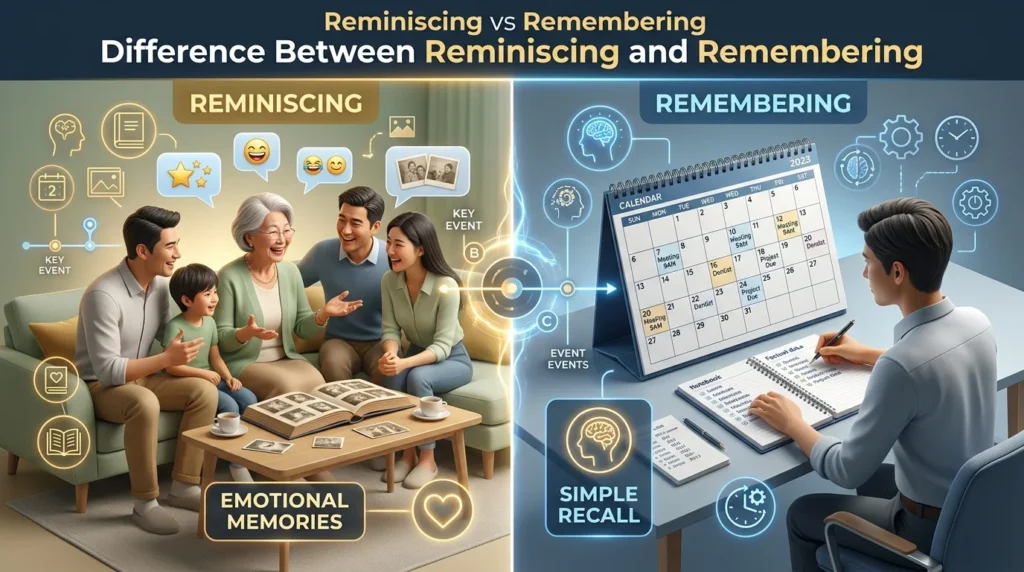
Many people believe reminiscing and remembering have exactly the same meaning, but there is a clear difference between the two. Remembering is the general act of recalling any information, event, person, or fact from the past. It can be emotional or completely factual. Reminiscing, however, specifically refers to recalling personal memories with emotion, nostalgia, or affection, often by sharing stories with others.
For example, remembering your friend’s phone number is simply recalling information. In contrast, talking with that friend about your childhood adventures, funny school moments, or family vacations is reminiscing because those memories carry emotional value. This distinction makes reminiscing a richer and more expressive word when discussing life experiences.
| Reminiscing | Remembering |
|---|---|
| Emotional reflection | General memory recall |
| Usually about personal experiences | Can be about facts or information |
| Often shared through conversations | May happen silently |
| Closely connected with nostalgia | Not always emotional |
Is Reminiscing a Positive Emotion?
Many people ask, is reminiscing a positive emotion? In most situations, the answer is yes. Reminiscing often brings feelings of happiness, gratitude, comfort, and appreciation by allowing people to reconnect with meaningful moments from their lives. Looking back on joyful experiences with family, friends, or loved ones can strengthen emotional bonds and create a sense of belonging.
However, reminiscing is not always completely positive. Sometimes old memories can remind people of someone they have lost or a period of life that has ended. Even then, the experience is often bittersweet rather than entirely negative. Psychologists explain that healthy reminiscing helps people appreciate their personal growth, preserve important memories, and maintain emotional connections with loved ones.
Why Do People Reminisce?
People reminisce because memories help them reconnect with their identity, relationships, and life experiences. Looking back at meaningful moments reminds us of where we came from, the people who shaped our lives, and the lessons we’ve learned over time. Family gatherings, reunions, anniversaries, birthdays, and old photographs often encourage people to reminisce naturally.
Research in psychology also suggests that reminiscing can improve emotional well-being. Talking about positive memories reduces stress, strengthens social relationships, and increases feelings of gratitude and happiness. This is why grandparents enjoy sharing stories with grandchildren and why friends often spend hours reminiscing during reunions. These conversations preserve memories while bringing people closer together.
Difference Between Reminiscing and Nostalgia
Although reminiscing and nostalgia are closely related, they are not identical. Reminiscing is the action of recalling or discussing memories from the past. Nostalgia, on the other hand, is the emotional feeling that often accompanies those memories. In simple words, reminiscing is something you do, while nostalgia is something you feel.
For example, when friends talk about their college years, they are reminiscing. If those memories create a warm feeling mixed with happiness and longing for those days, that emotional response is nostalgia. Understanding this difference helps you choose the correct word depending on whether you’re describing an action or an emotion.
Benefits of Reminiscing

Reminiscing offers several emotional, social, and psychological benefits. Looking back on meaningful experiences helps people appreciate how far they have come while reminding them of important relationships and achievements. Sharing memories also strengthens communication because it encourages storytelling and meaningful conversations between family members and friends.
Some of the biggest benefits of reminiscing include:
- Strengthens family relationships.
- Improves emotional well-being.
- Encourages gratitude.
- Preserves family history and traditions.
- Builds stronger friendships.
- Increases happiness through positive memories.
- Supports healthy self-reflection.
- Helps people cope with life changes.
- Encourages meaningful conversations.
- Improves emotional connection across generations.
These benefits explain why reminiscing plays an important role in psychology, communication, and personal development.
Common Situations Where People Reminisce
People naturally reminisce during important moments that remind them of the past. Family reunions, school reunions, weddings, birthdays, anniversaries, and holiday celebrations often lead to conversations about shared experiences. Looking through old photographs, watching home videos, or listening to favorite songs can also trigger memories and inspire people to reminisce.
Social media has created new opportunities for reminiscing as well. Many people post old pictures with captions like “Throwback Thursday” or “Remember this?” to share meaningful memories with friends and family. Whether the memories are about childhood, travel, education, or career milestones, reminiscing helps people celebrate life’s journey and strengthen personal relationships.
Common Mistakes When Using Reminiscing
One common mistake is using reminiscing to describe any type of remembering. While all reminiscing involves remembering, not every memory is reminiscing. For example, remembering a password or an appointment is simply recalling information. Reminiscing specifically involves emotional or meaningful memories connected to personal experiences.
Another mistake is confusing reminiscing with nostalgia. Remember that reminiscing is the act of recalling or discussing memories, whereas nostalgia is the feeling that those memories create. Using the words correctly makes your writing and conversations more precise, especially in academic or professional English.
Frequently Asked Questions
What does reminiscing mean?
Reminiscing means thinking about or talking about meaningful memories from the past, usually with happiness, nostalgia, or emotional reflection.
Is reminiscing a positive emotion?
Yes. In most cases, reminiscing creates positive feelings such as happiness, gratitude, comfort, and emotional connection, although some memories can also feel bittersweet.
What is the difference between reminiscing and remembering?
Remembering is simply recalling information or events, while reminiscing involves emotionally reflecting on personal experiences and often sharing those memories with others.
Why do people reminisce?
People reminisce to reconnect with meaningful experiences, strengthen relationships, preserve memories, celebrate life events, and reflect on personal growth.
How do you use reminiscing in a sentence?
Example: We spent the evening reminiscing about our childhood adventures and laughing at old memories.
Conclusion
Understanding the reminiscing meaning helps you express emotions that simple words like remember cannot fully capture. Whether you’re talking about childhood, family gatherings, friendships, travel experiences, or important life milestones, reminiscing describes the meaningful act of looking back on the past with appreciation and emotion. It is a beautiful word that reflects connection, gratitude, and the value of shared memories.
In this guide, you’ve learned the reminiscing meaning in English, what does reminiscing mean, reminiscing meaning in text, reminiscing meaning in Urdu, reminiscing meaning in Hindi, pronunciation, examples, sentence usage, synonyms, antonyms, the difference between reminiscing and remembering, why people reminisce, and the emotional benefits of reflecting on the past. These insights will help you use the word confidently in conversations, writing, and everyday English.
If you’re interested in learning the meanings of English words, idioms, abbreviations, internet slang, and trending expressions, visit Trendy Meaning. Our in-depth, easy-to-read guides are designed to improve your vocabulary, strengthen your communication skills, and help you understand modern English with confidence.
See Also:
Diligent Meaning: Definition, Examples & Sentence Uses