
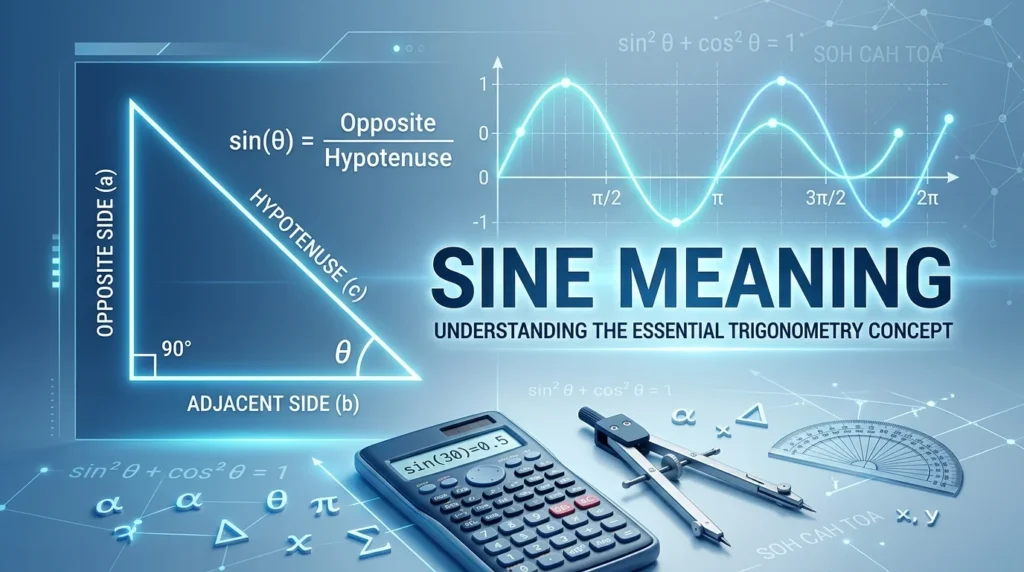

If you’ve ever studied mathematics or used a scientific calculator, you’ve probably come across the word sine. Many students and English learners search for sine meaning because they want to understand what it actually represents and why it is such an important concept in mathematics. Although the word is most commonly associated with trigonometry, it also appears in engineering, physics, architecture, computer graphics, and many real-world applications. Learning its meaning helps you understand both mathematical formulas and practical problem-solving.
This comprehensive guide explains the sine meaning in math, answers what does sine mean, explores its definition, history, and practical uses, and compares it with other trigonometric functions. Whether you’re a student, teacher, or simply curious about mathematics, you’ll find clear explanations, simple examples, and easy-to-understand language throughout this article. If you enjoy learning the meanings of educational terms and commonly searched words, Trendy Meaning is the perfect place to discover detailed yet beginner-friendly explanations.
Meaning & Definition
The sine meaning refers to one of the fundamental trigonometric functions used to calculate relationships between angles and sides in a right triangle. In mathematics, sine (sin) is defined as the ratio of the length of the opposite side to the length of the hypotenuse. This relationship helps solve problems involving angles, distances, heights, and waves.
The sine definition extends beyond simple geometry. Modern mathematics uses the sine function to study periodic motion, sound waves, light waves, electrical signals, and many natural phenomena. Because of its versatility, sine has become one of the most widely used mathematical functions in science and engineering. Understanding its definition provides a strong foundation for learning trigonometry and advanced mathematics.
Background
The concept of sine has a fascinating history that dates back thousands of years. Ancient mathematicians in India first developed ideas that later evolved into the modern sine function. These concepts were translated into Arabic and eventually introduced to Europe, where mathematicians refined the terminology and notation used today. Over centuries, sine became one of the core functions of trigonometry.
Today, the sine function is taught in schools and universities around the world because it plays a critical role in mathematics, engineering, architecture, navigation, astronomy, computer graphics, and physics. Although students often first encounter sine in geometry classes, its applications extend far beyond the classroom and into many everyday technologies.
Usage in Different Contexts
The meaning of sine changes slightly depending on the field in which it is used, but the mathematical principle remains the same. In trigonometry, it is used to calculate unknown sides and angles of right triangles. In physics, sine functions describe wave motion, oscillations, and vibrations. Engineers use sine when designing bridges, buildings, electrical systems, and communication technologies.
Sine also appears in computer graphics, animation, navigation systems, robotics, and signal processing. Even music and acoustics rely on sine waves to explain sound frequencies and vibrations. Because the sine function is essential in so many disciplines, understanding its meaning provides valuable knowledge that extends beyond mathematics into real-world problem solving.
Common Contexts Where “Sine” Is Used
- Mathematics
- Trigonometry
- Geometry
- Physics
- Engineering
- Architecture
- Astronomy
- Navigation
- Computer Graphics
- Signal Processing
- Electrical Engineering
- Wave Analysis
Sine Meaning in Math
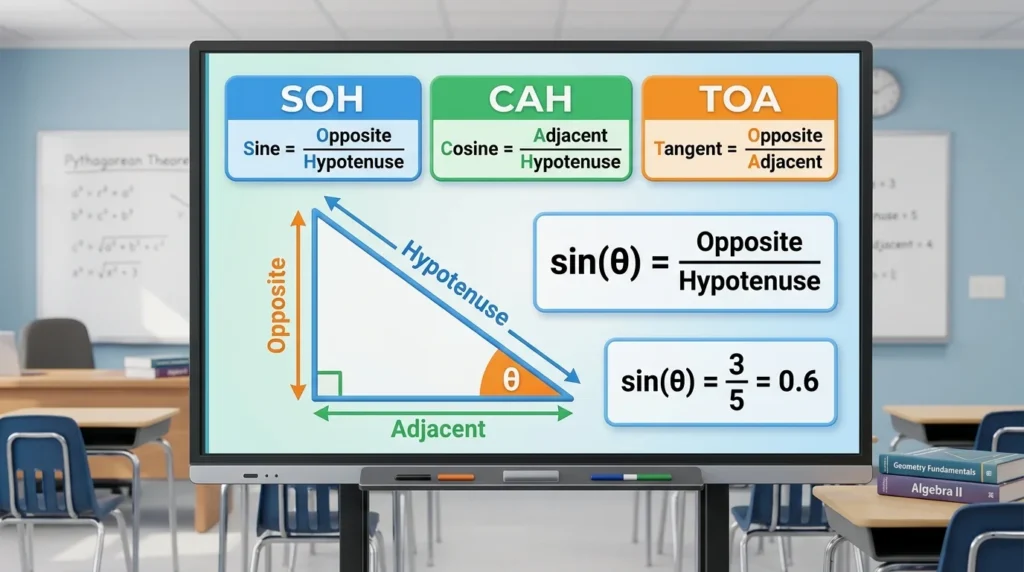
The sine meaning in math refers to one of the three primary trigonometric functions used to solve problems involving angles and sides of a right triangle. It is represented by sin and is calculated by dividing the length of the opposite side by the length of the hypotenuse. Students often remember this relationship using the famous mnemonic SOH CAH TOA, where SOH stands for Sine = Opposite ÷ Hypotenuse.
In mathematics, sine is much more than a simple ratio. It helps solve problems involving distances, heights, slopes, rotations, and circular motion. Whether you’re finding the height of a building or calculating the angle of a ramp, the sine function provides accurate mathematical solutions. This is why it is one of the first trigonometric concepts students learn.
What Does Sine Mean?
If you’re asking what does sine mean, the simplest explanation is that it measures the relationship between an angle and the sides of a right triangle. It tells us how large the opposite side is compared to the hypotenuse. This mathematical relationship makes it possible to calculate unknown lengths and angles without direct measurement.
Outside the classroom, sine represents repeating patterns and wave-like motion. Scientists and engineers use it to describe natural phenomena such as sound waves, ocean waves, electricity, and light. Because of its ability to model periodic motion, the sine function is considered one of the most important concepts in mathematics and science.
Sine Meaning in Trigonometry
The sine meaning in trigonometry is based on the ratio between the opposite side and the hypotenuse of a right triangle. Every angle has a unique sine value, allowing mathematicians to solve triangles quickly and accurately. Trigonometry relies heavily on sine, cosine, and tangent to analyze shapes, distances, and angles.
As students advance in mathematics, they discover that sine also works with the unit circle, radians, and graphs. This broader understanding allows trigonometric functions to solve complex problems in engineering, navigation, architecture, and advanced physics. The sine function therefore serves as a bridge between basic geometry and higher mathematics.
Sine Definition
The sine definition is the ratio of the opposite side to the hypotenuse in a right triangle. In mathematical notation, it is written as:
sin θ = Opposite ÷ Hypotenuse
This definition forms the foundation of trigonometry. Beyond triangles, sine is also defined using the unit circle, where it represents the vertical coordinate of a point on the circle. This extended definition allows the sine function to describe periodic motion, graphs, and wave behavior in many scientific fields.
Sine Meaning with Example
Understanding the sine meaning with example makes the concept much easier to remember. Imagine a right triangle where the opposite side measures 5 units and the hypotenuse measures 10 units. The sine of the angle is:
sin θ = 5 ÷ 10 = 0.5
Real-life examples include calculating the height of a tree using its shadow, determining the angle of a roof, measuring the slope of a road, or finding the distance between two locations. Engineers, architects, and surveyors use sine every day to perform accurate measurements.
Sine Meaning in English
The sine meaning in English refers to a mathematical function used in trigonometry. The word itself comes from ancient mathematical terminology and is now recognized worldwide as one of the standard trigonometric functions.
In everyday English, the word sine almost always appears in educational, scientific, or technical discussions. Unlike many English words, it has a very specific mathematical meaning, making it easy to identify whenever it appears in textbooks, calculators, or classroom lessons.
See Also: SAHM Meaning: Definition, Text, Parenting & Social Media
What Is Sine in Mathematics?
When people ask what is sine in mathematics, they are usually referring to one of the six trigonometric functions used to study angles and triangles. Sine helps calculate unknown sides and angles by comparing the opposite side to the hypotenuse.
Modern mathematics also uses sine in algebra, calculus, geometry, differential equations, and graphing. It plays an essential role in analyzing periodic functions, circular motion, and mathematical modeling, making it one of the most valuable tools in higher-level mathematics.
How to Find Sine
Learning how to find sine is straightforward once you understand right triangles. First, identify the angle you are working with. Then locate the opposite side and the hypotenuse. Divide the opposite side by the hypotenuse to calculate the sine value.
For more advanced problems, you can use a scientific calculator or the unit circle. Most calculators include a sin button that instantly calculates the sine of an angle measured in degrees or radians. Understanding both manual calculations and calculator methods improves mathematical confidence.
Sine Formula Explained
The sine formula explained in its simplest form is:
sin θ = Opposite ÷ Hypotenuse
This formula is the basis of countless mathematical calculations involving right triangles. It is also part of the famous memory aid SOH CAH TOA, which helps students remember the formulas for sine, cosine, and tangent.
As mathematics becomes more advanced, sine formulas are used in graphing, wave analysis, calculus, and physics. Despite these advanced applications, every concept begins with the simple ratio learned in introductory trigonometry.
Sine vs Cosine Difference
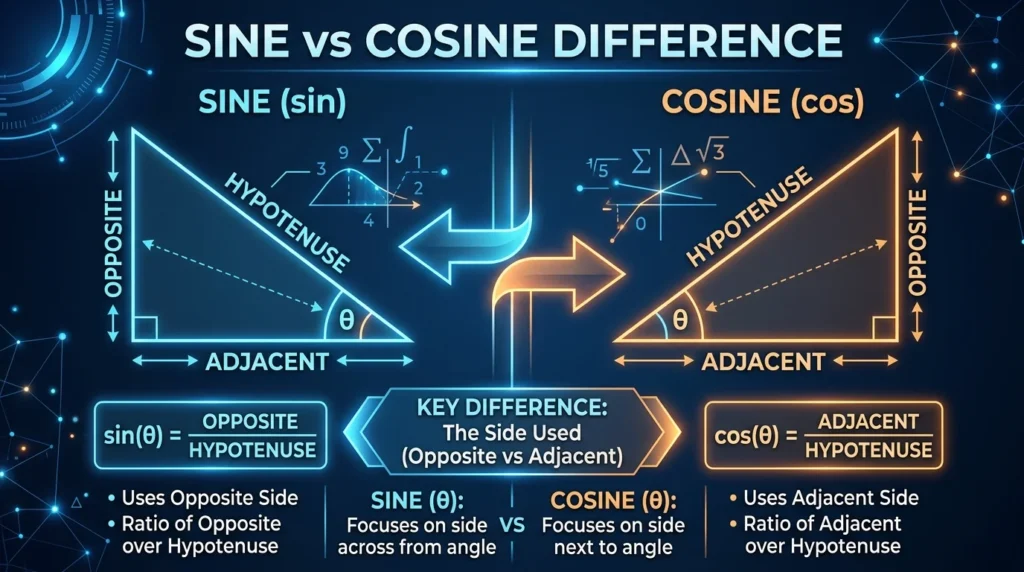
The sine vs cosine difference is one of the first topics students learn in trigonometry. Although both functions relate angles to triangle sides, they compare different sides.
- Sine = Opposite ÷ Hypotenuse
- Cosine = Adjacent ÷ Hypotenuse
While sine measures the opposite side, cosine measures the adjacent side. Both functions are closely related and often appear together when solving mathematical, engineering, and physics problems. Understanding their difference makes solving triangles much easier.
Real-Life Applications of Sine
Many competitors overlook this important topic, but sine has countless real-world uses. Engineers use sine when designing bridges, buildings, roads, and electrical systems. Architects rely on it to calculate roof angles and structural dimensions, while pilots and sailors use trigonometry for navigation.
The sine function is also essential in physics, astronomy, robotics, computer graphics, telecommunications, music production, and medical imaging. From GPS technology to sound engineering, sine plays a key role in many technologies people use every day.
See Also: 6 Mafia Meaning: Origin, Slang & Rap Culture Explained
Common Mistakes When Learning Sine
One common mistake is confusing the opposite side with the adjacent side when using the sine formula. Students also sometimes forget whether their calculator is set to degrees or radians, which can produce incorrect answers.
Another mistake is memorizing formulas without understanding their meaning. Learning how sine relates to triangles, circles, and real-life applications makes the concept much easier to remember and apply correctly in different situations.
Frequently Asked Questions
What does sine mean in math?
Sine is a trigonometric function that equals the ratio of the opposite side to the hypotenuse in a right triangle.
What is the sine formula?
The sine formula is sin θ = Opposite ÷ Hypotenuse.
What is the difference between sine and cosine?
Sine uses the opposite side and hypotenuse, while cosine uses the adjacent side and hypotenuse.
Why is sine important?
Sine is used in mathematics, engineering, physics, navigation, architecture, computer graphics, and many scientific applications.
How do you calculate sine?
Divide the opposite side by the hypotenuse or use the sin function on a scientific calculator.
Conclusion
Understanding the sine meaning is essential for anyone learning mathematics because it forms the foundation of trigonometry and many advanced scientific concepts. Whether you wanted to know what does sine mean, its definition, how to calculate it, or the difference between sine and cosine, the key idea remains the same: sine measures the relationship between the opposite side and the hypotenuse of a right triangle. From solving geometry problems to analyzing sound waves and designing modern technology, the sine function has practical applications far beyond the classroom.
Now that you understand the sine meaning in math, its formulas, examples, real-life uses, and importance in trigonometry, you’ll be able to recognize and apply this concept with confidence. If you’re looking for simple explanations of mathematical terms, English vocabulary, and trending word meanings, visit Trendy Meaning. Our easy-to-read guides help students, professionals, and curious learners understand complex concepts in a clear and engaging way.
See Also: Mea Culpa Meaning: English, Latin & Definition Explained