

Excel is the correct spelling when you mean “to be extremely good at something” or when referring to Microsoft Excel. Excell is not the standard spelling of the English verb. The confusion is understandable because the correct forms excelled and excelling contain two l’s. The important rule is simple: the base verb is excel, with one l.
Quick Answer
Excel is the correct spelling, while excell is normally a spelling mistake in standard English. The verb excel means to be extremely good at something or perform at a particularly high level. For example, “She excels at mathematics.” When suffixes are added, the spelling changes in forms such as excelled and excelling, which explains why people sometimes mistakenly write excell. Excel is also the proper name of Microsoft’s spreadsheet software.
What Is the Difference Between Excel and Excell?
The difference is primarily a matter of spelling and standard usage. Excel is an established English verb meaning to perform exceptionally well, be highly skilled, or stand out in a particular area. Excell is not the standard spelling of that verb.
For example:
Correct: She hopes to excel in her career.
Incorrect: She hopes to excell in her career.
The extra l belongs in forms such as excelled and excelling, not in the base form excel.
There is another important use of Excel. With a capital E, it is the name of Microsoft’s spreadsheet software. Cambridge lists Excel as a trademarked software product as well as recognizing excel as an ordinary English verb.
Why the Difference Matters
A one-letter spelling error can change how polished your writing appears. The mistake is especially noticeable in resumes, academic assignments, business emails, reports, professional profiles, and other edited writing.
Consider these two sentences:
She wants to excel in marketing.
She wants to excell in marketing.
The first uses the standard English verb. The second contains a spelling error.
The distinction also matters when writing about Microsoft Excel. If you write “Microsoft Excell,” “Excell spreadsheet,” or “Excell file,” you are using an incorrect spelling of the software’s name. The product is Excel.
The Core Rule

Use “excel” with one l as the base form. Do not write “excell” when you mean the English verb or Microsoft Excel.
- excel — correct base form
- excels — correct third-person singular form
- excelled — correct past tense and past participle
- excelling — correct present participle
- excell — not the standard spelling of the verb
The easiest rule to remember is: Excel has one l before an ending is added. The spelling can become doubled in forms such as excelled and excelling, but that does not change the base spelling.
How to Use Excel Correctly
Excel as a Verb
As a verb, excel means to be extremely good at something or to perform better than most others. Cambridge gives the core meaning as being extremely good at something and also lists uses with both in and at.
Examples include:
- She excels at solving complex problems.
- He excels in mathematics.
- The team excels at customer service.
- They excel in scientific research.
See Also: Busses vs Buses Differences: Meaning and Correct Usage
Excel With “At”
Excel at is commonly used when talking about an activity, skill, task, or specific thing someone does particularly well.
Examples:
- She excels at public speaking.
- He excels at writing reports.
- Our daughter excels at swimming.
- The designer excels at creating simple interfaces.
Excel With “In”
Excel in is also standard and is often used for a subject, field, area, profession, or broader domain.
- She excels in mathematics.
- He excels in business.
- The company excels in software development.
- They excel in academic research.
There is no need to treat excel at and excel in as completely separate rules. Both are established constructions. The best choice depends on what follows and the intended meaning. Cambridge specifically lists “excel in something” and “excel at something” as alternatives.
Excel as the Name of Microsoft Software
Excel is also the name of Microsoft’s spreadsheet software. In this use, it is a proper name and is normally capitalized.
Examples:
- I created the budget in Excel.
- Please send me the Excel spreadsheet.
- She uses Excel to analyze the sales data.
- The report was prepared in Microsoft Excel.
So, whether you mean the verb or the software, the spelling is Excel, not Excell.
Correct Examples of Excel
These examples show how excel works in different real-world contexts.
Conversation
“You really excel at explaining difficult ideas.”
“I believe Sarah will excel in this new role.”
School
“Daniel continues to excel in science and mathematics.”
Workplace
“Our customer support team excels at resolving technical issues quickly.”
Social Media
“Keep practicing and you’ll excel at this eventually.”
Academic Writing
“Students who excel in analytical reasoning often perform well in research-based subjects.”
Sports
“The athlete excels at defensive play.”
Career
“She has the communication skills needed to excel in management.”
Business
“The company aims to excel in customer experience.”
Technology
“The software is particularly useful for users who work with Excel spreadsheets.”
See Also: Altar vs Alter Differences: Meaning, Usage, and Examples
Incorrect vs. Correct
| ❌ Incorrect | ✅ Correct | Why |
|---|---|---|
| She wants to excell in school. | She wants to excel in school. | The base verb is spelled excel with one l. |
| He can excell at football. | He can excel at football. | After the modal verb “can,” use the base form excel. |
| They hope to excell in business. | They hope to excel in business. | “To” is followed by the base form of the verb. |
| She excells at mathematics. | She excels at mathematics. | The third-person form is excels, with one l before s. |
| He will excell in his new position. | He will excel in his new position. | “Will” takes the base form excel. |
| We use Microsoft Excell. | We use Microsoft Excel. | Excel is the correct name of the software. |
| Please open the Excell file. | Please open the Excel file. | The product name is Excel. |
| She wants to excelling at work. | She wants to excel at work. | After “wants to,” use the base form. |
| They are excell at customer service. | They excel at customer service. | The sentence needs the present-tense verb excel. |
| He is excell in science. | He excels in science. | For present third-person singular, use excels. |
| She excell in writing. | She excels in writing. | The correct third-person form is excels. |
| I hope to excell professionally. | I hope to excel professionally. | The infinitive uses the base form excel. |
Why People Make This Mistake
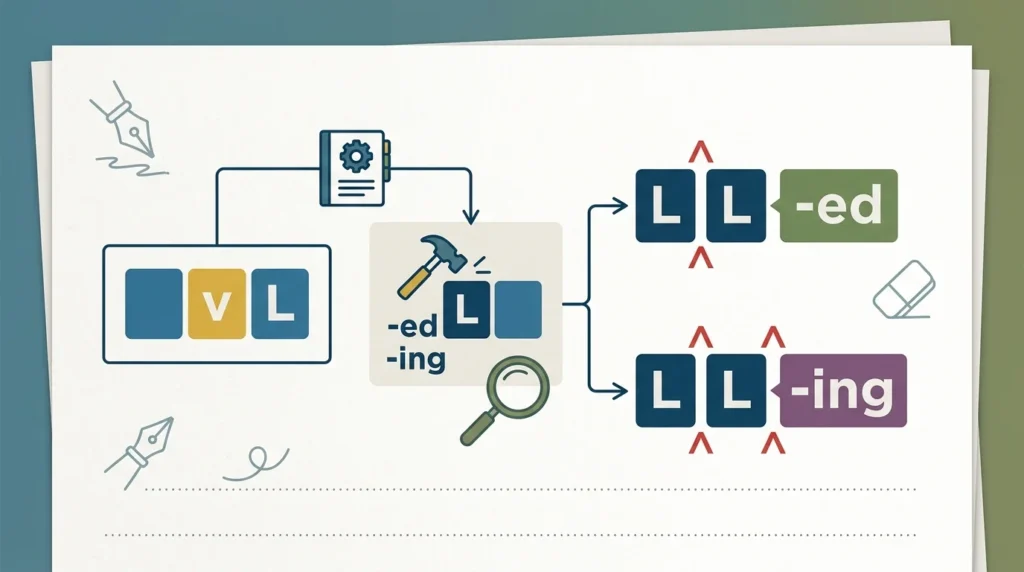
The Double L in Excelled and Excelling
The most common reason for the mistake is seeing excelled and excelling. Both forms contain two l’s, so writers may incorrectly assume that the base form must also contain two l’s.
That produces the incorrect form excell.
The correct relationship is:
excel → excelled → excelling
Not:
excell → excelled → excelling
Similarity to Other Words
English has many words containing doubled consonants, so spelling patterns can be easy to overgeneralize. A writer may remember the double l from a related-looking form and carry it into the base word.
The word excellent may also contribute to the confusion because it contains “excell.” However, excellent and excel have different spellings even though they are related in meaning.
Pronunciation Does Not Show the Spelling
Excel and the misspelling excell do not provide a useful pronunciation difference that can help a writer choose between them. When two spellings would sound the same, memorizing the standard written form is often the safest approach.
Typing and Autocomplete
Fast typing can introduce an extra letter, and spell-check tools do not always prevent every mistake. A spelling checker may miss a word if it appears in a proper name, brand, username, or other context. Human proofreading is still useful for short words that are easy to mistype.
Translation Interference
English learners may also create excell because the spelling pattern is not always predictable from their first language. The best solution is to learn the base form and its main inflected forms together rather than trying to reconstruct the spelling from pronunciation.
Common Mistakes Checklist
- Writing “excell” as the base verb: Remember that the base form is excel.
- Writing “excells”: The correct third-person singular form is excels.
- Writing “will excell”: After will, use excel.
- Writing “to excell”: After to in an infinitive, use excel.
- Confusing excel with excelled: Excelled is the past form, while excel is the base form.
- Writing “Microsoft Excell”: The software name is Microsoft Excel.
- Assuming every form has one l: Forms such as excelled and excelling correctly have two l’s.
Excel in Real English
Grammatically Correct and Natural: “She excels at mathematics.”
This is standard, natural English. The verb excels correctly agrees with the singular subject she, and at mathematics identifies the area in which she performs particularly well. Cambridge gives examples of excel with both in and at, so this construction is firmly established rather than merely grammatically possible.
Grammatically Correct and Natural: “He excels in business.”
This is also standard English. In business describes a broader field or area of performance, making it a natural setting for the verb. Similar constructions occur with subjects, professions, and disciplines. The choice between in and at should not be treated as a strict right-or-wrong distinction because both patterns are established in English.
Grammatically Correct but Different: “He excelled in college.”
This sentence is correct, but excelled refers to past performance. The double l does not make the spelling incorrect. In fact, excelled is the correct past form of excel. This is one of the main reasons learners mistakenly create the nonexistent standard base form excell.
Natural for Software: “Open the Excel file.”
When referring to Microsoft’s spreadsheet software, Excel is a proper name and is capitalized. In everyday workplace and academic communication, phrases such as “Excel file,” “Excel spreadsheet,” and “Excel document” are normal. Writing Excell in this context is a spelling error unless it is intentionally part of some separate name.
American vs. British English
There is no meaningful American-versus-British spelling difference between excel and excell. The standard verb is excel in both varieties.
Cambridge’s UK and American entries both give excel as the verb and describe the same basic meaning of performing extremely well.
British English also has the expression excel yourself, meaning to do something better than you normally do. That expression is marked as UK usage by Cambridge, but it does not create a different spelling of the base verb.
Formal and Informal Usage
Excel is appropriate in both formal and informal writing. You can use it in an academic essay, professional report, resume, email, conversation, or social media post.
For example:
- Academic: “The students excel in analytical writing.”
- Professional: “She excels at managing complex projects.”
- Conversation: “You really excel at this.”
- Resume: “Excels in client communication and project coordination.”
The issue is not formality. The important distinction is correct spelling and grammatical form.
Excel vs. Excell Comparison Table
| Feature | Excel | Excell |
|---|---|---|
| Standard English spelling | Yes | No, not for the standard verb |
| Verb | Yes | No |
| Meaning | To perform extremely well | No standard verb meaning |
| Base form | excel | Not excell |
| Third-person form | excels | Not excells |
| Past form | excelled | Not used as a base form |
| -ing form | excelling | Not excelling from “excell” |
| Microsoft software | Excel | Not Excell |
| Suitable for standard writing | Yes | No |
Verb Forms of Excel
| Verb Form | Correct Spelling | Example |
|---|---|---|
| Base form | excel | I want to excel. |
| Third-person singular | excels | She excels at science. |
| Past tense | excelled | He excelled in school. |
| Past participle | excelled | She has excelled in her field. |
| Present participle | excelling | They are excelling this year. |
Notice the spelling pattern:
- Present/base: excel
- Third person: excels
- Past: excelled
- Past participle: excelled
- Present participle: excelling
The presence of two l’s in excelled and excelling does not mean the base form should be spelled excell.
Excel vs. Excellent
Excel and excellent are related words, but they have different grammatical roles.
| Word | Part of Speech | Meaning | Example |
|---|---|---|---|
| excel | Verb | Perform extremely well | She excels at writing. |
| excellent | Adjective | Extremely good | She is an excellent writer. |
This difference can help explain why excell looks familiar. The spelling excell appears inside excellent, but that does not make excell the correct spelling of the verb.
Real-Life Situations
In an Interview
Correct: “I believe I can excel in a role that requires strong communication skills.”
Here, excel is the base form because it follows can.
In a Meeting
Correct: “Our team excels at solving urgent customer issues.”
Excels is used because the subject team is singular in this sentence.
In an Email
Correct: “I am confident that she will excel in this position.”
After will, the base form excel is required.
In a Text Message
Correct: “You really excel at this!”
The informal setting does not change the spelling.
In an Exam
Correct: “Students who excel in mathematics often develop strong analytical skills.”
This is appropriate for academic writing because excel is standard English.
In a Workplace Document
Correct: “The department aims to excel in customer satisfaction.”
The spelling remains excel even in formal business writing.
See Also: Cheeky Meaning: Definition, British Slang, Texting & Examples
How to Remember Excel vs. Excell
A simple memory trick is:
Excel = one L in the base form.
Then remember that some endings cause the final consonant to be doubled:
excel → excelled
excel → excelling
Think of it as a word-family pattern rather than trying to memorize excell as a separate word.
Another useful reminder is:
“I want to excel,” not “I want to excell.”
A Simple Decision Guide
- If you mean “perform extremely well,” use excel.
- If the subject is he, she, or it in the present tense, use excels.
- If you are describing past performance, use excelled.
- If you are describing an ongoing action, use excelling.
- If you mean Microsoft’s spreadsheet program, use Excel.
- If you have written excell as the ordinary verb, change it to excel.
Frequently Asked Questions
Is Excel or Excell correct?
Excel is correct. Excell is not the standard spelling of the English verb meaning to perform extremely well.
Is excell a word in English?
Excell is not the standard spelling of the verb excel. You may encounter Excell as part of a surname, business name, username, or other proper name, but that does not make it a standard alternative spelling of the English verb.
What does excel mean?
Excel means to be extremely good at something, to perform at a high level, or to stand out in a particular area. Cambridge gives examples using both excel in and excel at.
Why does excelled have two Ls?
Excelled is the correct past tense and past participle of excel. The final l is doubled when this form is created. This does not mean that the base form is excell.
Is excelling spelled with two Ls?
Yes. Excelling has two l’s. The base form is still excel.
Should I write “excels at” or “excels in”?
Both are standard constructions. Excel at is commonly used for activities or skills, while excel in is often used for subjects, fields, or broader areas. However, the distinction is flexible, and both patterns are established in English.
Is “excel” a verb or a noun?
Excel is commonly a verb meaning to perform extremely well. Excel is also a proper name for Microsoft’s spreadsheet software. Cambridge lists the software use separately as an IT trademark.
Is “excell” a British spelling of “excel”?
No. There is no standard British spelling excell for the verb. Excel is the standard spelling in both British and American English.
Is “I want to excell” correct?
No. The correct sentence is “I want to excel.” The word following to in this infinitive construction is the base form of the verb.
Is “She excells at math” correct?
No. The correct sentence is “She excels at math.” The third-person singular form is excels, with one l before the final s.
Is Microsoft Excell correct?
No. The software is called Microsoft Excel. “Microsoft Excell” is a misspelling of the product name. Cambridge identifies Excel as spreadsheet software used for creating spreadsheets and performing calculations.
How can I easily remember Excel?
Remember the base form as excel with one l. The double l appears in forms such as excelled and excelling. A useful sequence is: excel → excelled → excelling.
Quick Summary
Excel is the correct spelling, while excell is not the standard spelling of the English verb. Excel means to perform extremely well, be highly skilled, or stand out in a particular area. It is commonly used with at or in, as in “She excels at writing” and “He excels in mathematics.” The correct verb forms are excel, excels, excelled, and excelling. The double l in excelled and excelling can cause the spelling confusion, but the base form still has only one l. Excel is also the name of Microsoft’s spreadsheet software. For standard English writing, use excel, not excell.
See Also: Sodomized Meaning: Definition, Origin, Legal Context & Explanation