


Choosing is the correct spelling. Chosing is a misspelling and is not the standard English form. Choosing is the -ing form of choose, meaning to select, decide, or pick between possibilities. When forming choosing, remove only the final silent e from choose and add -ing: choose → choos → choosing. The two os remain.
What Is the Difference Between Choosing and Chosing?
The difference is simple: choosing is the correct English spelling, while chosing is a spelling error.
Choosing is the present participle and -ing form of the verb choose. It can describe an action in progress, as in “She is choosing a dress,” or it can function in a noun-like way, as in “Choosing a career takes time.” Cambridge lists choosing as the present participle of choose.
The verb choose means to decide what you want from two or more possibilities. Its main forms are:
- choose — base form
- chooses — third-person singular present
- choosing — present participle / -ing form
- chose — simple past
- chosen — past participle
So if you are talking about an action that is happening now or the general activity of making a selection, choosing is the form you need.
Why Is Choosing Correct?
The spelling becomes much easier to understand when you start with the base verb choose.
The word choose ends with a silent e. When this verb takes the -ing ending, the final e is removed. However, the two os in the middle remain.
The formation is:
choose → choos → choosing
Only the final e disappears. Nothing else is removed.
This is why the correct spelling is:
C-H-O-O-S-I-N-G
Not:
C-H-O-S-I-N-G
The spelling chosing incorrectly removes one of the two os.
The Core Rule
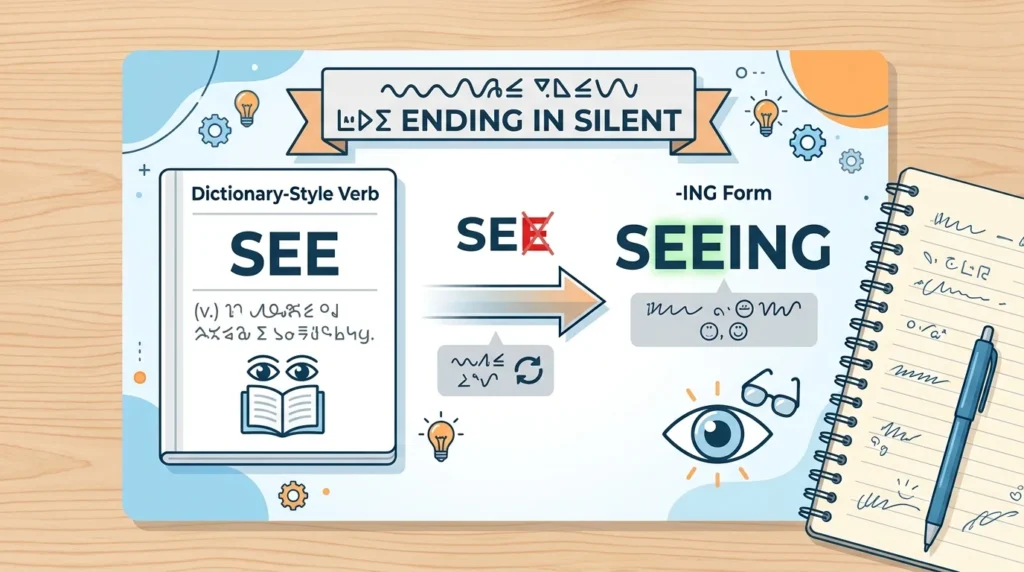
Rule: When you form the -ing version of “choose,” remove only the final silent “e” and keep both “o” letters.
A useful spelling formula is:
CHOOSE − E + ING = CHOOSING
Compare the correct and incorrect forms:
| Form | Status | Reason |
|---|---|---|
| Choosing | ✅ Correct | It is formed from choose by removing the final e and adding -ing. |
| Chosing | ❌ Incorrect | It incorrectly removes one of the o’s. |
| Chooseing | ❌ Incorrect | The final e should be removed before -ing is added. |
| Choosing | ✅ Correct | The two o’s from choose remain in the -ing form. |
How to Use Choosing
Choosing is used when you are describing the act or process of selecting something, deciding between alternatives, or deciding to take a particular option.
Choosing for an Action Happening Now
When choosing describes something happening at the moment, it commonly appears with a form of be.
- I am choosing a new phone.
- She is choosing a dress.
- They are choosing a restaurant.
- We are choosing between two apartments.
In these examples, choosing is part of a continuous verb phrase. Cambridge provides examples of choosing in this type of ongoing decision-making context.
Choosing as an Activity
Choosing can also refer to the activity or process itself.
- Choosing a career can be difficult.
- Choosing the right words matters.
- Choosing carefully can save time.
- Choosing a university requires research.
Here, choosing is not necessarily describing an action happening at this exact moment. It refers to the activity of making a selection.
Choosing Between Two or More Options
Use choosing when someone must select from different possibilities.
- She is choosing between two job offers.
- We are choosing between three designs.
- He had difficulty choosing between the two courses.
- They are choosing which hotel to book.
The related verb choose is commonly used with structures such as choose between and choose what, choose which, or choose to do something.
Choosing to Do Something
Choosing can be followed by to + verb when the meaning is deciding to take an action.
- She is choosing to stay home.
- He is choosing to work remotely.
- They are choosing to wait until tomorrow.
- I am choosing to focus on my studies.
This construction expresses a decision or deliberate selection of an action.
Correct Examples of Choosing
In Conversation
“I’m choosing what to wear for the dinner tonight.”
In a Text Message
“Are you still choosing a movie, or should I pick one?”
In an Email
“We are currently choosing the final design for the new website.”
At Work
“The hiring team is choosing a candidate for the position.”
In School
“Choosing the right subjects can affect your future study options.”
In Academic Writing
“Choosing an appropriate research method is an important part of the study.”
On Social Media
“Choosing a simple design made the post easier to understand.”
In Business
“The company is choosing between two suppliers.”
In Everyday English
“Choosing a gift for someone can be surprisingly difficult.”
For Personal Decisions
“I am choosing to spend more time improving my writing skills.”
For Technology
“We are choosing a laptop that can handle demanding software.”
For Travel
“They spent the evening choosing where to stay during their trip.”
See Also: Ballon or Balloon Differences: Which Spelling Is Correct?
Choosing vs. Chosing: Incorrect and Correct Examples
| ❌ Incorrect | ✅ Correct | Why |
|---|---|---|
| She is chosing a dress. | She is choosing a dress. | The -ing form comes from choose, so both o’s remain. |
| I am chosing a new laptop. | I am choosing a new laptop. | Only the final e in choose is removed. |
| They are chosing a restaurant. | They are choosing a restaurant. | Chosing is not the standard spelling. |
| Chosing the right course takes time. | Choosing the right course takes time. | The activity form is choosing, with two o’s. |
| He is chosing between two jobs. | He is choosing between two jobs. | The verb form is derived from choose, not chose. |
| We are chosing a new supplier. | We are choosing a new supplier. | Choosing is the correct present participle. |
| She was chosing her university. | She was choosing her university. | The past progressive still uses the -ing form choosing. |
| They are chosing which plan to buy. | They are choosing which plan to buy. | Both o’s must remain after the final e is removed. |
| Chosing carefully can prevent mistakes. | Choosing carefully can prevent mistakes. | Choosing is the noun-like -ing form in this sentence. |
| I am chosing to wait. | I am choosing to wait. | The correct spelling is choosing before “to wait.” |
Why Do People Make This Mistake?
The error is understandable because choose has an unusual set of forms. The present form contains two o’s, while its past form chose contains only one.
Confusion With Chose
The most important source of confusion is chose, the simple past form of choose.
Compare:
- choose — present/base form
- chose — simple past
- chosen — past participle
- choosing — -ing form
Someone may incorrectly think that chosing comes from chose plus -ing. It does not.
The correct formation begins with choose:
choose → choosing
The Double O Is Easy to Overlook
The two o’s in choose are followed by s and the final silent e. When the final e disappears, the remaining spelling can look unfamiliar to someone who has not consciously learned the form.
But the middle of the word stays intact:
chOOse → chOOse without e → chOO sing
Pronunciation Does Not Give You the Whole Spelling
English spelling cannot always be reconstructed perfectly from pronunciation. The pronunciation of choosing does not make the number of written o’s obvious, so listening alone is not a reliable spelling test.
Fast Typing
Because chosing looks close to the correct form, a missing letter can easily go unnoticed during fast typing. This is especially common when writing messages, comments, notes, or drafts without proofreading.
Translation Interference
English learners may also transfer spelling patterns from another language. If a learner’s first language represents the relevant sound differently, the spelling of choosing may not feel intuitive.
The safest approach is to learn the complete word family rather than trying to spell the word from sound alone.
Common Mistakes With Choosing
1. Writing Chosing
Wrong: “I am chosing a new course.”
Correct: “I am choosing a new course.”
The mistake removes one of the two o’s. Remember that only the final e is removed from choose.
2. Writing Chooseing
Wrong: “She is chooseing a dress.”
Correct: “She is choosing a dress.”
The opposite mistake is keeping the final e. Before -ing, the final e is dropped.
3. Using Chose for an Ongoing Action
Wrong: “I am chose a new phone.”
Correct: “I am choosing a new phone.”
Chose is the simple past form and cannot normally follow “am” in this construction.
4. Using Choosing for a Completed Past Decision
Incorrect: “Yesterday, I am choosing the blue one.”
Better: “Yesterday, I chose the blue one.”
The issue here is not spelling but verb tense. Choosing and chose have different grammatical roles.
5. Confusing Chosen and Choosing
Choosing describes the act or process of selecting. Chosen is the past participle used in perfect and passive constructions.
- She is choosing a dress.
- She has chosen a dress.
- The winner was chosen yesterday.
Choosing in Real English
Grammatically Correct and Natural
Choosing is standard and natural English in both everyday and formal contexts. It can describe an ongoing selection, as in “She is choosing a book,” or the activity of making a selection, as in “Choosing a career takes time.” It is also natural in structures such as “choosing between two options” and “choosing to do something.”
Grammatically Possible but Different in Meaning
The related forms choose, chose, chosen, and choosing are all standard, but they cannot simply replace one another. “Choosing” focuses on an ongoing or noun-like activity, while “chose” normally refers to a completed past decision. “Chosen” is the past participle. Selecting the correct form depends on the sentence structure and time of the action.
Not Standard: Chosing
Chosing is not a standard alternative spelling of choosing. It does not represent a separate meaning, informal version, or regional form. If you see “chosing” in an email, article, message, or social post, the intended word is normally “choosing.” In edited English, replace it with the standard spelling containing two o’s.
American vs. British English
There is no meaningful American-British spelling difference between choosing and chosing. Choosing is the standard form in both major varieties of English.
The related verb choose is also spelled the same way in American and British English. Cambridge gives the same core verb and the same irregular past forms, chose and chosen, across its American and British dictionary information.
Formal vs. Informal Usage
Choosing is appropriate in both formal and informal English. You can use it in a text message, casual conversation, business email, academic paper, report, application, or professional document.
There is no need to replace choosing with another spelling in casual writing. Chosing is not an accepted informal version; it is simply a misspelling.
Choosing vs. Chosing Comparison Table
| Feature | Choosing | Chosing |
|---|---|---|
| Standard English spelling | Yes | No |
| Meaning | Selecting or deciding | No standard meaning |
| Base verb | Choose | Not applicable |
| Number of o’s | Two | One |
| Grammar role | Present participle / -ing form; can also function in noun-like constructions | Misspelling |
| Formal writing | Correct | Incorrect |
| Informal writing | Correct | Still incorrect |
| Example | She is choosing a course. | She is chosing a course. ❌ |
Choose, Chose, Chosen, and Choosing

Learning the complete word family makes this spelling problem much easier.
| Form | Use | Example |
|---|---|---|
| Choose | Base form / present | I choose the blue one. |
| Chooses | Third-person singular present | She chooses the blue one. |
| Choosing | -ing form | She is choosing the blue one. |
| Chose | Simple past | She chose the blue one yesterday. |
| Chosen | Past participle | She has chosen the blue one. |
Cambridge lists chose as the past tense and chosen as the past participle of choose.
Real-Life Situations
In a Job Interview
“I am choosing this career because I enjoy solving practical problems.”
Here, choosing describes the decision-making process.
In a Business Meeting
“We are choosing between two software providers.”
The team is currently making a selection.
In an Email
“We are currently choosing the final design and expect to make a decision tomorrow.”
The spelling remains choosing regardless of the formality of the email.
In a Text Message
“I’m choosing a restaurant now. Give me five minutes.”
Casual writing still uses the same standard spelling.
In an Exam
“Choosing an appropriate research method is essential for a reliable study.”
This is a formal academic use of the word.
On a Website
“Choosing the right plan depends on your needs and budget.”
The word functions as the subject of the sentence.
Easy Way to Remember Choosing
Use this simple memory trick:
Choose keeps its OO in choosing.
Start with:
CHOOSE
Remove only the final E:
CHOOS
Add ING:
CHOOSING
So remember:
CHOOSE → CHOOSING
Not:
CHOSE → CHOSING
Quick Practice
Choose the correct form in each sentence:
- She is (choosing / chosing) a new phone.
- We are (choosing / chosing) between two hotels.
- (Choosing / Chosing) the right words is important.
- He is (choosing / chosing) a university.
- They are (choosing / chosing) which supplier to use.
- I am (choosing / chosing) to wait.
- She was (choosing / chosing) a gift.
- (Choosing / Chosing) carefully can prevent mistakes.
Answers: 1. choosing, 2. choosing, 3. Choosing, 4. choosing, 5. choosing, 6. choosing, 7. choosing, 8. Choosing.
Frequently Asked Questions
Is “chosing” a correct spelling?
No. Chosing is a misspelling. The correct spelling is choosing, with two o’s.
Is it “choosing” or “chosing”?
Use choosing. It is the standard -ing form of choose. Chosing is not a standard spelling.
Why does choosing have two o’s?
Because it comes from choose. When the final silent e is removed before adding -ing, the two o’s remain: choose → choos → choosing.
Is “chooseing” correct?
No. The final e in choose is removed before adding -ing. The correct form is choosing, not chooseing.
What is the past tense of choose?
The simple past tense of choose is chose. For example: “She chose the blue dress yesterday.”
What is the past participle of choose?
The past participle is chosen. For example: “They have chosen a new manager.”
Is choosing a verb?
Choosing is the present participle, or -ing form, of the verb choose. It can form part of a verb phrase, as in “She is choosing,” and it can also occur in noun-like constructions, as in “Choosing wisely takes time.”
Can choosing be used in formal writing?
Yes. Choosing is completely appropriate in formal, academic, professional, and business writing. There is no informal spelling that replaces it.
Can “chosing” be used in texting?
People may type it as a mistake, but it is not a standard informal spelling. If you want correct English, use choosing even in casual messages.
What is the easiest way to remember choosing?
Remember that choose keeps both o’s when it becomes choosing. Remove only the final e: choose → choos → choosing.
What is the difference between choosing and chose?
Choosing is the -ing form and commonly describes an ongoing activity or process. Chose is the simple past form. For example: “She is choosing a dress” describes an ongoing action, while “She chose a dress yesterday” describes a completed past decision.
What is the difference between choosing and chosen?
Choosing is the -ing form, while chosen is the past participle. For example, “They are choosing a winner” uses choosing, while “They have chosen a winner” uses chosen.
Quick Summary
Choosing is the correct spelling, while chosing is a misspelling. Choosing is the -ing form of choose, meaning to select, decide, or pick between possibilities. To form it, remove only the final silent e from choose and add -ing: choose → choos → choosing. The two o’s remain. Do not confuse choosing with chose, which is the simple past form, or chosen, which is the past participle. Choosing is correct in everyday conversation, texts, professional emails, academic writing, and formal documents. The easiest memory trick is simple: choose keeps its two o’s in choosing. If you are deciding between “choosing” and “chosing,” always use choosing.
See Also: DTM Meaning: Texting, Slang, Social Media & Definition Explained