
The phrase vice versa is one of the most commonly used expressions in English, yet many people are unsure about its exact meaning and how to use it correctly. You may hear it in everyday conversations, read it in books, see it in text messages, or come across it in professional writing. Because it appears in so many different situations, understanding the vice versa meaning can help you communicate more clearly and avoid common grammar mistakes. Although the phrase comes from Latin, it has become a natural part of modern English vocabulary and is widely understood around the world.
Learning the vice versa meaning in English is about more than memorizing a definition. It helps you express ideas more efficiently by showing that two situations can be reversed without changing the overall meaning. Whether you’re a student, an English learner, a professional writer, or simply curious about common English expressions, this guide explains the meaning, origin, pronunciation, grammar, examples, and correct usage of vice versa in simple, easy-to-understand language.
Meaning & Definition
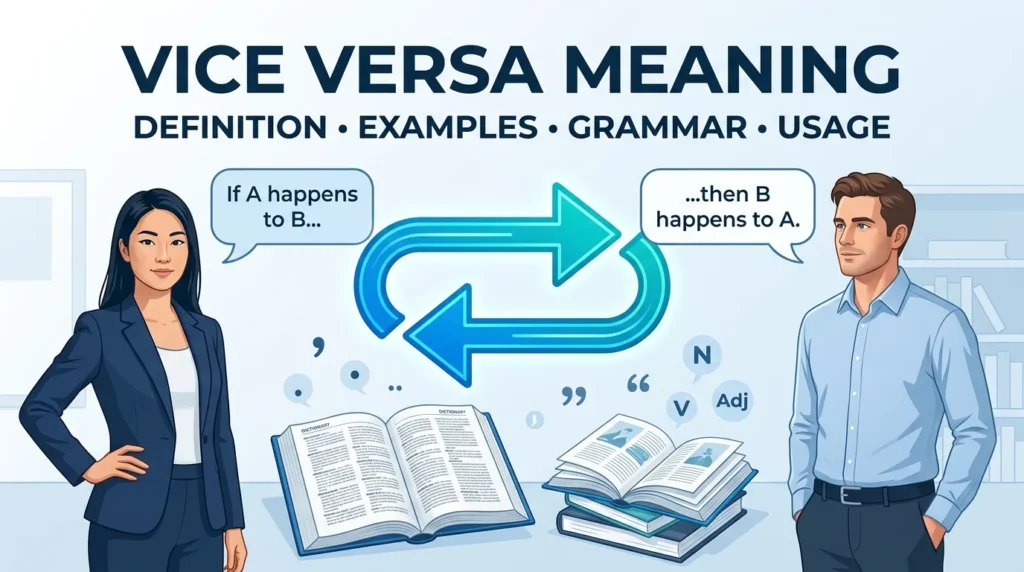
The vice versa meaning is “the other way around” or “the reverse is also true.” It is used when the opposite of a statement is equally correct, allowing you to avoid repeating the same idea in reverse. Instead of explaining both directions separately, you can simply add vice versa to indicate that the relationship works both ways.
For example, if someone says, “Parents learn from their children, and vice versa,” it means that children also learn from their parents. The phrase creates a two-way relationship between people, actions, or situations. Because of its simplicity and clarity, vice versa is commonly used in both spoken and written English, including academic writing, business communication, and everyday conversations.
Background
The phrase vice versa originates from Latin, where it literally means “the position having been reversed.” Over time, it entered the English language and became one of the most widely used Latin expressions that remains unchanged today. Unlike many borrowed words, vice versa has retained both its original spelling and its original meaning, making it instantly recognizable in English dictionaries and grammar guides.
Historically, writers and scholars adopted the phrase because it offered a concise way to describe reversed relationships without repeating information. Today, it appears in newspapers, books, classrooms, business documents, emails, and casual conversations. Its continued popularity demonstrates how a simple Latin phrase can become an essential part of modern English communication while maintaining its original purpose and meaning.
Usage in Different Contexts
The phrase vice versa is extremely versatile and can be used in many different contexts. In everyday conversation, people use it to describe mutual actions or relationships. For example, “I respect my friends, and vice versa” means that your friends respect you as well. This makes conversations shorter, clearer, and more natural.
In professional writing, education, journalism, and academic research, vice versa is used to explain reversible situations without unnecessary repetition. It is also common in emails, presentations, legal documents, and business reports. Even in texting and social media, people use the phrase because it quickly communicates that the opposite statement is equally true. Understanding these different contexts helps you recognize when vice versa is the most effective choice and when another expression may be more appropriate.
Vice Versa Meaning in English
The vice versa meaning in English is simply “the opposite is also true” or “the same applies in reverse.” It is used whenever two people, actions, ideas, or situations can switch places without changing the meaning of the statement. Instead of repeating the second half of an idea, English speakers often use vice versa to keep their sentences concise and easy to understand.
For example, consider the sentence “Teachers inspire students, and vice versa.” This means that students also inspire teachers. The phrase acts as a shortcut, replacing a repeated explanation with just two words. Because of its clarity and efficiency, vice versa is considered one of the most useful expressions in English grammar and is frequently used by native and non-native speakers alike.
What Does Vice Versa Mean?
If you’re wondering, what does vice versa mean, the easiest explanation is that it means “the reverse is also correct.” Whenever two things can exchange positions while keeping the same basic relationship, you can use vice versa instead of repeating yourself. It saves time, improves sentence flow, and makes communication more natural.
For instance, if someone says, “Good communication builds trust, and vice versa,” it means that trust also builds good communication. Both ideas support each other equally. This ability to express a two-way relationship is what makes vice versa such a valuable phrase in English. Whether you’re writing an essay, chatting with friends, or preparing professional content, understanding its meaning helps you communicate with greater confidence and accuracy.
Vice Versa Meaning in Text
The vice versa meaning in text is exactly the same as its meaning in formal English. In text messages, online chats, emails, and social media conversations, people use vice versa to say “the opposite is also true” or “the same applies the other way around.” Instead of typing two similar sentences, the phrase allows users to express both ideas in a short and natural way. This makes conversations quicker while keeping the meaning clear.
For example, if someone texts, “I help you whenever you need me, and vice versa,” they mean that the other person also helps them. The phrase is common on platforms like WhatsApp, Instagram, Facebook, X, and Messenger because it saves time without changing the message. Although it is frequently used in casual texting, it is also perfectly acceptable in professional emails and formal written communication.
Vice Versa Meaning with Examples
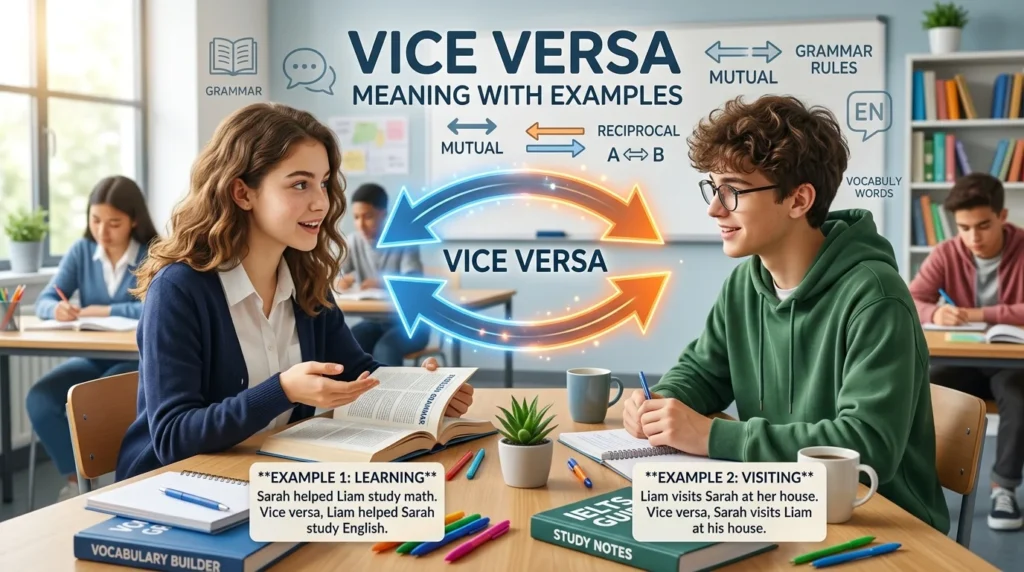
Understanding the vice versa meaning with examples is one of the easiest ways to learn how the phrase works. The expression always shows that two people, actions, or situations can be reversed while keeping the same meaning. Rather than repeating the second half of a statement, vice versa makes the sentence shorter and easier to read.
Here are several examples:
- Parents teach their children, and vice versa.
- Success builds confidence, and vice versa.
- I trust my best friend, and vice versa.
- Good communication improves teamwork, and vice versa.
- Employees respect great managers, and vice versa.
- Learning improves practice, and vice versa.
These examples demonstrate how vice versa naturally creates a two-way relationship. It can be used in everyday conversations, academic writing, business communication, and professional presentations without sounding repetitive.
Vice Versa Meaning and Pronunciation
Many English learners search for the vice versa meaning and pronunciation because they often read the phrase before hearing it spoken. Although it comes from Latin, the pronunciation used in modern English is simple and widely accepted by native speakers.
Pronunciation: VICE VUR-suh
IPA: /ˌvaɪs ˈvɜːr.sə/ (British)
IPA: /ˌvaɪs ˈvɝː.sə/ (American)
The first word sounds like “vice” in “vice president,” while versa is pronounced “VUR-suh.” Speaking it correctly helps improve confidence in both formal presentations and everyday conversations. Since the phrase is used worldwide, knowing its pronunciation makes communication more natural and professional.
Vice Versa Meaning in a Sentence
Learning the vice versa meaning in a sentence helps you understand when the phrase fits naturally into English. It is usually placed at the end of a sentence after the first relationship has been explained, indicating that the opposite relationship is also true.
Here are some natural examples:
- Children learn from adults, and vice versa.
- Healthy habits improve mental health, and vice versa.
- The manager supports the team, and vice versa.
- Reading improves writing skills, and vice versa.
- Respect creates trust, and vice versa.
- Teachers motivate students, and vice versa.
These examples show that vice versa creates balance between two connected ideas. Instead of repeating the second statement, the phrase clearly tells the reader that the relationship works both ways.
Vice Versa Meaning in Simple Words
The vice versa meaning in simple words is “the opposite is also true.” It means that if one statement is correct, reversing the people or things involved will also produce a correct statement. This makes it one of the easiest English expressions to understand once you see it used in real-life examples.
Imagine someone says, “I support my family, and vice versa.” In simple words, it means “My family supports me too.” The phrase simply avoids repeating the same idea twice. Because of its simplicity, vice versa is commonly taught to English learners and is useful in school, work, business, and everyday conversations. Once you understand this basic idea, you’ll recognize the phrase almost everywhere in spoken and written English.
How to Use Vice Versa Correctly
Knowing how to use vice versa correctly can make your English sound more natural and professional. The phrase should only be used when the reverse of your statement is also true. If changing the order of the people, objects, or ideas changes the meaning, then vice versa should not be used. It works best when describing mutual actions, shared relationships, or situations that are equally valid in both directions.
For example, “Doctors help patients, and vice versa” would be incorrect because patients generally do not help doctors in the same way. However, “Parents learn from children, and vice versa” is correct because both parts of the relationship are true. Before using the phrase, ask yourself whether the opposite statement makes complete sense. If it does, vice versa is the right choice.
Vice Versa Synonym and Meaning
Many people search for a vice versa synonym and meaning to understand similar expressions. Although there is no perfect one-word replacement, several phrases have a similar purpose depending on the context. Common alternatives include the other way around, conversely, the reverse is also true, reciprocally, and in reverse.
Each synonym has a slightly different meaning. For example, the other way around is more conversational, while conversely is often used in formal or academic writing to introduce a contrasting idea rather than a direct reversal. Understanding these differences helps you choose the most appropriate expression for your writing and avoid using similar phrases incorrectly.
Vice Versa vs Conversely
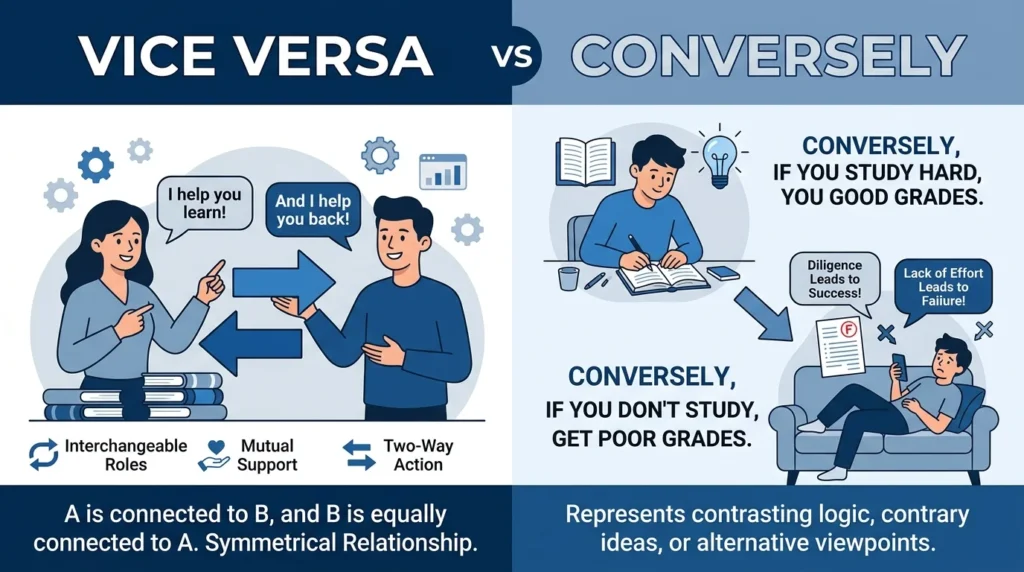
One of the most common grammar questions is vice versa vs conversely. Although these expressions are sometimes confused, they are not interchangeable. Vice versa means “the reverse is also true,” showing that two ideas work equally well when their positions are switched. Conversely, however, introduces an opposite or contrasting point instead of indicating a reversible relationship.
For example:
- Students inspire teachers, and vice versa. ✅ (Both statements are true.)
- Some people enjoy working alone. Conversely, others prefer teamwork. ✅ (This shows contrast, not reversal.)
Understanding this difference is important because many learners mistakenly replace one phrase with the other. Using each expression correctly improves both grammar and clarity.
Common Mistakes When Using Vice Versa
Although vice versa is a simple phrase, people often misuse it. One common mistake is using it when the reversed statement is not actually true. The phrase should only be used when both directions of the relationship make logical sense. If reversing the sentence creates an inaccurate statement, you should avoid using vice versa.
Another frequent mistake is treating vice versa as if it means “however” or “on the other hand.” It does not introduce contrast or disagreement. Instead, it indicates that the opposite version of the same relationship is also correct. Finally, some writers unnecessarily repeat the reversed statement after saying vice versa, which defeats the purpose of using the phrase. Keeping these grammar rules in mind will help you use the expression confidently in both formal and informal English.
Frequently Asked Questions
What does vice versa mean?
Vice versa means “the reverse is also true” or “the other way around.”
What is the vice versa meaning in English?
In English, vice versa means that two people, things, or situations can exchange places without changing the meaning.
Is vice versa a Latin phrase?
Yes. Vice versa comes from Latin and has been used in English for centuries.
How do you pronounce vice versa?
It is pronounced VICE VUR-suh.
What does vice versa mean in text?
In texting, it has the same meaning as in standard English: the opposite is also true.
Can vice versa be used in formal writing?
Yes. It is acceptable in academic writing, business communication, emails, and professional documents.
What is another word for vice versa?
Common alternatives include the other way around, the reverse is also true, and sometimes reciprocally, depending on the context.
What is the difference between vice versa and conversely?
Vice versa shows a reversible relationship, while conversely introduces a contrast between two ideas.
Can I use vice versa in everyday conversation?
Absolutely. It is commonly used in daily conversations, text messages, and social media as well as formal writing.
When should you avoid using vice versa?
Avoid using it when the reversed statement is not logically true or when you want to express contrast instead of reversal.
Conclusion
Understanding the vice versa meaning helps you communicate more clearly, avoid repetition, and write more naturally in English. Although the phrase comes from Latin, it has become a common part of modern English and is widely used in conversations, education, business, and professional writing. Whether you’re learning English or improving your grammar, knowing when and how to use vice versa correctly can make your sentences more concise and effective.
From exploring the vice versa meaning in English to learning its pronunciation, sentence examples, grammar rules, and differences from similar expressions like conversely, this guide has covered every important aspect of the phrase. If you’re looking for more easy-to-understand explanations of English words, phrases, internet slang, and trending expressions, visit Trendy Meaning. Our detailed guides are designed to help learners, students, and curious readers understand meanings quickly and confidently.
See Also:
Cartwright Meaning: Origin, Surname History & Definition