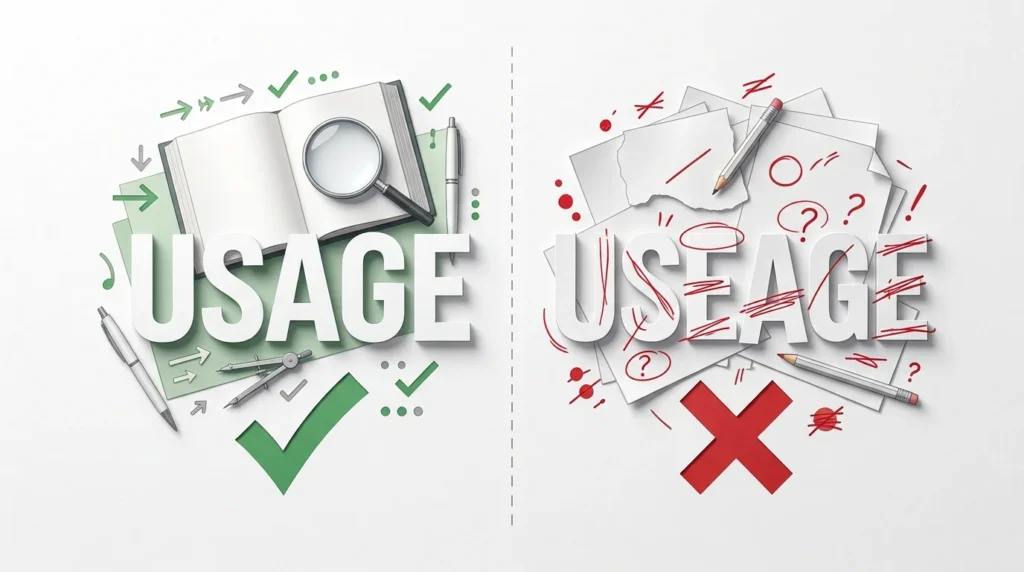

Usage is the correct spelling, while useage is a misspelling. “Usage” is a noun meaning the way something is used, how much it is used, or the accepted way words and expressions are used. For example, “internet usage,” “correct word usage,” and “water usage” are all correct. If you see useage in your writing, replace it with usage.
What Is the Difference Between Usage and Useage?
The difference is mainly a matter of correct spelling.
Usage is a standard English noun. It is used when talking about the way something is used, the amount or frequency of use, or the way language is normally used. Dictionaries recognize “usage” as a standard word.
Useage is not the standard spelling of this noun. It is usually an accidental spelling created by adding an extra e to “usage.”
| Word | Correct? | Meaning | Part of Speech |
|---|---|---|---|
| usage | ✅ Yes | The way, amount, or pattern of using something | Noun |
| useage | ❌ No | Intended to mean “usage” | Misspelling |
So, if you are deciding between usage vs useage, the answer is simple:
Use “usage.” Do not use “useage.”
Why Is Usage the Correct Spelling?
The spelling usage is an established English word. Its history goes back through Middle English and Old French to Latin usus, related to the idea of using something.
The important point for modern writers is that you should not create the word by mechanically keeping every letter from use and then adding -age.
That is why this is correct:
usage ✅
Not:
useage ❌
The extra e may look logical because the related word use contains an e, but English spelling does not always work by simply attaching a suffix to the complete modern spelling of another word.
The Core Rule
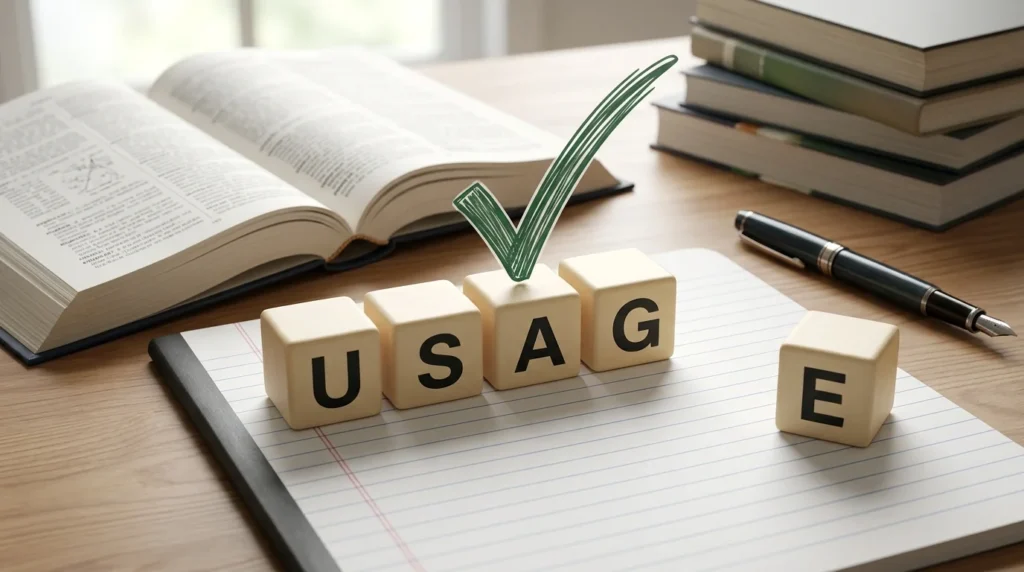
When you mean the noun describing how something is used, how much it is used, or an accepted way of using language, spell it “usage.” Never add the extra e in “useage.”
A quick way to remember it is:
usage = U-S-A-G-E
There is only one e in the word.
Usage vs Use
There is another distinction worth remembering. Use and usage are both correct words, but they do not always perform the same job.
Use can be a verb:
I use this software every day.
It can also be a noun:
The use of this software has increased.
Usage is a noun:
Software usage has increased.
So the real choice is sometimes not usage vs useage, but use vs usage.
How to Use Usage
“Usage” is commonly used in several situations.
1. Talking About How Something Is Used
Use usage when you are describing the manner or pattern in which something is used.
Examples:
- The manual explains the proper usage of the device.
- The study examined smartphone usage among students.
- Correct software usage can improve productivity.
2. Talking About Language
“Usage” is especially common when discussing words, grammar, expressions, and language conventions. Cambridge defines this sense as the way words or a language are used.
Examples:
- The teacher explained modern English usage.
- This expression is common in everyday usage.
- The dictionary provides examples of current word usage.
3. Talking About Amount or Frequency
“Usage” can also refer to how much something is used.
Examples:
- Our electricity usage increased last month.
- The company monitors data usage.
- Water usage is higher during the summer.
- The report tracks fuel usage.
This meaning is also recognized in major learner dictionaries.
Correct Examples
Here are examples of usage in different real-world contexts.
- Conversation:
“Your usage of that expression is interesting.” - Email:
“Please review the usage guidelines before submitting the form.” - School:
“The teacher discussed correct punctuation and word usage.” - Workplace:
“We are reviewing software usage across the department.” - Academic writing:
“The research examines language usage among younger speakers.” - Technology:
“You can check your monthly data usage in the app.” - Business:
“Customer usage increased after the new feature was released.” - Everyday life:
“Our water usage has gone down since we fixed the leak.” - Social media:
“The hashtag has gained wider usage this year.” - Technical writing:
“Improper equipment usage may affect performance.” - Language learning:
“The book focuses on common English usage.” - Professional communication:
“The report contains several examples of industry-specific usage.”
Incorrect vs. Correct
| ❌ Incorrect | ✅ Correct | Why |
|---|---|---|
| The software useage has increased. | The software usage has increased. | “Useage” is a misspelling. |
| Please monitor your internet useage. | Please monitor your internet usage. | The noun is spelled “usage.” |
| Proper word useage is important. | Proper word usage is important. | “Usage” is the standard noun. |
| Water useage has declined. | Water usage has declined. | The extra e does not belong in the word. |
| The manual explains equipment useage. | The manual explains equipment usage. | “Usage” is the established spelling. |
| Data useage is measured monthly. | Data usage is measured monthly. | “Useage” is a spelling error. |
| Correct grammar useage matters. | Correct grammar usage matters. | The language-related noun is “usage.” |
| High energy useage can be expensive. | High energy usage can be expensive. | “Usage” describes the amount used. |
| The app tracks phone useage. | The app tracks phone usage. | The standard spelling has one e. |
| Modern English useage changes over time. | Modern English usage changes over time. | “Usage” is the correct language term. |
Why People Make This Mistake
The spelling useage is understandable even though it is incorrect. Several factors can make it look reasonable.
The Word “Use” Creates Confusion
The most obvious reason is the spelling of use.
A writer sees:
use
and may instinctively try to build the noun as:
use + age → useage
But the established spelling is:
usage
The spelling must be learned as the standard form rather than reconstructed letter by letter.
Pronunciation Does Not Clearly Reveal the Spelling
“Usage” is pronounced approximately YOO-sij in both British and American English.
Because the final part sounds like “-ij,” pronunciation does not give you an obvious clue that there should be no second e.
Familiar Spelling Patterns Can Mislead You
English has many words ending in -age, so learners may try to apply a pattern that does not actually produce the correct spelling here.
This is a good example of why English spelling cannot always be predicted simply by joining a base word and a visible ending.
Typing Habits
When you type quickly, your brain may anticipate the spelling of use and automatically carry its e into the longer word.
This can happen even when you already know that usage is correct.
Translation Interference
Learners who translate directly from another language may construct the English spelling according to a familiar word-building pattern from their first language.
When learning English vocabulary, it is often better to memorize the established written form rather than assume every related word follows a predictable spelling pattern.
Common Mistakes Checklist
Mistake 1: Writing “useage”
Problem: You add the e from “use.”
Wrong:
“The website tracks user useage.”
Correct:
“The website tracks user usage.”
How to avoid it: Remember that usage has only one e.
Mistake 2: Thinking “useage” Is a British Variant
“Useage” is not a standard British spelling alternative to “usage.”
There is no need to switch between them based on whether you are writing for British or American readers.
Mistake 3: Using “usage” as a Verb
“Usage” is a noun, not the ordinary present-tense verb form of “use.”
Incorrect:
“I usage this program every day.”
Correct:
“I use this program every day.”
Mistake 4: Treating “use” and “usage” as Identical
They are related, but they can serve different grammatical purposes.
Use:
“I use the application every morning.”
Usage:
“My application usage has increased.”
Mistake 5: Trusting Spellcheck Too Much
Spellcheck is useful, but it should not replace proofreading.
If you are writing an important document, look specifically for useage before publishing or submitting it.
Usage in Real English
When “usage” sounds natural
“Usage” is especially natural when you are discussing patterns, amounts, conventions, or language.
For example:
“The report analyzes internet usage among university students.”
Here, “usage” naturally describes a pattern or amount of use.
Another natural example is:
“The dictionary explains current English usage.”
Here, “usage” refers to how language is used. Both senses are well established in dictionary usage.
When “use” is more natural
Although usage is correct, it does not mean that it should replace use everywhere.
For a simple action, use is usually the more direct choice:
“I use my laptop for work.”
Saying:
“I engage in laptop usage for work.”
is grammatically possible but unnecessarily formal and less natural for ordinary conversation.
This distinction matters because good writing is not only about avoiding incorrect words. It is also about choosing the word that fits the sentence naturally.
When “usage” is especially useful
“Usage” works particularly well with words such as:
- language usage
- word usage
- common usage
- current usage
- data usage
- internet usage
- water usage
- energy usage
- software usage
- usage patterns
These combinations are established in English and appear naturally in professional, academic, technical, and everyday contexts.
American vs. British English
There is no spelling difference between American and British English for this word.
Both use:
usage ✅
Neither uses:
useage ❌
Pronunciation is also listed as /ˈjuː.sɪdʒ/ in both British and American English by Cambridge.
So you do not need to change the spelling based on your audience.
Formal vs. Informal Usage
“Usage” itself is a neutral English noun and can appear in both formal and everyday contexts.
In formal writing, you might see:
“The study examines language usage among adolescents.”
In everyday communication, you might say:
“You can check your data usage in the settings.”
The important distinction is not that “usage” is formal and “use” is informal. Instead, the two words often communicate slightly different ideas.
Use is frequently the simpler choice for a direct action.
Usage is useful when discussing a pattern, amount, manner, or convention.
See Also: Ceftazidime Meaning: Uses, Dosage, Side Effects & Definition
Usage vs. Useage Comparison Table

| Feature | Usage | Useage |
|---|---|---|
| Correct spelling | ✅ Yes | ❌ No |
| Standard English word | ✅ Yes | ❌ No |
| Part of speech | Noun | Misspelling |
| Meaning | Way, amount, or pattern of use | Intended to mean “usage” |
| Language context | Common | Incorrect |
| Technical writing | Common | Incorrect |
| Academic writing | Common | Incorrect |
| Business writing | Common | Incorrect |
| British English | Correct | Incorrect |
| American English | Correct | Incorrect |
| Extra “e” | No | Yes |
The important takeaway is that this is not a genuine two-word comparison like “advice vs. advise.” There is no separate meaning attached to useage. The correct form is usage.
Real-Life Situations
In an Interview
A candidate might say:
“I have experience analyzing customer software usage.”
That sounds natural because the speaker is referring to patterns in how customers use software.
In a Workplace Meeting
A manager might say:
“Our data usage has increased significantly this quarter.”
Here, “usage” refers to the amount of data consumed.
In an Email
A support specialist might write:
“Please review the usage instructions before operating the equipment.”
This is a natural professional use of the noun.
See Also: Alhamdulillah Meaning: English Translation, Islamic Meaning & Usage
In a Text Message
Someone might write:
“Check your data usage before streaming the whole movie.”
The word works perfectly well in casual communication too.
In an Exam
A student might write:
“The passage demonstrates a common usage of the expression.”
Here, “usage” refers to a particular way a word or expression is used.
How to Remember Usage vs. Useage
The easiest rule is extremely short:
Usage has no extra E.
You can also remember the word visually:
U-S-A-G-E
Not:
U-S-E-A-G-E
Another useful reminder is:
Use the word “usage,” not “useage.”
If you remember only one thing from this article, remember that sentence.
A Simple Decision Guide
Use this quick process when you are unsure:
- Are you describing how, how much, or in what way something is used?
→ Use usage. - Are you talking about the direct action of using something?
→ Use may be the better choice. - Did you write “useage”?
→ Change it to usage. - Are you wondering whether “useage” is a British spelling?
→ No. Use usage in both major English varieties.
Quick Practice Quiz
Choose usage or use for each sentence.
- The company tracks customer ______ patterns.
- I ______ this application every morning.
- Water ______ has fallen since the new system was installed.
- Please ______ the correct password.
- The teacher discussed modern English ______.
- Our internet ______ is unusually high this month.
- She knows how to ______ the new equipment.
- The report examines smartphone ______ among teenagers.
Answers
- usage
- use
- usage
- use
- usage
- usage
- use
- usage
Frequently Asked Questions
Is it usage or useage?
The correct spelling is usage. Useage is a misspelling.
Is useage ever correct?
No. In standard modern English, use usage instead.
Why do people spell usage as useage?
The mistake usually happens because writers connect the noun with the spelling of the word use and incorrectly keep its final e.
What does usage mean?
“Usage” can mean the way something is used, how much or how frequently something is used, or the accepted way words and expressions are used.
Is usage a noun or a verb?
Usage is a noun. For example, “Internet usage is increasing.” The verb is use, as in “I use the internet every day.”
Is usage correct in American English?
Yes. Usage is the standard spelling in American English.
Is usage correct in British English?
Yes. Usage is also the standard spelling in British English.
Can I say “internet usage”?
Yes. Internet usage is a normal and widely used phrase referring to how much or how someone uses the internet.
Can usage mean the amount of something used?
Yes. For example, “energy usage” can refer to the amount of energy consumed.
Is “use” the same as “usage”?
Not always. Use can refer to a direct action or the general act of using something, while usage often describes a pattern, amount, manner, or convention of use.
How do you pronounce usage?
“Usage” is pronounced approximately YOO-sij, represented as /ˈjuː.sɪdʒ/ in Cambridge’s pronunciation entry.
What is the easiest way to remember the spelling?
Remember: usage has only one e. If you write useage, remove the extra e.
Quick Summary
Usage is the correct spelling, while useage is a misspelling. Usage is a noun that can describe the way something is used, the amount or pattern of use, or the way words and expressions are used in a language. It appears naturally in phrases such as “data usage,” “water usage,” “software usage,” and “English usage.” There is no separate British or American spelling called “useage.” Also, do not confuse usage with the verb use: “I use this tool” is correct, while “tool usage” describes the pattern or amount of using it. The easiest spelling rule to remember is simple: usage has no extra e.
See Also: Indefinitely Meaning: Definition, Examples & Does It Mean Forever?